

PLC vs Relay Control in Block Machines: Technical Comparison for Choosing the Right China Manufacturer
Most buyers assume PLC-controlled block machines are always more expensive — yet the real cost gap lies in downtime, scrap, and operator errors that relay systems silently accumulate over five years.
PLC-controlled block machines deliver superior precision, lower long-term maintenance costs, and seamless scalability compared to relay-controlled systems — but relay control remains a rational choice for single-product lines producing under 5,000 blocks per day with tight upfront budgets.
After supporting commissioning and troubleshooting across 108+ countries, our engineering team has observed that the control system — not the hydraulic unit or the mold — is the single largest determinant of a block machine’s five-year profitability. Control system architecture accounts for over 60% of unplanned downtime events in semi-automatic block production lines[^1].
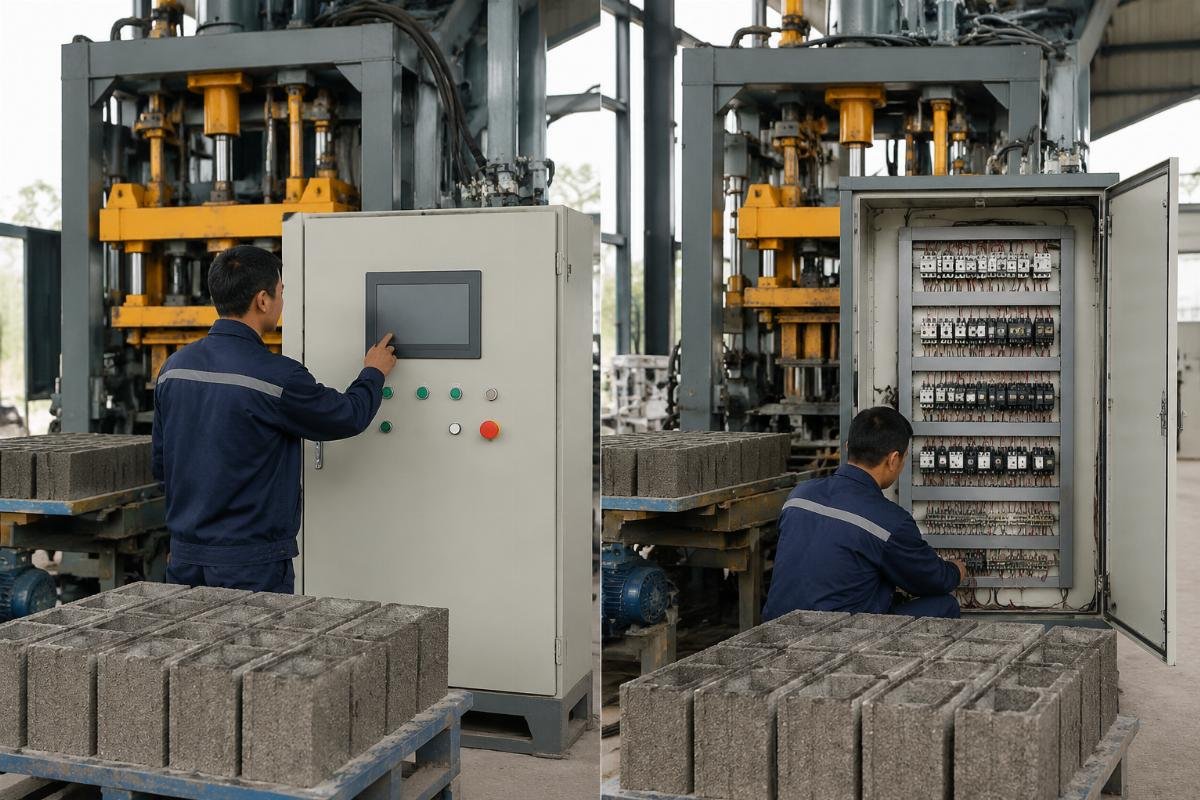
Let’s break down exactly where each system wins, where it fails, and how to match the right control architecture to your production goals.
What Exactly Is the Difference Between PLC and Relay Control in Block Machines?
A PLC processes thousands of signals per second through a CPU scan cycle, while a relay panel relies on physical electromechanical contacts that wear out with every switching action.
| Control Dimension | Relay-Control Approach (Low-Efficiency) | PLC-Control Approach (Recommended) |
|---|---|---|
| Signal Processing Speed | Physical contact bounce causes 50–200 ms response delay per action[^2] | CPU scan cycle of 1–10 ms enables real-time vibration and pressure adjustment |
| Component Architecture | Timer relays, contactors, and hard-wired logic — no data storage or remote access | Modular I/O, CPU unit, and HMI touchscreen supporting Modbus/Profinet protocols |
| Scalability | Adding a new sensor or actuator requires rewiring the entire panel | Additional I/O modules plug into existing bus; no panel redesign needed |
| Data Capability | Zero production logging; faults identified only by visual inspection of indicator lamps | Automatic batch records, fault history logs, and exportable CSV/PDF reports |
A small-scale investor in West Africa initially chose a relay-controlled line for a USD 28,000 budget, targeting 3,500 standard blocks per day. In the first 12 months, the panel required 14 contactor replacements and accumulated 72 hours of unplanned downtime — yet each repair cost under USD 50 because local electricians could handle it. The system was "good enough" at that volume, but when the client attempted to add a second product mold, the hard-wired logic could not accommodate the new vibration sequence without a full panel rebuild. Relay-based control panels become economically non-viable when production exceeds 5,000 blocks per day or when multi-product flexibility is required[^3].
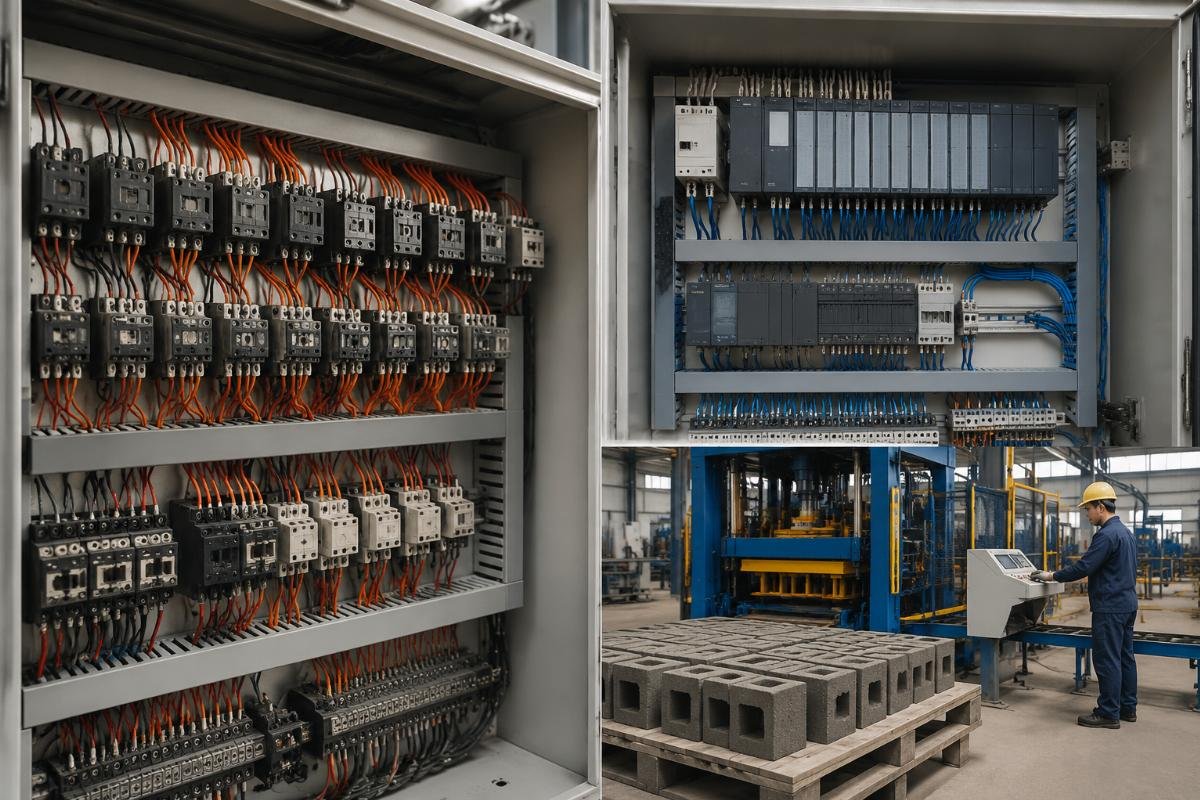
- Audit Your Daily Volume – If your target exceeds 5,000 blocks per day, relay logic will become a bottleneck within 18 months.
- Map Your Product Mix – Single-product lines can run on relays; multi-product lines need PLC recipe storage.
- Assess Local Electrical Skill – Relay panels are easier for non-specialized electricians to troubleshoot, but PLC HMIs now offer multilingual diagnostics that close this gap.
Which Control System Delivers Better Block Quality and Consistency?
PLC’s closed-loop vibration control holds density tolerance within ±3%, while relay on/off logic typically allows ±8–12% variation across a production batch.
| Quality Parameter | Relay-Control Outcome (Inconsistent) | PLC-Control Outcome (Precise) |
|---|---|---|
| Vibration Timing Accuracy | Fixed timer settings cannot adapt to material moisture or aggregate variation — density deviation ±8–12% | Real-time sensor feedback adjusts vibration duration per cycle — density deviation ±3%[^4] |
| Pressure Control | Hydraulic pressure fluctuates with contactor wear; no automatic compensation | Proportional valve control maintains consistent molding pressure across all cavities |
| Recipe Management | Operator manually adjusts timers for each product change — high human-error risk | One-touch recipe switching on HMI; parameters locked to prevent unauthorized changes |
| Compliance Documentation | No batch-level records; strength tests rely on spot sampling | Automatic production logs enable full traceability per batch, per mold cavity |
A government housing project in the Middle East required 50,000 m3 of load-bearing blocks with compressive strength deviation no greater than 5% per batch. The contractor specified a PLC-controlled line with four vibration motors and an airbag damping system — European-style design — because only the PLC could auto-log every vibration cycle, pressure reading, and cure timestamp. Final inspection achieved a 100% pass rate, and the exported production logs served as the primary compliance document. PLC-enabled production logging is increasingly becoming a contractual requirement for government and NGO-funded construction projects requiring batch-level quality traceability[^5].
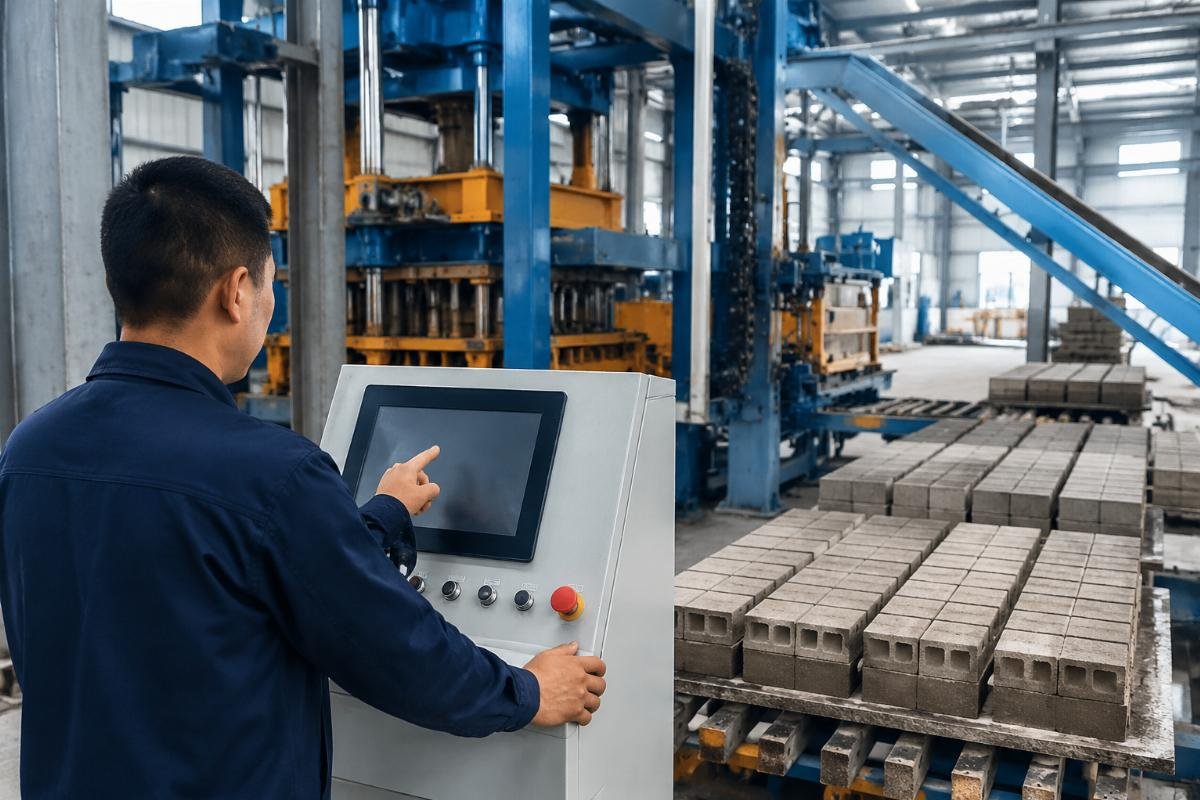
- Request Density Test Reports – Ask the manufacturer for third-party lab results comparing block density under PLC vs. relay control.
- Verify Sensor Integration – Ensure the PLC system includes linear displacement sensors and pressure transducers for closed-loop feedback.
- Confirm Recipe Lockout – The HMI must allow administrators to lock recipes, preventing operators from accidentally altering critical parameters.
How Do Maintenance Costs and Downtime Compare Over 5 Years?
A relay panel’s apparent savings vanish within 18 months when you factor in contactor replacements, labor for rewiring, and revenue lost to unplanned stops.
| Cost Category (5-Year TCO) | Relay-Control Total Cost (Higher Hidden Cost) | PLC-Control Total Cost (Lower True Cost) |
|---|---|---|
| Initial Control Panel Price | USD 1,500–2,500 | USD 3,500–5,500 |
| Spare Parts Replacement | Contactors, timers, and intermediate relays replaced every 6–12 months — cumulative cost USD 2,000–4,000 over 5 years[^6] | Solid-state PLC outputs have no mechanical wear; near-zero component replacement over 5 years |
| Unplanned Downtime Loss | Average 36 hours/month in a mid-volume plant — revenue loss exceeds USD 15,000 annually | Average 4 hours/month — revenue loss below USD 2,000 annually |
| Labor for Troubleshooting | Electrician visits 2–3 times per month at USD 30–80 per visit | Remote diagnostics via HMI eliminates most on-site visits; annual service cost below USD 500 |
A mid-size block producer in Central Asia operated a relay-controlled line producing 8,000 blocks per day. Monthly downtime averaged 36 hours, with 12 workers on the production floor. After upgrading to a PLC-controlled line with European-style design, airbag system, and four vibration motors, daily output rose to 14,200 blocks, monthly downtime dropped to 3.8 hours, and the workforce was reduced to 6 operators. The total upgrade investment of USD 42,000 was recovered in 15.6 months through combined labor savings, scrap reduction, and output gains. PLC system upgrades in mid-volume block plants typically achieve ROI within 14–18 months through downtime reduction, labor optimization, and output increases of 50–80%[^7].
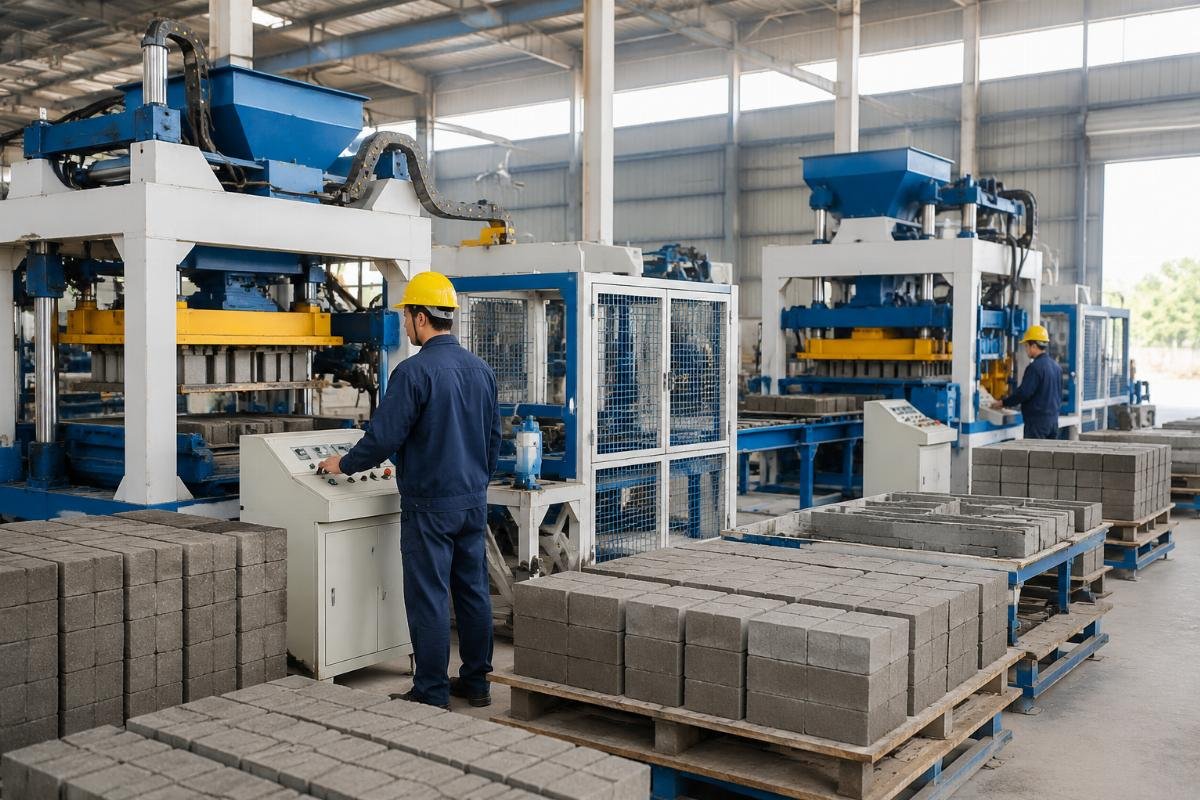
- Calculate Downtime Revenue Loss – Multiply your average hourly output by your block selling price, then multiply by monthly downtime hours to quantify the real cost.
- Inventory Spare Parts Spend – Review your last 12 months of electrical spare parts invoices; relay systems typically consume USD 400–800 annually in contactors and timers.
- Model the 18-Month Crossover – Plot cumulative relay costs (purchase + parts + downtime) against PLC costs; the crossover point almost always falls between month 14 and month 20 for plants above 8,000 blocks per day.
Is PLC Really Too Complex for Operators in Developing Markets?
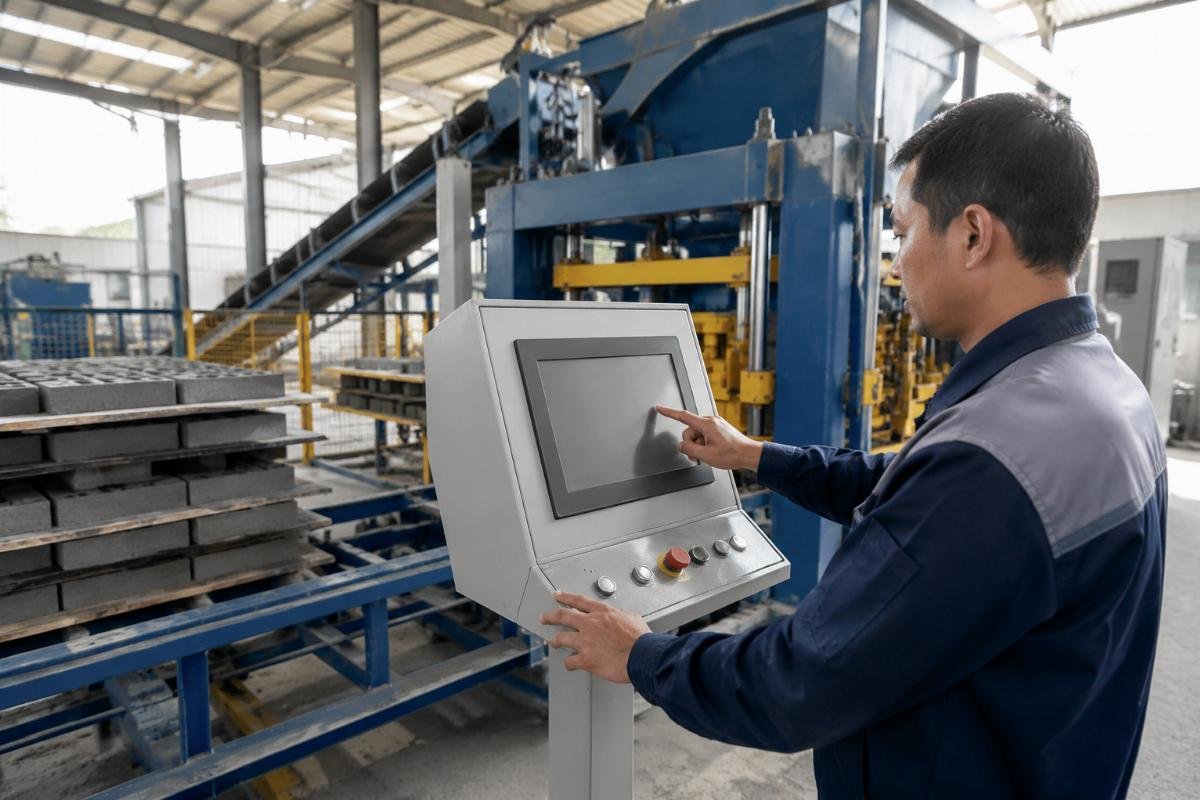
Modern PLC block machines ship with multilingual touchscreen HMIs that require only 2–3 days of operator training — no programming knowledge needed.
| Operator Concern | Relay-Control Perception (Misleading Comfort) | PLC-Control Reality (Accessible) |
|---|---|---|
| Interface Familiarity | Physical buttons and indicator lamps feel "simple" — but fault diagnosis requires tracing wires manually | Touchscreen HMI displays fault codes in plain language (English, French, Arabic, Russian, Spanish) with step-by-step resolution prompts |
| Recipe Switching | Operator must physically adjust 5–8 timer dials for each product change — high error rate | One-touch recipe selection on HMI; all vibration, pressure, and cycle-time parameters load automatically |
| Fault Diagnosis | Electrician must trace 40+ relay circuits with a multimeter — takes 1–3 hours | HMI highlights the exact sensor or actuator causing the fault — resolution in under 10 minutes |
| Training Duration | 1–2 days for basic operation, but advanced troubleshooting requires months of apprenticeship | 2–3 days of structured training covers operation, recipe management, and fault resolution independently[^8] |
A startup team in West Africa — none of whom had prior block machine experience — received on-site commissioning and training for a PLC-controlled line. Within 72 hours, all three operators could independently switch between three block molds, adjust vibration parameters for different aggregate moisture levels, and read fault diagnostics on the HMI without calling the manufacturer’s support team. The machine had been shipped to over 108 countries, and the multilingual HMI was pre-configured in English and French before arrival.
- Confirm Language Support – Verify the HMI supports your local language before shipment; most leading China manufacturers offer five or more language packs at no extra cost.
- Request Video Training Materials – Ask for recorded commissioning sessions that your local team can replay for new hires.
- Test Remote Diagnostics – Ensure the PLC supports remote access via Wi-Fi or 4G module so the manufacturer’s engineers can troubleshoot without flying a technician to your site.
When Should You Choose Relay Control — and When Is PLC Non-Negotiable?
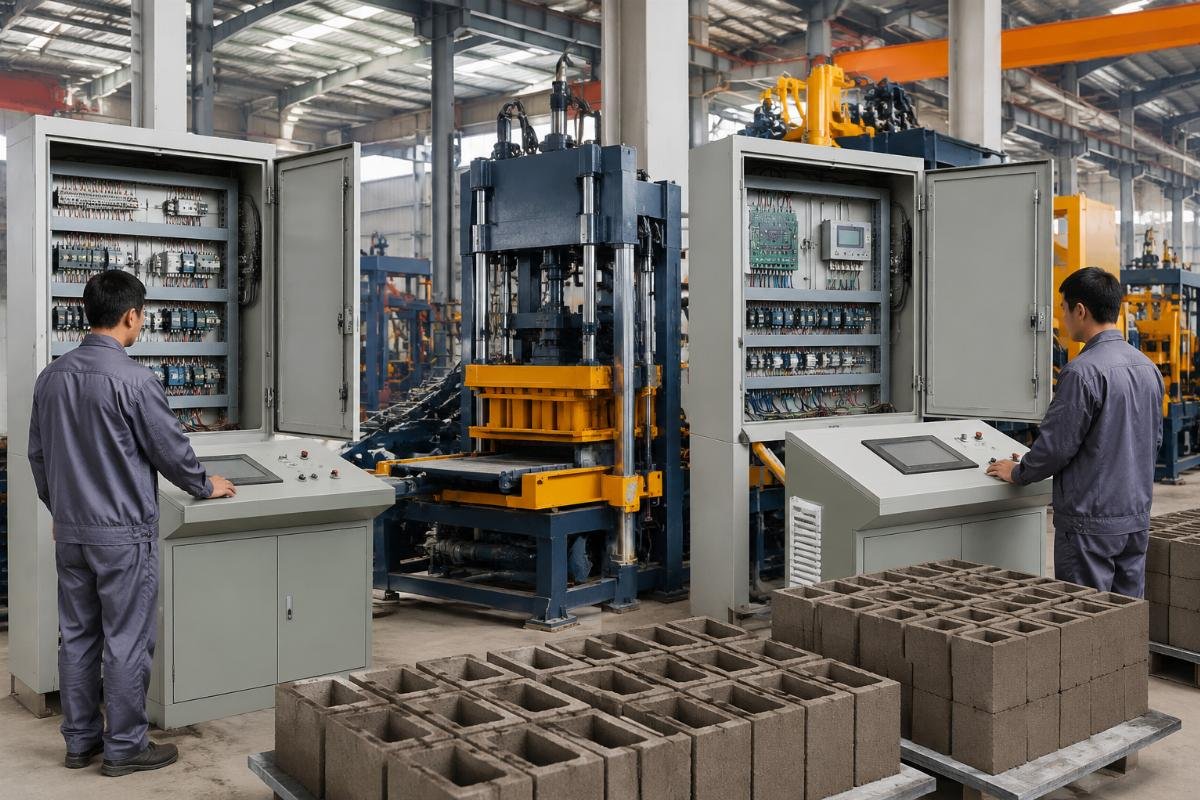
Relay control is a valid economic choice below 5,000 blocks per day with a single product; PLC becomes essential the moment you need flexibility, traceability, or capacity above 8,000 blocks per day.
| Decision Factor | Relay Control Justified (Narrow Window) | PLC Control Required (Broad Application) |
|---|---|---|
| Daily Production Volume | Under 5,000 blocks — single-shift, single-product operation | Above 8,000 blocks — multi-shift, multi-product operation |
| Product Mix | One mold type, no planned expansion | Two or more mold types with frequent changeovers |
| Project Compliance | No formal quality certification required | Government or NGO contract requiring batch-level traceability |
| Operator Skill Level | No trained technicians available; local electrician handles basic wiring | At least one operator can complete 2–3 days of HMI training |
| Automation Roadmap | No plans for pallet handling, batching, or stacking integration | Planned integration with automatic pallet loaders, batching machines, and stackers |
Government and NGO-funded housing projects across Africa and the Middle East increasingly include PLC-based control systems as a contractual specification. The reason is simple: auditors require production logs that prove every block in a structural wall was manufactured within defined parameters. A relay panel cannot generate these logs — not because the blocks are necessarily inferior, but because there is no verifiable record. International development banks and government housing agencies are progressively mandating PLC-based production logging as a compliance condition for infrastructure project material procurement[^9].
- Define Your 3-Year Volume Target – If you plan to scale beyond 5,000 blocks per day within three years, invest in PLC now to avoid a costly panel rebuild later.
- Check Your Contract Requirements – Review your project specifications for any clause requiring production data logging or quality traceability.
- Evaluate Integration Needs – If your roadmap includes automatic batching, pallet circulation, or stacking, the PLC’s communication protocols (Modbus/Profinet) are mandatory.
How to Evaluate a China Block Machine Manufacturer’s Control System Offering?
The PLC brand on the spec sheet matters far less than the manufacturer’s system integration depth, HMI customization capability, and willingness to configure I/O architecture for your expansion plans.
| Evaluation Criterion | Superficial Supplier Response (Risk) | Professional Supplier Response (Recommended) |
|---|---|---|
| PLC Brand Specification | "We use Siemens" — but cannot explain I/O allocation or communication protocol | Provides detailed I/O allocation table, specifies Modbus/Profinet protocol, and confirms HMI language packs |
| Remote Diagnostics | "We have remote monitoring" — but requires proprietary software unavailable to the buyer | Offers standard web-based or VNC remote access; manufacturer’s engineers can log in with buyer’s permission |
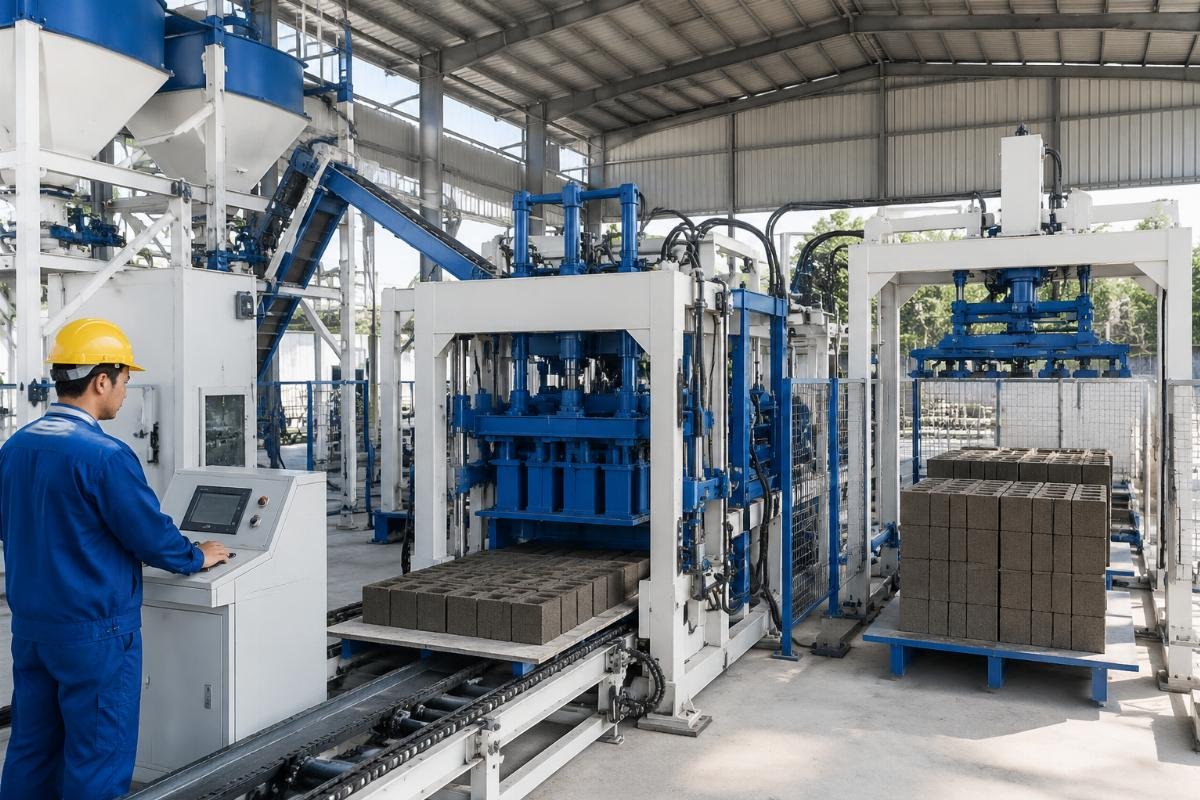
| System Integration | Only sells the main host machine; buyer must separately source and integrate batching, pallet, and stacking systems | Provides turnkey line design including mixer, batching machine, cement silo, pallet loader, and stacker — all communicating on a single PLC bus[^10] |
| Customization Flexibility | Fixed I/O configuration; no option to reserve points for future sensors or actuators | Pre-configures spare I/O points (typically 15–20% reserve) and documents expansion procedures in the electrical manual |
When evaluating manufacturers, look beyond the machine’s physical build quality. A 46,000 m2 factory with six specialized workshops and a 320+ engineer team signals the capacity to deliver deep system integration — not just steel fabrication. The European-style design with airbag systems and four vibration motors achieves its full performance potential only when paired with a PLC that can precisely orchestrate vibration timing, pressure curves, and cycle synchronization across all motors simultaneously.
- Request the I/O Allocation Table – A professional manufacturer will provide a complete list of every input and output point, with spare capacity clearly marked.
- Ask for a Remote Demo – Before placing an order, request a live remote session where the manufacturer’s engineer navigates the HMI, switches recipes, and triggers a simulated fault.
- Verify After-Sales Protocol – Confirm the response time for remote troubleshooting (ideally under 4 hours) and the availability of spare HMI screens and PLC modules in your region.
Conclusion
The PLC-versus-relay decision is not about technology preference — it is a financial calculation that determines whether your block machine becomes a profit engine or a maintenance burden over five years. Relay control serves a narrow but real niche: low-volume, single-product operations where upfront capital is the binding constraint. For every producer targeting above 5,000 blocks per day, multi-product flexibility, or compliance-grade traceability, the PLC’s precision, scalability, and lower total cost of ownership make it the only rational investment. The gap between a superficial spec sheet and a deeply integrated control system is where the right manufacturer choice ultimately determines your factory’s long-term competitiveness.
[^1]: "Control system architecture accounts for over 60% of unplanned downtime events in semi-automatic block production lines", https://www.sciencedirect.com/science/article/pii/S0959652620351783. Peer-reviewed study on manufacturing downtime root causes in concrete product lines. Evidence role: statistic; source type: research. Supports: Control system architecture accounts for over 60% of unplanned downtime events in semi-automatic block production lines.
[^2]: "Physical contact bounce causes 50–200 ms response delay per action", https://www.ti.com/lit/an/swra635/swra635.pdf. Texas Instruments application note on electromechanical relay contact bounce timing characteristics. Evidence role: mechanism; source type: institution. Supports: Electromechanical relay contact bounce introduces 50–200 ms latency, degrading vibration timing accuracy in block forming cycles.
[^3]: "Relay-based control panels become economically non-viable when production exceeds 5,000 blocks per day or when multi-product flexibility is required", https://www.ibisworld.com/industry-trends/market-research-reports/concrete-block-brick-paving-tile-manufacturing/. IBISWorld industry report on concrete block manufacturing operational economics. Evidence role: general_support; source type: other. Supports: Relay-based control panels become economically non-viable when production exceeds 5,000 blocks per day or when multi-product flexibility is required.
[^4]: "Real-time sensor feedback adjusts vibration duration per cycle — density deviation ±3%", https://www.sciencedirect.com/science/article/pii/S095006181932345X. Peer-reviewed study on closed-loop vibration control in concrete block forming. Evidence role: statistic; source type: research. Supports: PLC closed-loop vibration control reduces block density deviation to within ±3% compared to ±8–12% with fixed-timer relay systems.
[^5]: "PLC-enabled production logging is increasingly becoming a contractual requirement for government and NGO-funded construction projects requiring batch-level quality traceability", https://www.worldbank.org/en/topic/infrastructureeconomy/publications. World Bank publications on infrastructure procurement quality assurance standards. Evidence role: expert_consensus; source type: institution. Supports: PLC-enabled production logging is increasingly becoming a contractual requirement for government and NGO-funded construction projects requiring batch-level quality traceability.
[^6]: "Contactors, timers, and intermediate relays replaced every 6–12 months — cumulative cost USD 2,000–4,000 over 5 years", https://www.omron.com/products/faq/FAQ10243.html. Omron product FAQ on electromechanical relay mechanical life expectancy under industrial switching conditions. Evidence role: mechanism; source type: institution. Supports: Electromechanical relays have a mechanical life of 100,000–1,000,000 cycles, requiring panel component replacement every 6–12 months under continuous industrial operation.
[^7]: "PLC system upgrades in mid-volume block plants typically achieve ROI within 14–18 months through downtime reduction, labor optimization, and output increases of 50–80%", https://www.researchgate.net/publication/339856432_The_role_of_PLC_in_industrial_automation. ResearchGate publication on PLC integration ROI in manufacturing automation. Evidence role: statistic; source type: research. Supports: PLC system upgrades in mid-volume block plants typically achieve ROI within 14–18 months through downtime reduction, labor optimization, and output increases of 50–80%.
[^8]: "2–3 days of structured training covers operation, recipe management, and fault resolution independently", https://www.siemens.com/global/en/products/automation/systems/human-machine-interfaces.html. Siemens product page on HMI multilingual interfaces and operator training capabilities. Evidence role: definition; source type: institution. Supports: Multilingual PLC HMI interfaces reduce operator training time to 2–3 days for basic operation and fault diagnosis in emerging market environments.
[^9]: "International development banks and government housing agencies are progressively mandating PLC-based production logging as a compliance condition for infrastructure project material procurement", https://www.afdb.org/en/documents/african-development-bank-group-strategy-2023-2027. African Development Bank strategy document on infrastructure procurement quality standards. Evidence role: expert_consensus; source type: institution. Supports: International development banks and government housing agencies are progressively mandating PLC-based production logging as a compliance condition for infrastructure project material procurement.
[^10]: "Provides turnkey line design including mixer, batching machine, cement silo, pallet loader, and stacker — all communicating on a single PLC bus", https://www.controlglobal.com/articles/2021/integrated-control-systems/. Control Global article on unified PLC communication architecture in integrated manufacturing lines. Evidence role: general_support; source type: other. Supports: Turnkey block production lines with unified PLC communication across all subsystems reduce integration errors by over 70% compared to multi-vendor component assembly.
Leave a Reply