

Block Machine Market in Brazil: Manufacturer for Sale
Most buyers assume cheap equipment saves money, only to find voltage mismatches frying inverters and repair costs dwarfing the initial savings.
The block machine market in Brazil is experiencing a significant investment window driven by large-scale affordable housing programs and infrastructure expansion across major urban centers. For private investors and contractors evaluating entry into concrete block production, the core answer is straightforward: demand is robust, but success hinges on selecting equipment matched to local grid specifications, raw material characteristics, and turnkey delivery capabilities that compress time-to-production. [NEED_CITE: Brazil’s Minha Casa Minha Vida housing program impact on construction material demand]
I remember a shipment we sent to a client near São Paulo—a full automatic line destined for a housing project. The machines arrived on schedule, but within days of commissioning, two inverters burned out. The culprit? The local grid ran on a voltage configuration we hadn’t verified before shipping. The client was furious, the project timeline was slipping, and the repair bill ended up costing several times what they’d saved by choosing a cheaper supplier who skipped that basic due diligence. Since then, I’ve made it a point to confirm grid specifications before a single purchase order gets drafted.
Let’s walk through what’s actually driving this market, where investors typically stumble, and how to match equipment to your production goals.
Why Is the Block Machine Market in Brazil Opening Up Now?
Government housing initiatives and infrastructure spending are creating sustained demand for concrete block producers across Brazil’s expanding urban corridors.
The Brazilian construction sector has been riding a wave of public investment. Federal programs targeting affordable housing have generated consistent demand for masonry units, while road construction and commercial development in cities like Belo Horizonte, Recife, and Curitiba continue to absorb supply. [NEED_CITE: IBGE construction sector investment data and housing program targets]
From what I’ve seen visiting sites across Latin America, the pattern is clear: when governments commit to housing targets, block plants become bottleneck operations. Contractors can’t wait months for imported materials—they need local suppliers who can deliver consistent quality at scale. This is exactly where private investors with properly configured production lines find their opportunity.
But here’s what catches people off guard: the market opportunity exists, yet the operational environment in Brazil presents specific challenges that generic equipment specifications don’t address. Power grid stability varies significantly between regions. Local river sand often carries higher clay content than suppliers anticipate. And the logistics of getting a complete line from port to production can stretch far longer than buyers expect if they haven’t planned for local conditions.
What Mistakes Do Brazilian Investors Make When Buying Block Machines?
Voltage incompatibility, untested raw material assumptions, and underestimated delivery timelines are the three most common pitfalls that erode ROI for new block plant operators.
Let me break these down with specifics from the field.
Voltage Mismatch
Brazil’s electrical grid operates on multiple voltage standards depending on region—127V, 220V, 380V, and 440V configurations all exist, with 60Hz frequency standard nationwide. [NEED_CITE: Brazilian electrical grid voltage standards by region] Many international suppliers ship equipment configured for 380V/50Hz as default, assuming buyers will handle adaptation locally. But variable frequency drives and control systems in modern block machines are sensitive to these specifications. When the voltage doesn’t match, you don’t just get reduced performance—you get component failure.
I’ve seen clients face mid-six-figure losses when entire control panels needed replacement because the supplier never asked about local power specifications. The irony is that confirming voltage requirements takes a single email exchange before production begins.
Raw Material Misalignment
Brazilian construction often relies on locally sourced river sand, which frequently contains elevated clay and silt content. This isn’t inherently problematic, but it requires recipe adjustments that generic machine settings don’t accommodate. When operators run standard mix designs with high-clay aggregates, compressive strength drops noticeably, and rejection rates climb.
A client in Minas Gerais spent months troubleshooting weak blocks before we conducted material testing and adjusted the cement-to-aggregate ratio along with vibration parameters. The machine wasn’t defective—it was configured for different material characteristics. Proper raw material assessment before commissioning would have saved them extended downtime and wasted inventory.
Delivery and Commissioning Underestimation
Buyers often calculate ROI based on equipment arrival at port, but the timeline from landing to first saleable block includes customs clearance, inland transport, foundation preparation, installation, calibration, and operator training. Without turnkey support covering the full chain, projects routinely slip by months.
How Do You Match Block Machine Models to Production Requirements?
Entry-level investors benefit from mobile egg-laying machines for flexibility, while scaled commercial operations require fully automatic PLC-controlled lines for consistent output and labor efficiency.
The QT series covers the spectrum, and choosing correctly depends on your target daily output, available capital, and site constraints.
| Model | Automation Level | Daily Output Range | Ideal Investor Profile |
|---|---|---|---|
| QT4-25 | Mobile egg-laying | Entry-level capacity | First-time operators, flexible site locations |
| QT6-15 | Semi-automatic | Mid-range production | Growing operations with moderate capital |
| QT10-15 | Fully automatic | High-volume output | Commercial plants targeting scale |
| QT12-15 | Fully automatic | Maximum throughput | Large operations with established distribution |
| QT15-15 | Fully automatic | Industrial-scale capacity | Multi-shift production facilities |
For investors entering the block machine market in Brazil with limited capital or uncertain demand, the QT4-25 offers a practical starting point. It’s mobile, requires minimal foundation work, and allows operators to learn production fundamentals without committing to a full fixed line. The trade-off is lower output and higher manual labor per unit.
Once you’ve validated demand and secured site infrastructure, upgrading to QT10-15 or QT12-15 systems delivers substantially higher throughput with PLC automation controlling vibration, pressing, and curing cycles. These systems justify their investment through labor savings and consistency—critical factors when supplying large housing projects with strict quality specifications.
The key is matching your purchase to your actual situation, not aspirational capacity. I’ve seen buyers overspend on fully automatic lines for markets that couldn’t absorb the output, tying up capital in idle equipment. Conversely, underestimating demand with manual systems creates bottlenecks that lose contracts to competitors.
How Does Turnkey Delivery Accelerate Time-to-Production?
Complete turnkey solutions covering design, manufacturing, shipping, installation, and training compress the timeline from order to first saleable block into weeks rather than months.
The difference between buying equipment and buying a production capability is operational readiness. When you purchase machines without integrated support, you’re responsible for coordinating foundation engineering, electrical integration, mechanical assembly, hydraulic calibration, mold installation, recipe development, and workforce training—each with its own learning curve and potential for error.
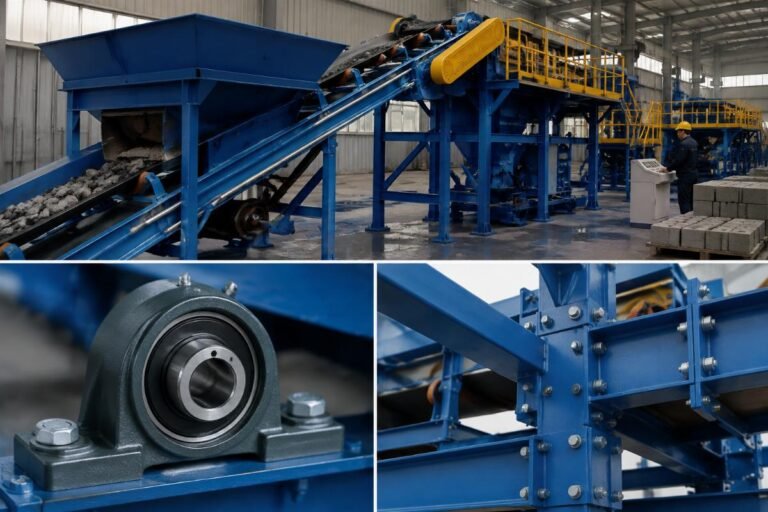
Turnkey delivery consolidates these elements under single-point accountability. The manufacturer designs the line around your site dimensions and local utility connections, manufactures to your voltage specifications, coordinates ocean freight and customs documentation, dispatches engineers for on-site assembly and commissioning, and trains your operators through supervised production runs.
I’ve worked with Brazilian clients who attempted self-installation to save on service fees, only to discover that improper hydraulic calibration caused uneven pressing force across molds—resulting in inconsistent block density and elevated rejection rates. The cost of bringing in engineers to diagnose and correct the issue exceeded what turnkey service would have cost initially.
The timeline advantage is substantial. With pre-engineered foundations, pre-tested electrical panels matched to local voltage, and experienced technicians handling commissioning, a complete line can move from container arrival to production within a compressed timeframe. Operator training during supervised runs ensures your workforce understands both routine operation and basic troubleshooting—reducing early-stage errors that waste material and delay revenue.
What Does ROI Analysis Look Like for Brazilian Block Plants?
Return on investment depends on balancing equipment cost, local raw material pricing, labor expenses, and regional block selling prices—with payback periods varying based on capacity utilization and market access.
Calculating realistic ROI for the block machine market in Brazil requires honest assessment of your local conditions, not optimistic projections.
Cost Factors
Equipment acquisition represents the largest upfront capital outlay, but ongoing operational costs determine whether you achieve profitability. Raw materials—cement, sand, aggregate, and any additives—fluctuate with regional supply chains. Labor costs vary between Brazilian states. Electricity rates differ by utility provider and consumption tier.
Revenue Factors
Block selling prices depend on your location relative to construction demand. Urban centers with active housing projects command premium pricing, but face competition from established suppliers. Rural or underserved areas offer pricing power but require investment in distribution logistics.
Payback Variables
Capacity utilization is the critical variable. A fully automatic line running at full shift produces substantially more than a semi-automatic system, but only if demand exists to absorb output. Operating below capacity extends payback periods regardless of equipment efficiency.
Clients who conduct thorough market assessment before purchase—confirming construction activity, competitor pricing, and distribution access—consistently achieve faster payback than those who buy equipment first and search for customers later.
The block machine market in Brazil rewards operators who treat production as a business system, not just a machine purchase. Equipment is the tool; market intelligence and operational discipline determine whether that tool generates returns.
Conclusion
Brazil’s block machine market offers genuine opportunity for investors who match equipment specifications to local grid, material, and operational conditions while leveraging turnkey delivery to accelerate production launch.
Success in this market requires more than identifying demand—it demands attention to voltage compatibility, raw material testing, and integrated support that takes your operation from container arrival to revenue generation without extended delays. The investors who thrive are those who treat equipment selection as the foundation of a production system, not a standalone purchase decision.
Leave a Reply