

Concrete Block Machine Price in Canada: 2026 Complete Buyer Guide
The machine price tag is only the starting line. Compliance retrofits, voltage mismatches, and cold-climate material upgrades routinely push the real landing cost far beyond the FOB quote.
For Canadian buyers, the total concrete block machine price in Canada spans three layers: the base equipment cost, the provincial compliance adaptation, and the electrical and climate-proofing modifications. Ignoring any of these turns a straightforward import into a costly on-site headache.
I still remember the container that sat at the Port of Vancouver for weeks. An Alberta investor had ordered a full production line, excited about the quoted price, but nobody had checked whether the mold specifications matched his province’s compressive strength requirements under CSA standards. The molds had to be pulled, reworked, and re-shipped. That delay alone cost several times what a simple pre-order consultation would have. Since then, I never finalize a quote without asking three questions first: which province is the plant in, what is the site voltage, and what freeze-thaw resistance class does the local building code demand? [NEED_CITE: CSA A82 series standards for concrete masonry units vary by provincial adoption]
These three questions shape every realistic conversation about the concrete block machine price in Canada, and they separate buyers who get running quickly from those who spend months and extra budget fixing what should have been specified upfront.
What Factors Determine Concrete Block Machine Price in Canada?
The concrete block machine price in Canada is driven by four cost layers that most first-time importers only discover after the machine arrives at the dock.
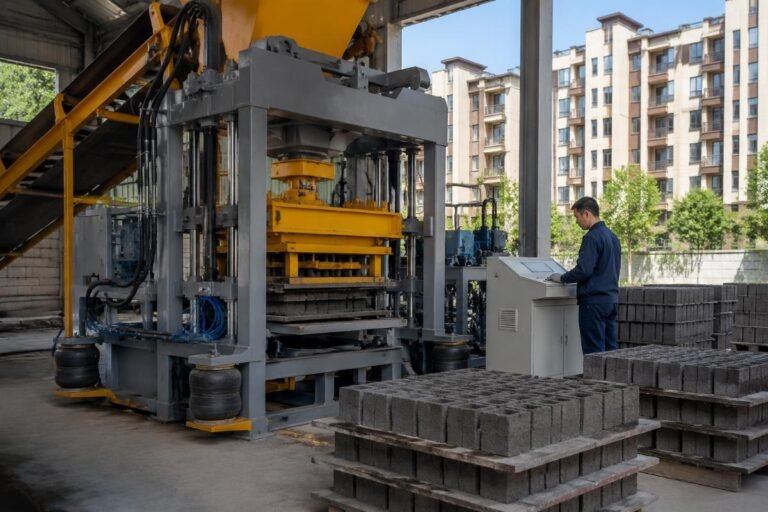
The base FOB price covers the machine itself: the frame, the hydraulic system, the PLC panel, the standard molds, and the auxiliary equipment like pallet feeders and stackers. This is the number that appears on quotation sheets and trade platform listings. But for Canadian projects, this number tells only part of the story.
The second layer is compliance adaptation. Canada’s concrete masonry standards are administered through the CSA Group, and while the national framework provides a baseline, provincial building codes can impose additional requirements on compressive strength, dimensional tolerance, and absorption rates. [NEED_CITE: Provincial adoption and enforcement of CSA A82 standards for concrete block specifications] A mold set designed for Ontario’s requirements may not satisfy Alberta’s or British Columbia’s specific testing protocols. Modifying molds after arrival means machining time, new steel, and production downtime.
The third layer is electrical configuration. Canada’s industrial voltage landscape is not uniform. Many facilities run on 600V three-phase systems, while others, particularly in older buildings or specific municipal setups, use 347V. [NEED_CITE: Natural Resources Canada industrial voltage standards and motor configuration requirements] Motors, contactors, and PLC power supplies must match the site voltage exactly. A mismatch means rewinding motors or replacing entire electrical cabinets, which adds noticeable cost and weeks of delay.
The fourth layer is climate durability. Canadian winters demand that hydraulic systems, seals, and mold steels withstand repeated freeze-thaw cycles without cracking or losing precision. Standard tropical-grade hydraulic hoses and seals will fail within a single season in unheated plants. Upgrading to cold-rated components is a material cost increase, but skipping it guarantees premature failure.
| Cost Layer | Standard Export Config | Canadian Adaptation Required |
|---|---|---|
| Base Equipment | Included in FOB | Included in FOB |
| Mold Compliance | Generic block shapes | Provincial CSA spec alignment |
| Electrical System | 380V/50Hz default | 600V or 347V, 60Hz motors and panels |
| Climate Durability | Tropical-grade seals and hoses | Freeze-thaw resistant hydraulic and mold materials |
A private investor in Saskatchewan once compared two quotes side by side. The cheaper one looked attractive until the electrical cabinet had to be completely rebuilt for 600V and the hydraulic seals replaced with cold-climate-rated ones. The final invoice ended up substantially higher than the initially more expensive quote that had included these adaptations from the start. When evaluating the concrete block machine price in Canada, always ask for a line-item breakdown that separates the base machine from the compliance and climate packages.
How Do Canadian Provincial Standards Affect Machine Configuration?
CSA standards provide the national framework, but provincial building codes determine the exact mold dimensions, compressive strength targets, and absorption limits your machine must meet.
The CSA A82 series covers concrete masonry units at the national level, but enforcement and supplementary requirements fall to provincial authorities. [NEED_CITE: CSA A82 series standards and provincial building code adoption for concrete masonry] This means a block that passes inspection in one province might fail in another, not because the concrete mix is wrong, but because the mold cavity dimensions or the testing protocol differ.
For the machine builder, this has direct implications on mold design. The core cavity size, the face shell thickness, and the web configuration all need to align with the provincial specification. A standard mold set shipped without this verification risks producing blocks that are dimensionally non-compliant, even if the concrete recipe is perfectly mixed.
I worked with a buyer in Atlantic Canada who had sourced molds from a European supplier. The molds were well-made, but they were designed to EN standards, not CSA. The face shell thickness was slightly outside the tolerance range his provincial inspector enforced. He ended up ordering a completely new mold set. The molds themselves were not enormously expensive, but the production downtime while waiting for replacements was the real burden.
| Provincial Requirement | Mold Design Impact | Verification Method |
|---|---|---|
| Compressive strength class | Core ratio and face shell thickness | Lab testing per CSA protocol |
| Dimensional tolerance | Cavity machining precision | Caliper measurement per batch |
| Absorption rate limit | Mix design and vibration frequency | Water absorption test per CSA |
The practical takeaway is straightforward: before finalizing the concrete block machine price in Canada, confirm the exact provincial standard your blocks must meet, and ensure the mold supplier has either existing tooling for that standard or the capability to machine new molds to spec. Manufacturers who ask for your province and building code during the quotation stage are saving you from problems that only surface during your first inspection.
What Are the Electrical and Climate Requirements for Canadian Block Plants?
Getting the voltage wrong means dead motors on arrival. Skipping cold-climate upgrades means cracked seals before the first spring thaw.
Canada’s industrial electrical infrastructure operates primarily on 60Hz, which is straightforward. The voltage, however, varies. The most common three-phase industrial supply is 600V, but 347V systems exist, particularly in older facilities or specific municipal distributions. [NEED_CITE: Natural Resources Canada industrial voltage standards and motor configuration requirements] Motors rated for 380V, the default export configuration from most Asian manufacturers, will not run on 600V without a transformer or complete rewinding. Contactors, variable frequency drives, and PLC power modules must also match.
An Ontario buyer received his line with motors wound for 380V. His facility ran on 600V. The solution was not simply adding a transformer. The motor mounting dimensions, shaft heights, and cooling fan designs all needed to align with the existing conveyor and mixer interfaces. Rewinding was possible but took weeks. Replacing the motors entirely was faster but cost noticeably more than specifying the correct voltage at the ordering stage. The lesson was expensive but clear: voltage confirmation belongs in the pre-order checklist, not the post-arrival troubleshooting list.
Climate requirements are equally non-negotiable. Canada’s freeze-thaw cycles are among the most demanding in the world for concrete products and the machinery that makes them. [NEED_CITE: Freeze-thaw resistance requirements for concrete masonry in cold climate zones per CSA testing protocols] Hydraulic systems using standard NBR seals will harden and crack below certain temperatures. Hydraulic fluid viscosity changes dramatically in cold conditions, affecting cycle times and pressure stability. Mold steels that lack proper alloying and heat treatment become brittle under repeated thermal cycling.
| System Component | Standard Tropical Spec | Canadian Cold-Climate Spec |
|---|---|---|
| Hydraulic seals | NBR rubber | Cold-rated polyurethane or fluorocarbon |
| Hydraulic fluid | ISO VG 46 standard | Low-temp rated fluid with pour point depression |
| Mold steel | Standard carbon steel | Alloy steel with controlled heat treatment |
| Electrical cabinet | Standard ventilation | Heated enclosure with condensation management |
The concrete block machine price in Canada must account for these upgrades. Buyers who accept the lowest base quote and plan to handle climate adaptation locally often find that sourcing cold-rated seals, specialty hydraulic fluid, and alloy mold steel in Canada costs substantially more than having the manufacturer include them in the original build. The manufacturer’s supply chain for these components is typically more efficient, and the integration is done under controlled factory conditions rather than rushed in a cold warehouse.
How to Compare ROI Between Semi-Auto and Fully-Auto Lines in Canada?
Higher upfront cost for a fully automatic line pays back faster in Canada because labor costs are high and production uptime directly determines whether you meet seasonal construction deadlines.
Canadian construction seasons are compressed. In most provinces, exterior block work peaks between late spring and early fall. A plant that experiences frequent downtime during this window loses not just daily output but entire project contracts. This reality makes the ROI calculation for fully automatic lines versus semi-automatic lines particularly favorable in the Canadian context, even though the initial concrete block machine price in Canada for a fully automatic line is substantially higher.
Fully automatic lines, such as the QT10-15 or QT12-15 configurations, integrate automated material batching, mixing, conveying, block forming, pallet handling, and product stacking. The operator’s role shifts from physical labor to monitoring and quality control. Semi-automatic lines, like the QT6-15, require more manual intervention at each stage: pallet loading, wet product handling, and stacking. In a market where skilled labor is expensive and difficult to retain, the automation premium translates directly into predictable operating costs.
| Factor | Semi-Auto Line (QT6-15 class) | Fully-Auto Line (QT10-15 class) |
|---|---|---|
| Base Equipment Cost | Lower initial investment | Higher initial investment |
| Labor Requirement | Multiple operators per shift | Minimal operators, primarily monitoring |
| Output Consistency | Variable with operator fatigue | Stable PLC-controlled cycles |
| Seasonal Downtime Risk | Higher due to labor dependency | Lower due to automation |
| Maintenance Complexity | Simpler mechanical systems | More complex, requires trained technician |
A buyer in Quebec operated a semi-automatic line for several years. His labor costs consumed a growing share of revenue as minimum wage increases took effect and turnover remained high. When he upgraded to a fully automatic line, his per-block labor cost dropped noticeably. The payback period was shorter than he had anticipated, primarily because the automated stacking and pallet return systems eliminated the two most physically demanding and hardest-to-staff positions in his plant.
The concrete block machine price in Canada for a fully automatic line includes the PLC system, automated pallet circulation, stacker, and often a color feeder for decorative products. These components add cost, but they also add capability. A plant running a fully automatic line can switch between standard structural blocks and decorative pavers within a single shift, opening revenue streams that semi-automatic setups struggle to serve profitably.
For buyers evaluating the concrete block machine price in Canada, the ROI model should factor in not just the machine cost but the three-to-five-year labor cost trajectory, the value of production uptime during the short construction season, and the revenue potential from product diversification. In Canada’s cost structure, automation is not a luxury. It is the path to predictable margins.
Why Choose Chinese Manufacturers Over European Brands for the Canadian Market?
Chinese manufacturers match European build quality for Canadian applications at a fraction of the price, with faster turnaround on the custom configurations that Canadian projects demand.
European block machine brands have long held a reputation for precision engineering. That reputation is earned. But for Canadian buyers, the relevant question is not whether European machines are good. They are. The question is whether the premium price is justified when Chinese manufacturers now produce machines that meet the same CSA compliance requirements, handle the same voltage configurations, and withstand the same freeze-thaw conditions, all while offering significantly more flexibility on customization.
The price gap is substantial. A fully automatic line from a European manufacturer typically carries a concrete block machine price in Canada that is multiples higher than a comparable specification from a established Chinese manufacturer. [NEED_CITE: Market price comparison between European and Chinese concrete block making machine manufacturers for North American specifications] This gap does not reflect a proportional difference in performance for the Canadian application. It reflects brand positioning, European labor costs in manufacturing, and the overhead of distribution networks designed for a different market structure.
Customization speed is where the difference becomes even more pronounced. Canadian projects require specific mold configurations for provincial standards, specific motor windings for site voltage, and specific material upgrades for climate durability. European manufacturers often have long lead times for non-standard configurations because their production schedules are optimized for their domestic market specifications. Chinese manufacturers, particularly those with established export operations, structure their production lines to accommodate customization as a standard workflow rather than an exception.
| Factor | European Manufacturer | Established Chinese Manufacturer |
|---|---|---|
| Base Price for Equivalent Spec | Substantially higher | Significantly more accessible |
| Custom Mold Lead Time | Extended, subject to domestic schedule priority | Streamlined for export customization |
| Voltage Configuration Flexibility | Often limited to standard EU configs | Built to order for global voltage variants |
| Cold-Climate Material Upgrades | Available at premium | Integrated into standard export packages |
| On-Site Installation Support | High cost, limited availability | Included in turnkey packages |
A buyer in Manitoba was comparing quotes for a complete plant. The European option was technically excellent but carried a price that would have required him to secure additional financing at unfavorable terms. The delivery timeline for his specific mold configuration was also extended. The Chinese option he ultimately selected matched his provincial CSA requirements, included 600V motor configuration, specified cold-rated hydraulic components, and arrived within a timeframe that allowed him to begin production before the winter shutdown. The total installed cost was a fraction of the European alternative, and the machine has performed reliably through multiple freeze-thaw seasons.
The concrete block machine price in Canada from Chinese manufacturers does not represent a compromise on quality for the application. It represents a different cost structure, one that benefits buyers who need specific configurations delivered efficiently. For Canadian investors and contractors, the calculation is simple: does the machine meet CSA standards, handle site voltage, survive the climate, and arrive in time for the construction season? If the answer is yes, the brand origin matters far less than the specification sheet and the delivery commitment.
Conclusion
The concrete block machine price in Canada is a multi-layered figure that extends well beyond the base equipment cost. Provincial CSA compliance, 600V or 347V electrical configuration, and freeze-thaw climate durability each add meaningful cost to the landing price. Buyers who address these factors during the quotation stage avoid expensive post-arrival modifications, and those who compare fully automatic versus semi-automatic lines against Canadian labor costs and compressed construction seasons find that automation delivers faster payback than the initial price difference suggests. Chinese manufacturers now offer specification-matched equipment at accessible price points with the customization flexibility that Canadian projects require, making the total cost of ownership competitive without compromising on compliance or durability.
Leave a Reply