

Buy QT6-15 Block Machine Turnkey Solution from China Manufacturer
Most buyers fixate on the daily output number printed on the nameplate. The real profit driver of a QT6-15 Block Machine Turnkey Solution is pallet turnover rate, not theoretical molding cycle.
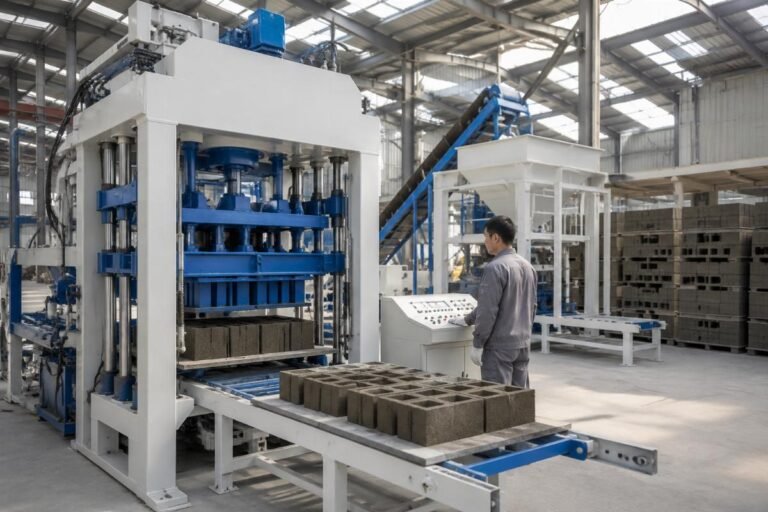
A QT6-15 Block Machine Turnkey Solution delivers the highest ROI entry point for emerging market investors because it balances semi-automatic efficiency with manageable labor costs, provided the mixer, batcher, and pallet system are rhythm-matched to the forming unit and local power conditions are stabilized upfront.
I still remember standing in a corrugated-iron shed outside Lagos, watching a control board fry because someone skipped the voltage regulator. The QT6-15 Block Machine Turnkey Solution was sitting there, fully wired, but the local grid was swinging between brownouts and surges. That machine didn’t fail—the infrastructure around it did. When sizing a QT6-15 Block Machine Turnkey Solution, the forming machine is only the visible tip; the batching plant, mixer discharge timing, curing yard layout, and pallet circulation volume determine whether the line actually prints money or just burns diesel on the generator [NEED_CITE: root cause distribution of block plant downtime in Sub-Saharan Africa per industry field surveys].
Let’s walk through what actually makes or breaks this configuration.
Why QT6-15 is the Sweet Spot for Emerging Market Investors?
The QT6-15 sits at the exact intersection where automation lifts output without demanding a fully skilled PLC maintenance team.
Full-automatic lines like the QT10-15 or QT12-15 are tempting on paper, but they assume stable three-phase power, a dedicated electrician on shift, and a curing yard large enough to absorb their continuous discharge. In many West African, Southeast Asian, and Latin American markets, those assumptions collapse within weeks. A QT6-15 Block Machine Turnkey Solution, by contrast, runs on a simpler hydraulic-electric architecture that local technicians can troubleshoot with basic multimeters and spare contactors.
| Parameter | QT4-15 Manual-Assist | QT6-15 Semi-Auto | QT10-15 Full-Auto |
|---|---|---|---|
| Operator Skill Required | Basic | Moderate | Advanced PLC |
| Power Stability Tolerance | Moderate | Robust | Vulnerable |
| Pallet Dependency | Low | Standard | High |
| Minimum Viable Curing Area | Small | Medium | Large |
| Spare Parts Localization | Easy | Moderate | Difficult |
The table tells the real story: the QT6-15 Block Machine Turnkey Solution tolerates the messy realities of emerging grids and semi-skilled labor pools far better than its bigger siblings, while still producing enough standard hollow blocks to repay capital within a realistic timeframe [NEED_CITE: comparative payback modeling of semi-auto versus full-auto block lines in volatile grid environments].
A private investor in Accra once compared two quotes—one for a larger automatic line, one for the QT6-15. The larger line looked cheaper per block on paper. But once we factored in the voltage stabilizer, the extra pallets, the dedicated electrician salary, and the generator fuel during outages, the QT6-15 Block Machine Turnkey Solution came out ahead on actual cash-in-hand within the first operating year.
How to Configure a Turnkey Line Beyond the Machine Itself?
The forming machine is thirty percent of the system; the other seventy percent is material flow, pallet circulation, and curing logistics.
A QT6-15 Block Machine Turnkey Solution that ships without a properly sized batcher and mixer is like buying an engine without a transmission. The mixer must discharge a full batch within the molding cycle window, or the forming unit sits idle waiting for concrete. The batcher must weigh aggregates consistently, or block strength varies and rejection rates climb. The pallet return conveyor must loop fast enough that the machine never pauses for a pallet shortage.
| Subsystem | Matching Principle | Risk if Undersized |
|---|---|---|
| Batching Plant | Weigh cycle shorter than molding cycle | Strength inconsistency, cement waste |
| Mixer | Discharge volume covers one full mold shot per cycle | Idle time on forming unit |
| Pallet System | Circulation volume exceeds daily output by a defined buffer | Production bottleneck at peak heat |
| Cement Silo | Capacity covers multiple days to avoid supplier gaps | Unplanned shutdowns |
Shiyue’s engineering team approaches every QT6-15 Block Machine Turnkey Solution by first mapping the customer’s local sand gradation, cement grade availability, and daily shift pattern before locking in the mixer and batcher specs. When a buyer in Dakar specified local cement that cured slower than the Chinese standard, the team adjusted the pallet buffer upward and added a mist-curing zone—small changes that prevented a catastrophic pallet shortage during the hot season [NEED_CITE: influence of local cement setting time on pallet turnover requirements in tropical climates].
What Site & Power Pitfalls Can Kill Your ROI?
Voltage fluctuation and poor site layout are the two silent killers that turn a profitable QT6-15 Block Machine Turnkey Solution into a money pit.
I have seen entire containers of equipment sit at a West African port for weeks because the site foundation was not ready. I have also seen brand-new control cabinets replaced because someone connected a high-draw line directly to an unstable municipal feed without industrial-grade stabilization. The QT6-15 Block Machine Turnkey Solution draws significant current during hydraulic pressing; if the supply sags, the PLC resets, the cycle aborts, and half-formed blocks must be scrapped.
The fix is not optional—it is structural. An industrial voltage regulator sized to the full connected load of the line must be installed upstream of the main distribution panel. Shiyue includes customized stabilizer specifications in every QT6-15 Block Machine Turnkey Solution package based on the customer’s declared grid conditions, and the on-site commissioning engineers verify voltage stability before the first test run.
Site layout mistakes are equally expensive. If the curing yard is too far from the forming machine, pallet transport time eats into cycle output. If the raw material stockpile is uphill from the batcher, loader fuel costs climb. If drainage is ignored, the rainy season turns the yard into a mud pit and blocks stored on ground level absorb moisture unevenly.
| Pitfall | Symptom | Corrective Action |
|---|---|---|
| Unstable grid voltage | PLC resets, hydraulic stalls | Industrial stabilizer upstream |
| Curing yard too distant | Pallet cycle time exceeds target | Relocate yard within compact radius |
| Poor drainage | Ground-stored blocks degrade | Raised curing racks with graded floor |
| Inadequate foundation | Machine vibration misaligns mold | Reinforced concrete pad per spec |
A buyer in East Africa learned this the hard way when his first QT6-15 Block Machine Turnkey Solution lost nearly a month of production because the curing yard was laid out on low ground that flooded during short rains. The blocks cured unevenly, strength tests failed, and an entire batch had to be crushed and reprocessed [NEED_CITE: case documentation of site drainage failures affecting concrete block curing in tropical monsoon zones].
How to Calculate the Real Payback Period?
Throw away the nameplate output number. Real payback is calculated on pallet-turnover-limited capacity, local brick selling price, and actual cement cost per block.
The nameplate says the QT6-15 produces a certain number of standard hollow blocks per cycle. Multiply by cycles per hour, hours per shift, shifts per day, and you get a theoretical daily output that looks fantastic in a spreadsheet. But that number assumes zero pallet shortage, zero mixer wait time, zero power interruption, and zero material variation. None of those assumptions hold in the field.
The realistic calculation for a QT6-15 Block Machine Turnkey Solution starts with pallet inventory. Count the total pallets in circulation. Divide by the number of pallets consumed per cycle. That gives you the maximum number of cycles before the machine must pause for pallet return. Multiply by actual cycle time including minor stops. That is your real hourly output. Then multiply by local selling price per block, subtract cement cost, sand cost, labor, electricity, and maintenance per block. The remainder is gross margin per block. Divide total capital investment by daily gross margin to get payback days.
| Input Variable | Source of Data | Typical Variance from Nameplate |
|---|---|---|
| Pallet inventory | Physical count on site | Noticeably reduces theoretical output |
| Mixer discharge time | Stopwatch measurement | Noticeably reduces theoretical output |
| Power availability | Utility records over a month | Substantially reduces theoretical output |
| Local block price | Market survey | Directly determines revenue per block |
| Cement cost per bag | Supplier invoice | Directly determines cost per block |
A QT6-15 Block Machine Turnkey Solution configured with adequate pallets, a matched mixer, and a stabilized power supply typically achieves payback well within the first operating year in markets where standard hollow blocks command a stable price. The buyers who struggle are almost always those who minimized the pallet order to save on the initial invoice, then watched their machine idle every afternoon waiting for pallets to return from the curing yard.
Shiyue’s turnkey packages include a pallet inventory calculation based on the buyer’s declared shift pattern and local curing conditions, so the pallet buffer is sized correctly from day one rather than discovered as a bottleneck three months in [NEED_CITE: methodology for pallet buffer sizing based on curing duration and daily output targets].
Conclusion
A QT6-15 Block Machine Turnkey Solution wins not on paper output but on field survivability and real pallet-driven capacity. Match the mixer, batcher, pallets, and power stabilization to local conditions, and the payback follows. Ignore those subsystems, and even the best-formed machine sits idle.
Leave a Reply