

Buy Block Machine Best Price 2026 | QT10-15/QT12-15 Manufacturer for Sale
The cheapest block machine quote you receive today will likely become the most expensive asset on your balance sheet within two years.
In 2026, the true buy block machine best price is not the lowest FOB number on a proforma invoice. It is the total cost per produced block over a five-year operating window, factoring in steel price swings, automation-driven labor ratios, mould lifespan, hydraulic reliability, and spare-parts availability. A semi-automatic line may appear cheaper upfront but can produce each block at a noticeably higher cost than a fully automatic plant once local wage inflation is accounted for.
I still remember standing inside a corrugated-roof warehouse in Dakar, watching a production team swap out a worn mould for the third time that month. The machine itself was running, but the hydraulic ram had begun cycling unevenly, and the cycle time had stretched from what the nameplate promised to something far less productive. The owner had selected the lowest-quoted unit from a trading company two years earlier. When I asked him what the real cost of that "bargain" had been, he pointed to a stack of idle pallets and a half-empty spare-parts cage. He was not paying for a machine; he was paying for downtime, emergency air-freighted components, and lost contracts. That warehouse visit reshaped how I evaluate every quotation that crosses my desk. [NEED_CITE: global steel price index trend and its pass-through effect on construction machinery manufacturing cost]
Let me walk you through what actually determines whether a quotation represents genuine value, and where the hidden cost traps are buried.
What Factors Determine Block Machine Price in 2026?
Three variables dominate the quotation you receive: raw-material cost at the time of production, the automation architecture selected, and the completeness of the auxiliary equipment package.
Steel accounts for a substantial share of any block machine’s manufacturing cost. When hot-rolled coil and structural plate prices climb, manufacturers either absorb the increase temporarily or pass it through within one to two quotation cycles. Buyers who lock in orders during a steel-price dip secure meaningfully better pricing than those who wait until a construction boom triggers demand spikes. [NEED_CITE: World Steel Association monthly steel price indicator and its correlation with machinery export pricing]
Automation level is the second multiplier. A manually operated egg-laying unit requires a small crew but limits daily output to a few thousand blocks. A semi-automatic line with a basic batch mixer, pallet conveyor, and simple stacking frame reduces headcount and raises consistency. A fully automatic PLC-controlled line with servo-driven mould vibration, automated pallet circulation, and integrated cubing cuts labor demand to a fraction while pushing output into the tens of thousands of blocks per shift. The price gap between these tiers is wide, yet the per-block labor cost often inverts expectations once you factor in regional wage trends across Africa, the Middle East, and Latin America.
The third factor is configuration completeness. Some quotations include only the main forming unit. Others bundle the mixer, batcher, pallet system, stacker, colour feeder, and a spare mould set. Comparing a bare-machine quote against a turnkey quote is like comparing a chassis price against a fully equipped vehicle. [NEED_CITE: industry survey on configuration scope variation in block machine quotations from different supplying regions]
When I reviewed a tender submission for a West African public housing programme last year, the shortlisted bids varied by a factor of nearly three. The lowest bid excluded the batching plant and pallet system entirely. The highest bid included two years of consumable spare parts and on-site commissioning. The evaluation committee had to rebuild the comparison on a like-for-like basis before any meaningful decision could be made.
Block Machine Price Range by Type: Complete 2026 Breakdown
Mobile egg-laying machines occupy the entry tier, semi-automatic lines sit in the mid-range, and fully automatic plants command the top tier—yet the overlap zone is where smart buyers find real value.
| Machine Category | Typical Output Range | Automation Level | Investment Tier | Labour Demand |
|---|---|---|---|---|
| Mobile Egg-Layer (e.g. QT4-25 class) | Low daily output | Manual to semi-manual | Entry-level | High |
| Semi-Auto Static Line (e.g. QT4-15 / QT6-15 class) | Moderate daily output | Semi-automatic with basic aux | Mid-range | Moderate |
| High-Output Semi-Auto (e.g. QT6-15 upgraded config) | Substantial daily output | Semi-auto with full aux | Upper mid-range | Moderate to low |
| Fully Automatic Line (e.g. QT10-15 / QT12-15 class) | High daily output | Full PLC with servo systems | Premium | Low |
| Premium Fully Automatic (e.g. QT15-15 class) | Very high daily output | Advanced PLC with cubing | Top tier | Minimal |
A private investor in North Africa recently upgraded from a manual setup to a QT6-15-class semi-automatic configuration. His monthly output rose noticeably, and the crew size dropped by more than half. The payback period shortened because the per-block labour cost fell faster than the equipment amortisation rose. He did not chase the cheapest machine; he chased the lowest per-block operating cost.
For government housing tenders, fully automatic lines in the QT10-15 or QT12-15 class are typically specified. The bid must account for the machine, the batching and mixing plant, the pallet circulation system, the stacker, installation, commissioning, and operator training. Buyers who only budget for the main unit discover the shortfall when auxiliary costs surface. [NEED_CITE: typical cost composition breakdown for turnkey block plant projects in emerging-market public procurement]
A distributor in Southeast Asia who purchases in container-load batches has learned to negotiate the unit price downward while maintaining a spare-parts buffer. His strategy is to treat the spare-parts inventory as an operating-cost line item, not an afterthought. Machines that sit waiting for a replacement hydraulic seal generate zero revenue.
Hidden Costs Buyers Often Overlook When Comparing Quotes
Mould wear, hydraulic maintenance, electrical adaptation, and spare-parts inventory collectively represent a substantial portion of lifetime ownership cost—yet they rarely appear in the initial quotation.
Moulds are consumable tools. Every cycle causes abrasive wear on the forming cavities and core pins. High-quality moulds fabricated from properly heat-treated alloy steel retain dimensional accuracy far longer than cheaper alternatives. When a mould wears beyond tolerance, block dimensions drift, rejection rates climb, and the customer either accepts off-spec product or halts production for a replacement. The cost difference between a premium mould and a budget mould is small relative to the revenue lost from a production stoppage. [NEED_CITE: mould lifespan comparison data based on material grade and heat treatment standards]
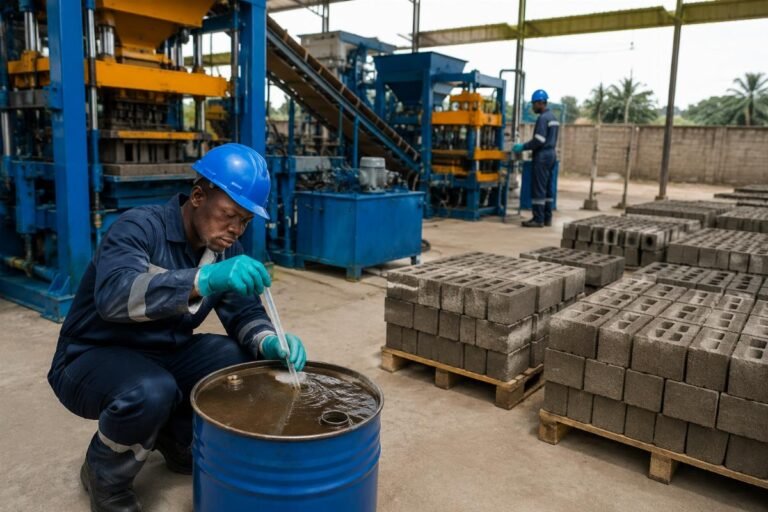
Hydraulic systems are the circulatory system of any block machine. Contaminated fluid, degraded seals, or poorly specified valves lead to erratic ram behaviour, longer cycle times, and eventual cylinder failure. Buyers who skip routine fluid analysis and filter replacement schedules pay for it in unplanned downtime. I have seen operations where a single hydraulic failure during a peak-order week cost more in lost delivery penalties than the entire annual maintenance budget would have run.
Electrical adaptation is another silent cost. Machines designed for one voltage and frequency standard may require transformer upgrades, cable rewiring, or component swaps when installed in a country with a different grid specification. In regions where power supply is unstable, additional protection—surge suppressors, voltage regulators, soft-start panels—becomes essential. Skipping these protections invites control-board failures that are expensive and slow to replace.
Spare-parts availability separates reliable suppliers from unreliable ones. A manufacturer that stocks wearing parts and ships them within days keeps your line running. A supplier that sources parts from third parties or requires weeks of lead time turns minor failures into major crises. When evaluating any buy block machine best price proposal, ask explicitly what spare-parts package is included, what the lead times are for critical components, and whether the supplier maintains a regional service presence. [NEED_CITE: industry benchmark on spare-parts lead time impact on overall equipment effectiveness in block production]
How to Calculate True ROI: Beyond the Machine Price Tag
The only metric that matters is the total cost per produced block over the equipment’s usable life—not the purchase price on day one.
Start by estimating monthly output based on realistic shift patterns and maintenance windows, not theoretical nameplate capacity. Multiply the monthly block output by the selling price per block in your market to determine revenue. Then subtract all operating costs: raw materials (cement, aggregates, sand, admixtures), labour, electricity, water, mould amortisation, hydraulic fluid and filter replacement, spare-parts consumption, and facility overhead. The remainder is your monthly gross contribution. Divide the total equipment investment—including shipping, installation, and commissioning—by that monthly contribution to estimate the payback period in months.
A buyer in the Middle East ran this exercise before committing to a QT10-15-class fully automatic line. His initial instinct was to choose a cheaper semi-automatic option. When he modelled the labour cost at local wage rates and factored in the output gap, the fully automatic line delivered a shorter payback despite its higher upfront price. The per-block cost was lower because the labour component was spread across a much larger monthly output. [NEED_CITE: ROI modelling methodology for concrete block production investment appraisal]
Conversely, a small-scale entrepreneur in East Africa found that a QT4-25 mobile egg-layer matched his market reality better. His demand volume did not justify the capital commitment of a static line, and his site conditions favoured a mobile unit that could produce directly on curing yards. The buy block machine best price for him was the one that matched his actual demand curve, not the one with the lowest per-unit theoretical output.
The mistake many buyers make is anchoring on the machine price alone. Two quotations that differ by a modest percentage can produce wildly different per-block costs once you factor in mould life, energy consumption, and maintenance frequency. Always request a detailed configuration list, and model the five-year operating cost before signing.
Why Chinese Manufacturers Offer Best Value in 2026
Chinese block machine manufacturers combine competitive pricing with rapidly maturing automation technology, shorter delivery windows, and responsive after-sales networks—making them the default sourcing choice for buyers across emerging markets.
The price advantage is structural, not accidental. Manufacturing ecosystems in provinces like Shandong concentrate steel processing, hydraulic-component fabrication, electrical-assembly, and machining within compact industrial clusters. This density reduces logistics cost, shortens supply chains, and enables manufacturers to iterate on designs quickly. When a European or Turkish competitor quotes a fully automatic line, the Chinese equivalent in comparable configuration typically comes in at a noticeably lower price point—without sacrificing the core performance parameters that determine block quality. [NEED_CITE: comparative pricing analysis of concrete block machinery across major manufacturing regions]
Delivery speed is another differentiator. A complete line—main machine, mixer, batcher, pallet system, stacker, and colour feeder—can be manufactured, assembled, test-run, disassembled, and container-loaded within a compressed timeframe. Buyers facing tight project deadlines or seasonal construction windows benefit directly from this responsiveness.
Certification and compliance have also matured. Leading Chinese manufacturers now hold CE, SGS, and ISO certifications as standard, and their documentation is structured to meet the requirements of government tender processes across Africa, the Middle East, and Latin America. The machines are field-proven in environments with unstable power grids, high ambient dust, and limited technical infrastructure—conditions that would prematurely disable equipment designed only for controlled factory settings.
On-site installation, commissioning, and operator training are routinely included in turnkey packages. Engineers travel to the buyer’s location, supervise the mechanical and electrical setup, run trial production, and train the local crew until the line operates at target output. This hands-on support reduces the risk of costly commissioning errors and accelerates the path to revenue generation.
A distributor who has sourced from multiple regions over the years told me that his Chinese supply partners respond to spare-parts enquiries within days, whereas competitors from other continents sometimes take weeks. In this business, that responsiveness is worth more than a marginal price saving on the initial order. When you evaluate the buy block machine best price, factor in the entire ecosystem—manufacturing capability, delivery speed, certification readiness, and after-sales responsiveness—because the machine is only the beginning of the relationship.
Conclusion
The buy block machine best price is never the lowest number on a quotation—it is the lowest total cost per block over the equipment’s operating life. Steel-price timing, automation selection, configuration completeness, mould quality, hydraulic reliability, electrical adaptation, and spare-parts responsiveness all feed into that true cost. Buyers who model their investment on per-block economics rather than upfront price consistently make better decisions, whether they are private entrepreneurs, government contractors, or regional distributors.
Leave a Reply