

Block Machine Supplier for Thailand: China Factory Direct
Picking a block machine supplier for Thailand based purely on spec sheets is the fastest way to burn months of production time and a mid-six-figure budget.
The right block machine supplier for Thailand is not the one offering the highest output on paper, but the one that customizes voltage stabilization, mixer calibration, and hydraulic cooling for local site conditions—ensuring the line runs at full capacity from day one.
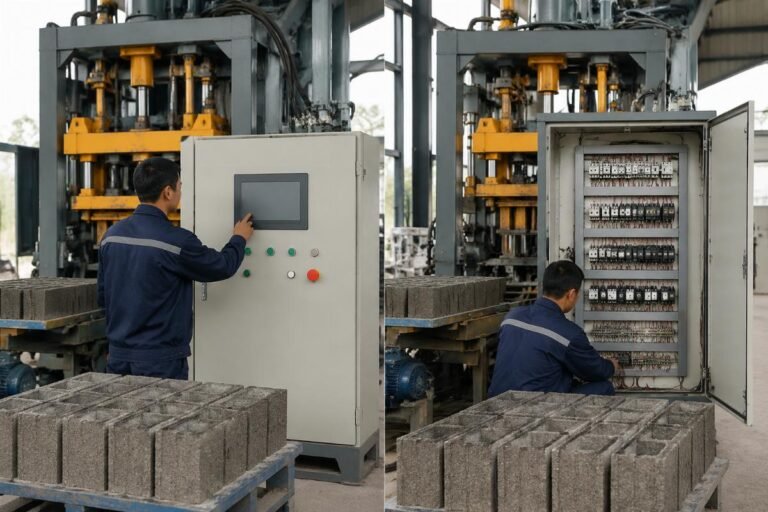
I still think about that QT10-15 automatic line we shipped to Chonburi Province a couple of years back. We quoted it with standard domestic configuration—after all, the machine itself was identical to dozens we had already assembled. What we did not account for was the voltage fluctuation pattern on the local industrial grid and the high clay content in the river sand the customer planned to use. When our engineer arrived on site, the forming rate would not climb past a fraction of what the machine was rated for. The PLC kept tripping, the mold compaction was uneven, and the customer was close to rejecting the entire shipment. That job forced a permanent shift in how we approach every order heading to Southeast Asia. Before a single drawing is finalized, we now ask about the local power grid stability, the exact aggregate sources, and the physical layout of the yard. Buying a block machine is not about purchasing a parameter list; it is about purchasing a system that actually runs on your land.
If you are sourcing equipment across borders, understanding how a block machine supplier for Thailand handles localization is the difference between a smooth commissioning and a prolonged headache.
Why Thailand Projects Demand a China Factory That Understands Local Conditions?
Copying a domestic Chinese configuration directly to a Thai site almost guarantees equipment incompatibility. The root cause is rarely the machine itself—it is the mismatch between factory-default settings and the real-world environment the machine will operate in. [NEED_CITE: industrial voltage standard variations across Southeast Asian grids per IEC classification]
Thailand’s industrial power supply follows the IEC standard framework, yet the actual voltage stability at many provincial industrial estates can swing noticeably during peak hours. A block machine supplier for Thailand that ships equipment with generic electrical cabinets will find the PLC system faulting repeatedly. In the Chonburi case, we ended up designing a custom transformer setup and reprogramming the PLC tolerance thresholds to absorb the voltage dips without halting the cycle. The forming rate recovered to full spec only after those modifications were in place.
Then there is the raw material variable. Thai river sand, particularly from central and eastern provinces, tends to carry higher silt and clay content compared to the manufactured sand commonly used in northern Chinese plants. If the mixing cycle and mold vibration parameters remain unchanged, the block density drops, and compressive strength tests fail to meet the required benchmarks. [NEED_CITE: concrete block compressive strength testing methodology per ASTM C129] We adjusted the mixing sequence—extending the dry-mix phase before water addition—and recalibrated the mold vibration frequency. The density improved noticeably, and the blocks passed strength verification on the next round of testing.
The tropical climate introduces a third layer. Hydraulic systems on block machines generate significant heat during continuous operation. In a climate where ambient temperatures stay high for most of the year, standard oil cooling setups cannot dissipate heat fast enough. Oil temperature climbs, viscosity drops, and the hydraulic actuators lose precision. The solution was adding an oversized cooling circuit to the hydraulic power pack. After that modification, the system maintained stable pressure throughout full shifts without overheating.
| Configuration Factor | Generic Domestic Setup | Thailand-Customized Setup |
|---|---|---|
| Voltage Tolerance | Standard Range | Extended Range with Custom Transformer |
| Mixing Cycle | Fixed Timing | Adjusted for High-Silt Aggregate |
| Hydraulic Cooling | Standard Radiator | Oversized Cooling Circuit |
| PLC Fault Response | Narrow Threshold | Wide Absorption Band |
| Mold Vibration | Default Frequency | Recalibrated for Local Sand Profile |
A block machine supplier for Thailand that skips these customization steps is essentially delivering a machine that looks right on paper but cannot perform in the field.
How to Verify a Supplier’s Factory-Direct Claims and Customization Capability?
Request site-specific engineering drawings before committing to any purchase order. A genuine factory-direct block machine supplier for Thailand will provide customized layout plans, electrical schematics adjusted for local voltage, and mixing system designs based on your actual raw material samples—not a generic brochure.
Start by asking for the electrical cabinet wiring diagram. If the supplier sends back the same schematic they use for domestic orders, that is a red flag. The diagram should show transformer specifications matched to Thailand’s industrial voltage range and PLC input/output configurations that account for local power quality. [NEED_CITE: Thailand industrial voltage standards published by the Thai Industrial Standards Institute]
Next, request a mixing system proposal based on samples of your local aggregate. A credible block machine supplier for Thailand will ask you to ship a batch of your sand, laterite, or fly ash to their testing facility. They should then return a mixing protocol—dry-mix duration, water-to-cement ratio, additive dosage—tailored to those specific materials. If they skip this step and quote a standard mixing cycle, your blocks will likely fail density and strength requirements.
Ask for commissioning case records from previous Thai projects. Not marketing photos—actual commissioning logs showing what problems were encountered on site and how they were resolved. A supplier with genuine field experience in Thailand will have documentation of voltage-related adjustments, aggregate-specific mold calibrations, and hydraulic modifications for high-temperature environments.
Verify the factory’s physical scale through a live video tour or a third-party inspection. The facility should include dedicated assembly bays, electrical testing stations, and a raw material testing lab. A block machine supplier for Thailand operating from a proper manufacturing plant will have these capabilities in-house rather than outsourcing critical assembly steps.
Key Milestones in Delivering a Complete Block Line from Linyi to Thailand
A successful delivery involves far more than loading containers—it requires coordinated site planning, on-site commissioning, and operator training as a single integrated process.
The first milestone is site layout planning. Before the machine is even manufactured, the block machine supplier for Thailand should work with you to design the production line layout based on your actual land dimensions, material storage areas, and curing yard capacity. This includes positioning the batching plant, mixer, block machine, conveyor system, pallet circulation loop, and stacker for optimal workflow. A poorly planned layout adds unnecessary transport distances and creates bottlenecks that no machine speed can overcome.
The second milestone is pre-shipment factory testing. The complete line should be assembled and run at the factory in Linyi before disassembly. This confirms that every component functions correctly, the PLC programs are loaded, and the hydraulic system holds pressure under continuous operation. Factory testing catches integration issues that would be far costlier to diagnose on site.
The third milestone is on-site commissioning. When the equipment arrives in Thailand, the supplier’s engineers should be present for the full reassembly and startup sequence. This is where the customization pays off—the voltage settings, mixing parameters, and hydraulic cooling configurations are verified under actual site conditions. [NEED_CITE: best practices for concrete block machine commissioning in emerging market environments]
The fourth milestone is operator training. A block machine supplier for Thailand that leaves after the machine starts running is setting you up for problems. The local crew needs hands-on training covering daily operation, mold changes, routine maintenance, and basic fault diagnosis. Without this training, even a perfectly commissioned line will suffer from avoidable downtime and inconsistent product quality.
Investment Return Analysis: Where China-Direct Equipment Wins in Thailand
The cost advantage of sourcing from China extends well beyond the initial purchase price—it includes faster customization turnaround, lower spare part costs, and shorter response times for technical support.
When Thai investors compare block machine suppliers, European and Turkish brands often appear in the conversation. Those brands carry a premium price tag that can be substantially higher than equivalent Chinese output. For a private investor setting up a new block plant, that upfront premium directly extends the payback period. A block machine supplier for Thailand offering factory-direct pricing from China typically positions the total equipment cost at a fraction of what European alternatives demand, while delivering comparable production capacity.
Spare parts represent another significant cost factor. Wear components—mold liners, vibration springs, hydraulic seals, conveyor belts—need regular replacement. Sourcing these from European manufacturers involves long lead times and high per-unit costs. A Chinese block machine supplier for Thailand with an established export operation can ship replacement parts within a short timeframe, keeping downtime minimal.
Technical support response time matters equally. When a PLC fault or hydraulic issue halts production, every hour of downtime translates directly to lost revenue. A block machine supplier for Thailand that maintains remote diagnostic capability and can dispatch engineers to Southeast Asia quickly provides a practical advantage over brands whose nearest service team is thousands of miles away.
| Cost Factor | European/Turkish Brands | China Factory-Direct |
|---|---|---|
| Equipment Purchase Price | Substantially Higher | Noticeably Lower |
| Spare Part Lead Time | Extended | Short |
| Spare Part Unit Cost | High | Moderate |
| Customization Turnaround | Lengthy | Rapid |
| On-Site Support Response | Delayed | Prompt |
For government contractors executing infrastructure or public housing projects in Thailand, the certification factor adds another dimension. A block machine supplier for Thailand should provide CE, SGS, and ISO documentation that meets tender requirements. Chinese manufacturers with established export operations now carry these certifications as standard, removing a previous advantage that European brands held in formal bidding processes.
Conclusion
Choosing a block machine supplier for Thailand is a localization challenge, not a spec-sheet competition. Voltage stability, aggregate characteristics, and tropical operating temperatures all demand factory-level customization before the equipment ships. Verify the supplier’s capability through site-specific drawings, material testing, and documented commissioning experience. When these elements align, the result is a production line that performs at full capacity from the first week—protecting your investment and accelerating your return.
Leave a Reply