

QT9-18 Auto Block Line Manufacturer for Chile Buyers
Lowest FOB price is not the cheapest option for Chile.
Sourcing a QT9-18 auto block line manufacturer for Chile buyers requires prioritizing documentation precision and electrical compatibility over initial unit cost. The true landed cost is determined by customs clearance efficiency, correct HS classification, and adherence to ISPM 15 wood packaging standards, not just the factory gate price.
I still remember the silence in the office when the call came from Iquique. A client had received a full container of machinery, but the customs broker rejected the entry. The reason was not a missing certificate or a damaged crate, but a single digit error in the HS code on the Bill of Lading. The cargo sat in the bonded zone for weeks. The storage fees alone consumed a significant portion of the project’s projected margin. That incident changed how we handle every shipment to Latin America. It is not enough to build a machine that works; it must arrive with paperwork that clears. [NEED_CITE: Chilean Customs Authority documentation requirements for industrial machinery]
This guide breaks down the specific technical and logistical hurdles for importing automatic block making lines into Chile. It moves beyond generic specifications to address the real-world constraints of Andean construction projects and local regulatory frameworks.
Why the QT9-18 Configuration Fits Mid-Sized Chilean Plants
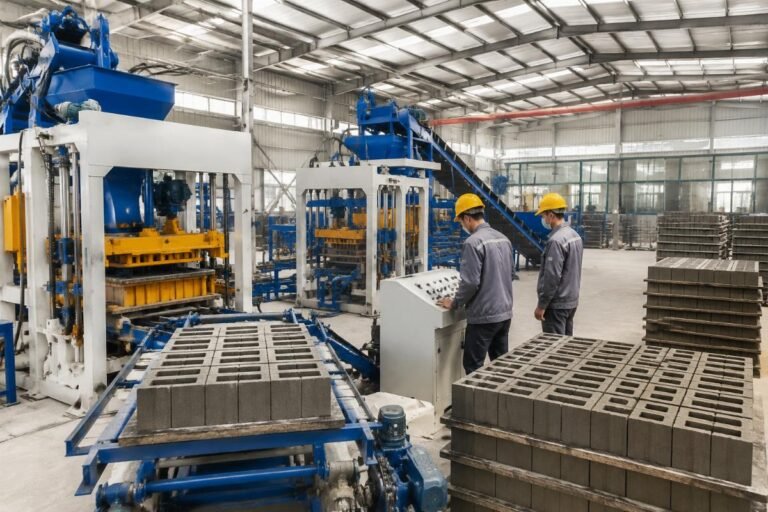
The choice of machinery often defaults to the highest capacity available, assuming volume equals profit. In the Chilean context, this is a miscalculation. The QT9-18 auto block line manufacturer for Chile buyers must offer a balance between output and operational flexibility. The QT9-18 model sits at a strategic intersection. It provides fully automatic PLC-controlled production without the massive footprint and energy demands of larger industrial lines like the QT12 or QT15 series.
Chilean construction firms, particularly those involved in social housing and mid-scale infrastructure, require consistent daily output rather than peak theoretical capacity. The QT9-18 delivers this through its modular design. It allows for the integration of various mould sets for hollow blocks, solid bricks, and interlocking pavers. This versatility is crucial in markets where demand shifts between structural units and decorative paving stones.
| Feature | Manual/Semi-Auto Lines | QT9-18 Fully Automatic Line | Large Industrial Lines (QT12+) |
|---|---|---|---|
| Labor Requirement | High (Manual feeding/stacking) | Low (Automated feeding/stacking) | Very Low (Fully integrated) |
| Output Consistency | Variable (Dependent on operator) | High (PLC controlled cycle) | Very High |
| Foundation Complexity | Minimal | Moderate (Requires reinforced base) | Extensive (Heavy civil works) |
| Seismic Resilience | Low (Loose components) | Robust (Integrated frame structure) | Robust (Engineered for load) |
| Initial Investment | Low | Moderate | High |
The table above highlights why the QT9-18 is often the optimal entry point. It reduces labor dependency, which is a growing concern in urban centers like Santiago and Valparaiso, while avoiding the excessive civil engineering costs associated with larger plants. [NEED_CITE: Comparative analysis of block machine labor efficiency]
Furthermore, the structural rigidity of the QT9-18 is designed to withstand vibration. In seismic zones, equipment stability is not just an operational preference but a safety requirement. A loosely assembled manual machine can drift out of alignment after minor tremors, leading to defective products. The welded frame of the QT9-18 maintains tolerance levels even under stress.
Navigating Chilean Customs: The Hidden Costs of Documentation Errors
The most expensive part of importing a QT9-18 auto block line manufacturer for Chile buyers solution is not the freight, but the delay. Chilean customs authorities are stringent regarding documentation accuracy. A common pitfall is the assumption that standard commercial invoices suffice. They do not.
The Bill of Lading must be original. Electronic copies or telex releases often face scrutiny or rejection unless pre-approved by the broker. More critically, the HS code must match the physical description exactly. A mismatch between the declared code for "block making machine" and the actual components shipped can trigger a full inspection. This inspection halts the clearance process and incurs daily storage charges.
Wood packaging is another frequent failure point. All wooden pallets, crates, and dunnage must comply with ISPM 15 standards. This means they must be heat-treated or fumigated and clearly stamped with the official mark. I have seen shipments held at Valparaiso port because the fumigation stamp was faint or partially obscured. The cost of re-fumigating or replacing packaging at the port is prohibitive. [NEED_CITE: ISPM 15 international standards for wood packaging material]
To avoid these issues, the documentation package must include:
- Original Bill of Lading
- Detailed Commercial Invoice with accurate HS codes
- Packing List matching physical cargo exactly
- Fumigation Certificate with visible ISPM 15 marks on all wood
A reliable QT9-18 auto block line manufacturer for Chile buyers will verify these documents before the vessel departs. They will ensure the HS code aligns with Chilean tariff classifications and that every piece of wood bears a legible stamp. This pre-shipment verification is a small step that prevents large financial losses.
Technical Specs That Matter: Voltage, Moulds, and Seismic Stability
Technical specifications are often copied from generic brochures, leading to operational failures upon arrival. The most critical specification for Chile is voltage. While many countries use standard 380V/50Hz, Chile has specific variations. Some industrial grids operate at 440V. Ordering a machine configured for standard 380V without confirming the local grid can result in motor burnout or PLC errors.
A professional QT9-18 auto block line manufacturer for Chile buyers will request the exact electrical diagram of the plant site before finalizing the control panel configuration. This customization ensures the hydraulic pumps and vibration motors operate within safe parameters. It is not a matter of using a transformer; it is about configuring the PLC and protective relays for the specific voltage fluctuation profile of the region.
Mould selection also requires local adaptation. Chilean aggregates vary in size and shape depending on the quarry source. Standard moulds designed for fine sand may clog or wear prematurely when used with coarser Andean gravel. The mould steel thickness and discharge mechanism must be adjusted to handle local raw materials. [NEED_CITE: Impact of aggregate type on concrete block mould wear rates]
Additionally, the foundation design must account for seismic activity. The QT9-18 generates significant vibration during the compaction phase. In stable regions, a simple concrete slab may suffice. In Chile, the foundation must be reinforced and isolated to prevent resonance with the building structure. The manufacturer should provide detailed foundation drawings that specify rebar density and concrete grade based on local seismic codes.
Factory-Direct vs. Trader: How to Verify Real Manufacturers in Linyi
Linyi, Shandong Province, is a hub for construction machinery manufacturing. However, it is also home to numerous trading companies that present themselves as factories. Distinguishing between the two is essential for after-sales support and spare parts availability. A trader may offer a lower price but lacks the technical depth to resolve complex PLC issues or customize moulds.
To verify a genuine QT9-18 auto block line manufacturer for Chile buyers, look for evidence of in-house production capabilities. Request videos of the assembly line, not just finished products. Ask for certification documents such as CE and SGS reports that list the manufacturer’s name and address. These certificates are issued to the factory, not the trader.
Another indicator is the ability to provide turnkey solutions. A real manufacturer can coordinate the batching plant, mixer, block machine, and palletizer into a single integrated system. They understand the flow of materials and the timing of each component. A trader often sources these items from different suppliers, leading to compatibility issues.
Experience with Latin American projects is also a strong signal. Manufacturers who have successfully exported to Chile, Peru, or Colombia understand the specific challenges of the region. They have refined their packaging, documentation, and technical support processes based on past feedback. This institutional knowledge is invaluable for new investors.
Conclusion
Success in importing block machinery depends on preparation, not just purchase.
Sourcing a QT9-18 auto block line manufacturer for Chile buyers involves navigating a complex landscape of customs regulations, technical specifications, and supplier verification. By focusing on documentation accuracy, electrical compatibility, and structural resilience, investors can avoid costly delays and operational failures. The right partner provides not just a machine, but a verified pathway to production.
Leave a Reply