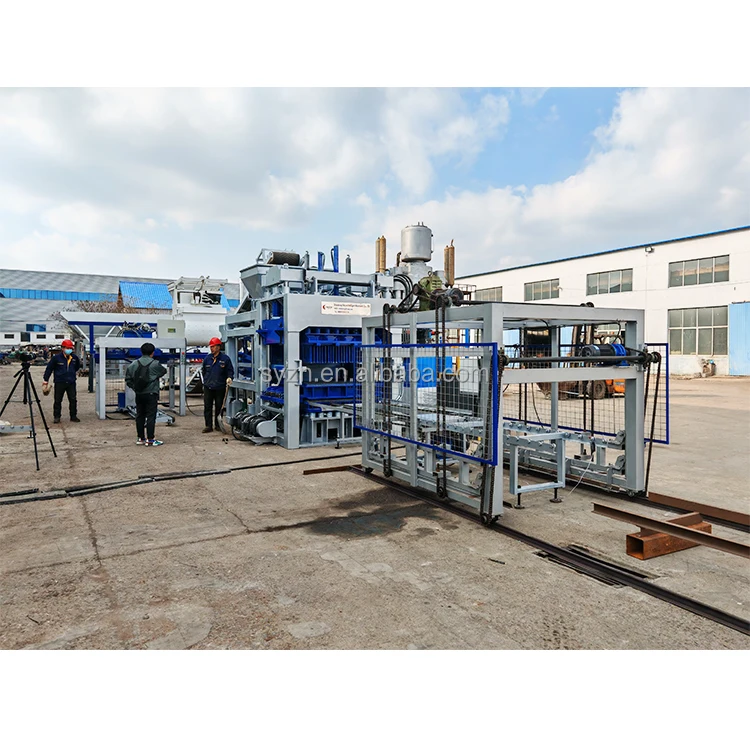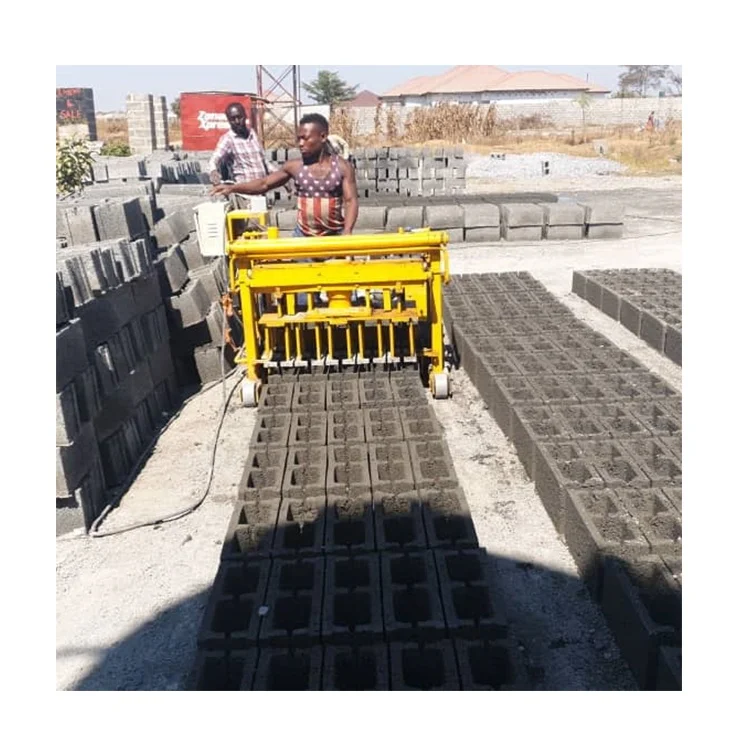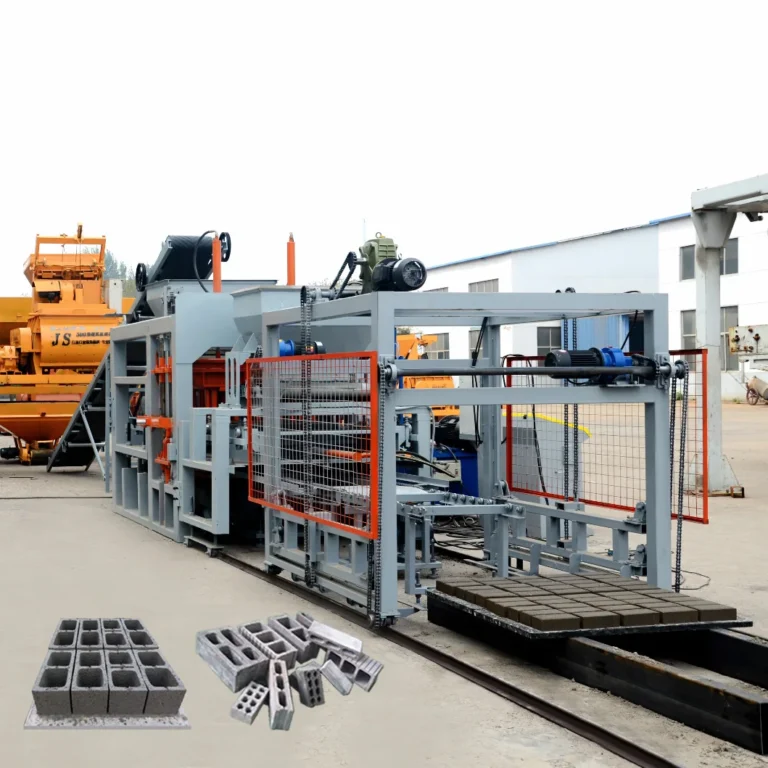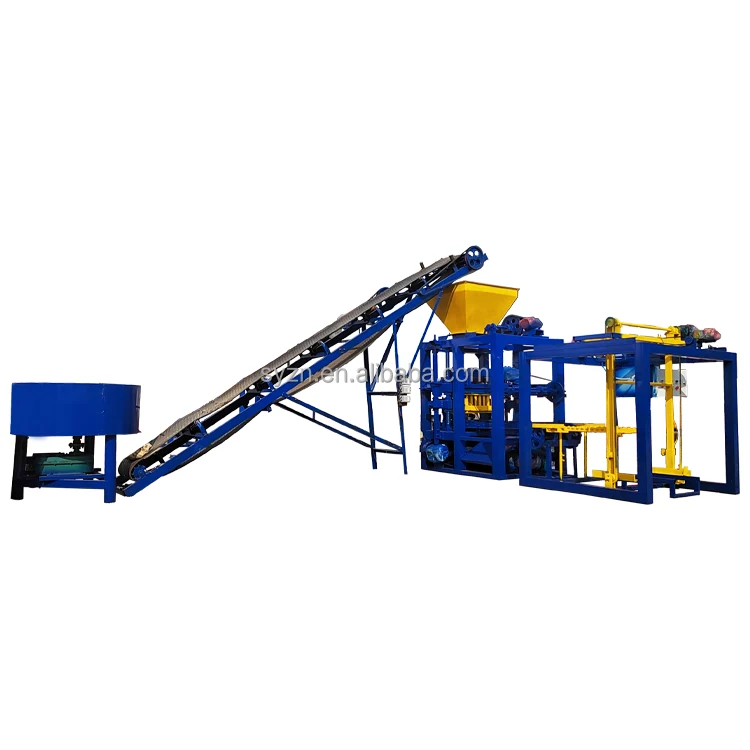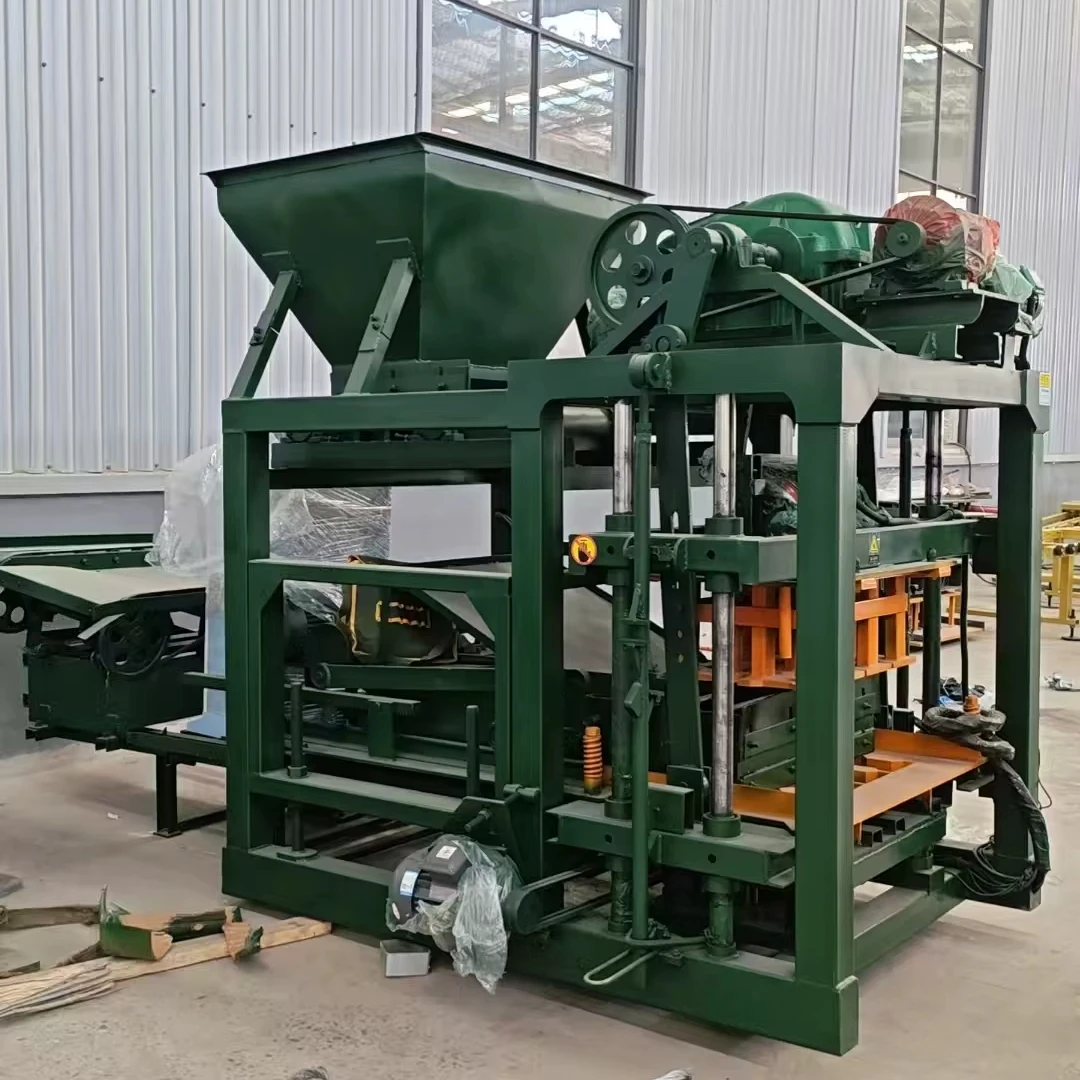


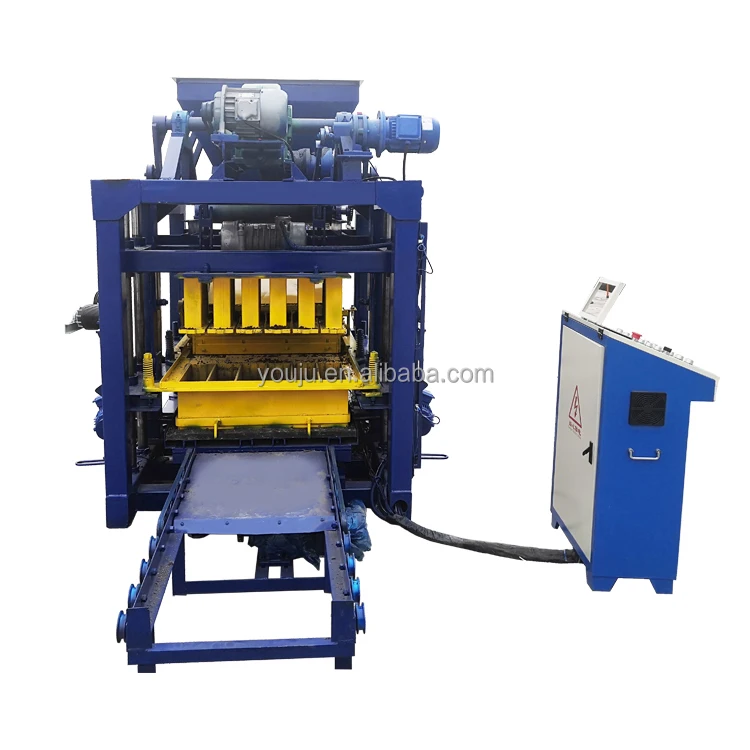

Description
Stocked readiness confirmed — QTJ4-25 units are assembled, factory-tested, and staged for container loading, so dispatch lead time can be written into the contract before you commit.
Technical Specifications
| Parameter | Value |
|---|---|
| Model | QTJ4-25 |
| Product Type | Semi-Automatic Concrete Block Making Machine |
| Rated Power | 17.9 kW |
| Overall Dimensions (L×W×H) | 6400×1500×2700 mm |
| Net Weight | 2500 kg |
| Moulding Cycle | 25 s (basis: 400×200×200 mm hollow block) |
| Output Capacity | 960 pcs/h, 7680 pcs/day (based on 400×200×200 mm hollow block, 4 pcs/mould) |
| Pallet Size | 850×550×20 mm |
| Vibration Frequency | 2800 r/min |
| Exciting Force | 60 kN |
| Configuration | Host machine 1 set, block mould 1 set, JQ350 mixer |
| Automation Level | Semi-automatic |
| Mould Format | Hollow, solid, paver, curbstone (mould changeable) |
| Hydraulic Station | Equipped (high pressure, stable operation) |
| Voltage & Frequency | Configurable to local grid (basis to be confirmed) |
| Control System | PLC or manual control (basis to be confirmed) |
| Certification | CE or other applicable (basis to be confirmed) |
Application Suitability
| Application | Material or Output |
|---|---|
| Hollow block production for housing and commercial builds | Crushed stone, sand, cement, water |
| Solid block manufacturing for load-bearing walls | Aggregate blend with cement binder |
| Paving block runs for driveways and walkways | Fine aggregate with pigment additives |
| Kerbstone forming for road and boundary edging | Coarse aggregate with high cement content |
| On-site production for development contractors | Locally sourced aggregate matched to mix design |
What "960 Pieces per Hour" Actually Means on the QTJ4-25 Block Making Machine in Stock Fast Delivery
The 960 pcs/h figure holds only when you are running 400×200×200 mm hollow blocks with the standard four-cavity mould.
Switch to a smaller solid block format and the pieces-per-cycle count changes, which shifts the daily total. I have watched buyers sign off on a headline capacity number, then discover on commissioning day that their actual product format runs at a different pace entirely. Before the QTJ4-25 block making machine in stock fast delivery leaves the factory, we confirm the exact block format you intend to produce and recalculate the cycle and daily output against that specific mould. [NEED_CITE: block format effect on cycle time and daily output]
Stocked Configuration and Dispatch Window
When a project deadline is tight, the gap between order confirmation and container departure matters more than any brochure spec. The QTJ4-25 block making machine in stock fast delivery is assembled and tested at the factory before the order is finalized, not built from scratch after payment arrives. Standard mould sets for hollow, solid, and paver formats are staged alongside the host machine, so the entire package can be loaded into a container within a confirmed dispatch window. This eliminates the multi-week production queue that custom-built machines typically require.
Container Loading and Arrival Estimate
A 2500 kg machine with a 6400 mm footprint does not simply roll into a container intact. The host frame is separated from the mixer and pallet sections, then secured against the container walls with timber bracing and steel straps. Before you place the order, we provide a written arrival estimate that covers factory release, inland transport, port handling, and sea transit to your destination. The QTJ4-25 block making machine in stock fast delivery is packed with the mould, JQ350 mixer, and a documented spare parts kit inside the same container, so nothing arrives on a second shipment weeks later. [NEED_CITE: container loading practices for heavy industrial machinery]
How Exciting Force, Hydraulic Pressure, and Pallet Size Shape Your Blocks
The 60 kN exciting force at 2800 r/min is what compacts the concrete mix inside the mould cavity. Without sufficient vibration, the block comes out with air pockets and weak edges. The hydraulic station adds downward pressure during the vibration phase, locking the aggregate particles into a dense matrix. These two forces must match your local aggregate gradation — a coarse crushed stone needs more vibration energy than a fine sand mix. The 850×550×20 mm pallet size determines how many blocks fit on your curing racks. If your existing forklift and curing area were sized for a different pallet dimension, you will spend weeks reorganizing the yard after the QTJ4-25 arrives.
The Real Cost of Skipping the Voltage Conversation
I once saw a semi-automatic block line sit idle for nine days at a site in Tanzania because the control panel was wired for a frequency the local grid did not supply. The contractor had confirmed voltage but never mentioned Hz. With the QTJ4-25, voltage and frequency must be locked in writing before the machine is released from stock. A PLC display in a language the operator cannot read adds another layer of delay. These are small details on paper, but they stop production completely when missed. [NEED_CITE: voltage and frequency standards by export market]
Why Buyers Source This Machine Here
Block machinery is the single focus of this operation, which means the QTJ4-25 is not assembled from mismatched components pulled from different factory floors. The host machine, mould, pallet, and JQ350 mixer are specified as a matched set, so cycle times align across every station. Mould design covers the hollow, solid, paver, and curbstone formats that local markets actually buy, and custom mould drawings are accepted when the standard range does not fit. Configuration is set against the buyer’s real mix design and local aggregate, not a generic catalogue default. Stock availability is confirmed in writing with a dispatch lead time attached, so project schedules are not built on guesswork. Factory test records and packing photographs are shared before the container door closes. [NEED_CITE: factory test documentation standards for concrete block machinery]
Documentation & Verification
- Capacity calculation sheet stating the block format and pieces-per-cycle assumed
- Machine specification sheet with hydraulic and electrical schematic for the QTJ4-25
- Mould drawing and format list covering hollow, solid, paver, and curbstone options
- Pallet specification confirming 850×550×20 mm dimensions and material grade
- Voltage, frequency, and control language confirmation signed before dispatch
- Factory test record with block sample output from the buyer’s target format
Installation, Commissioning & Support
- Foundation pad must support 2500 kg net weight across the 6400×1500 mm footprint
- Dedicated power circuit required for the 17.9 kW rated load at confirmed voltage
- Host machine, mixer, and pallet sections arrive separated and require on-site assembly
- First production run includes cycle timing verification against the buyer’s block format
- Operator training covers mould change procedure across all supplied formats
- Wear parts kit shipped inside the same container to cover initial replacement intervals
What to Include in Your Inquiry
Send the exact block formats you plan to produce, including dimensions and target daily volume. Confirm your local grid voltage, frequency, and the language your operators need on the control display. If you already have curing racks, pallets, or a forklift on site, share the dimensions so we can verify compatibility with the 850×550 mm pallet size before the machine ships.
Frequently Asked Questions
Q: Is the QTJ4-25 currently in stock and what is the dispatch lead time?
A: QTJ4-25 units are assembled and staged at the factory with standard mould sets for hollow, solid, and paver formats. Dispatch lead time is confirmed in writing at the quotation stage and covers factory release through container loading. Typical readiness runs from immediate to a short preparation window depending on current stock rotation and the mould configuration you select.
Q: How is the machine dismantled and loaded into a container for shipment?
A: The host frame is separated from the JQ350 mixer and pallet handling sections to fit within a standard container. Components are secured with timber bracing and steel strapping. Moulds, the spare parts kit, and documentation are packed inside the same container so the complete line arrives on a single shipment.
Q: What arrival estimate can I expect from order to port of destination?
A: An arrival estimate is provided before the order is confirmed. It covers factory release, inland transport to port, ocean transit, and estimated arrival at your destination port. The estimate is based on current shipping schedules and is updated if vessel bookings shift after dispatch.
Q: Are standard moulds included in stock or made to order?
A: Standard moulds for 400×200×200 mm hollow blocks and common solid and paver formats are kept alongside stocked machines. Custom moulds built to buyer drawings follow a separate production lead time. The quotation states clearly which moulds are from stock and which require a build cycle.
Q: Can voltage and control language be confirmed before the machine ships?
A: Voltage, frequency, and PLC display language must be confirmed in writing before the machine is released from stock. This step is built into the dispatch checklist so the machine arrives wired for the correct grid and the operator can read every screen prompt on day one.