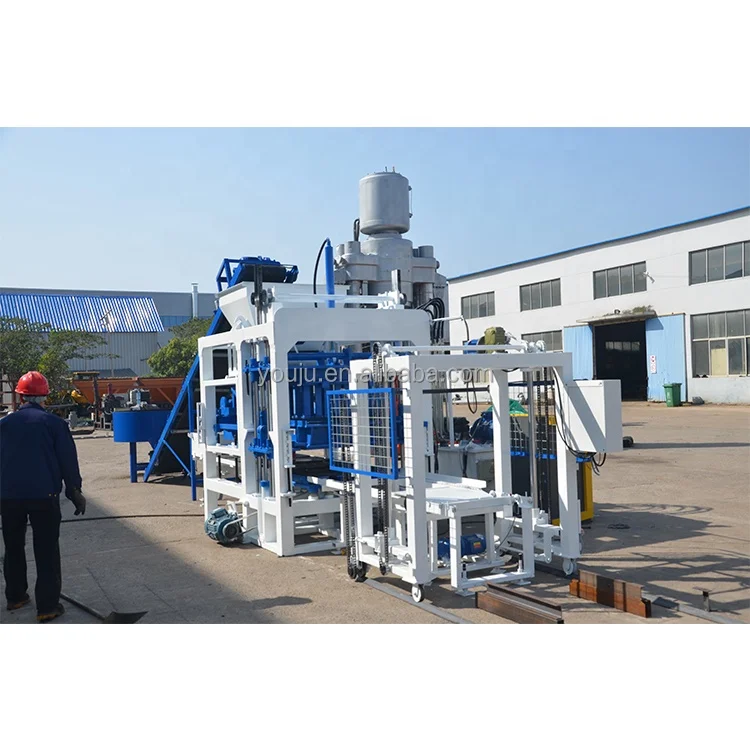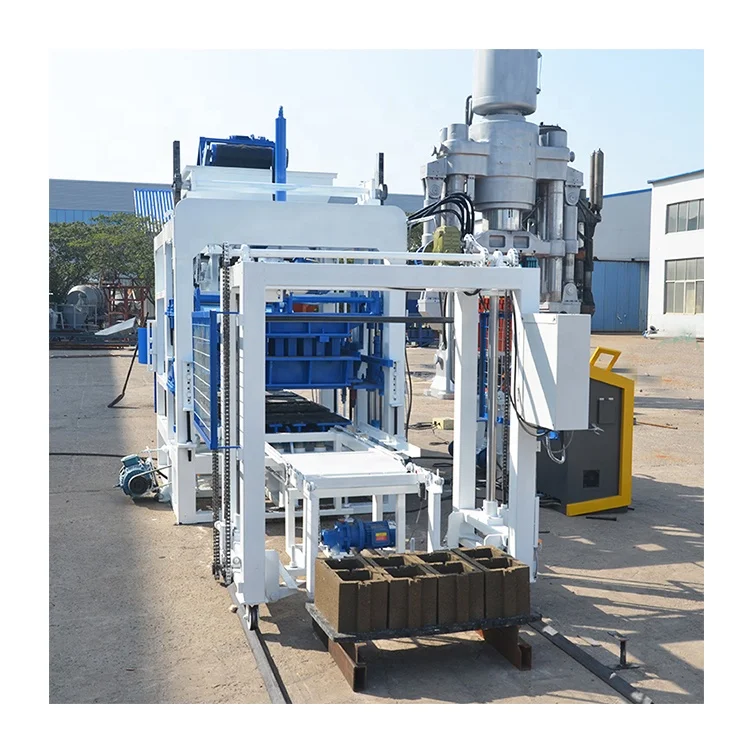
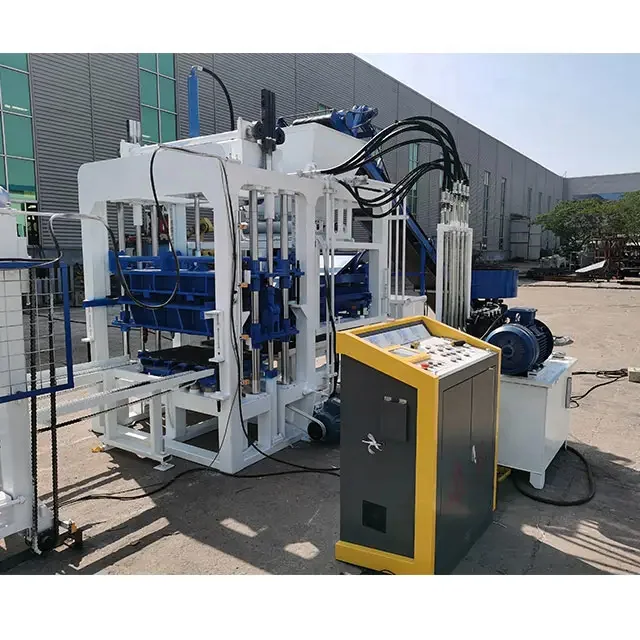
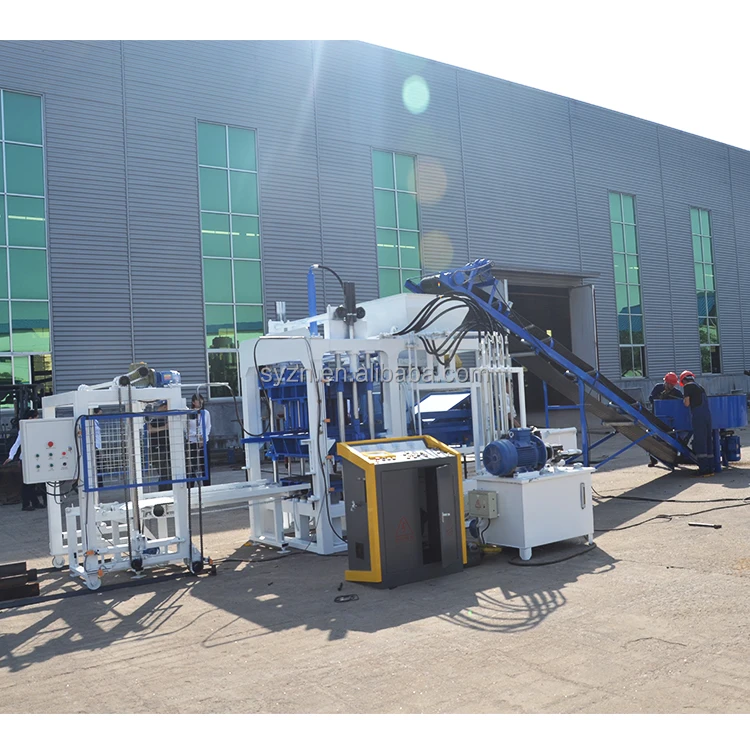
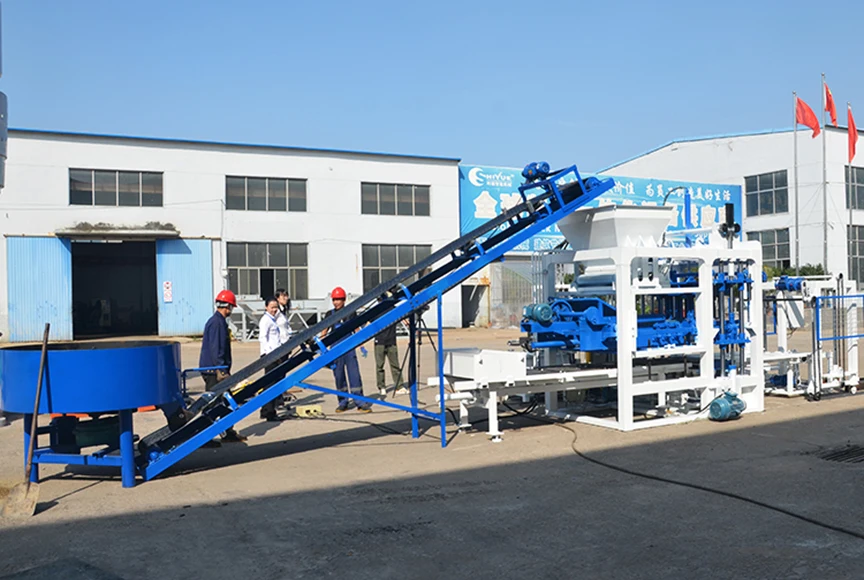
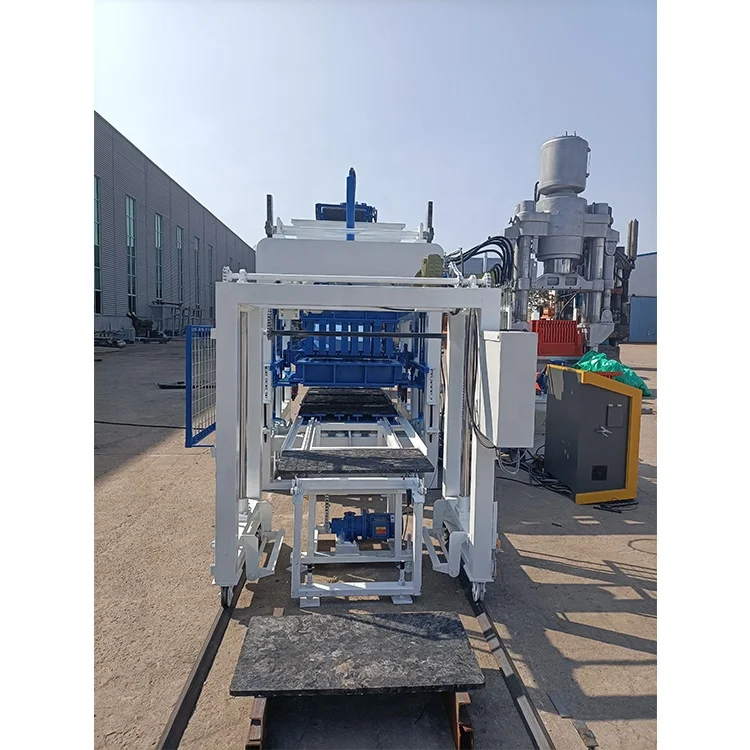
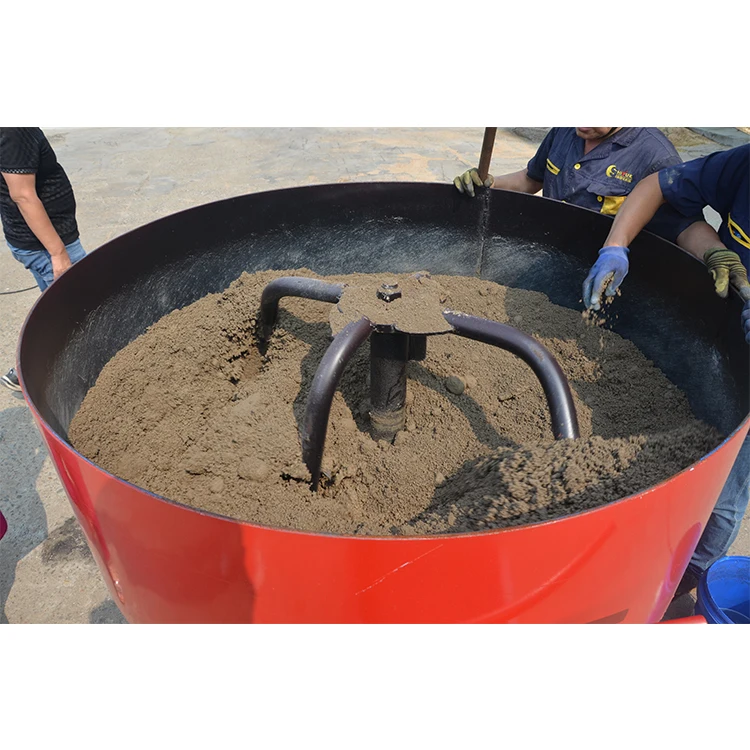
Description
Stock-to-port coordination — every QT4-18 unit is verified against the buyer’s pallet size, curing layout and forklift tonnage before the container is sealed, so the machine you receive fits your site on day one.
Technical Specifications
| Parameter | Value |
|---|---|
| Model | QT4-18 |
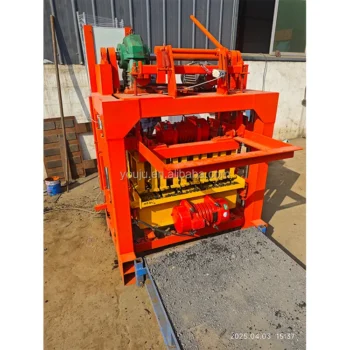
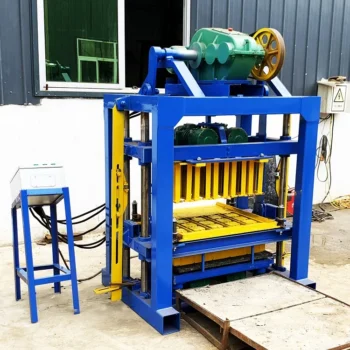
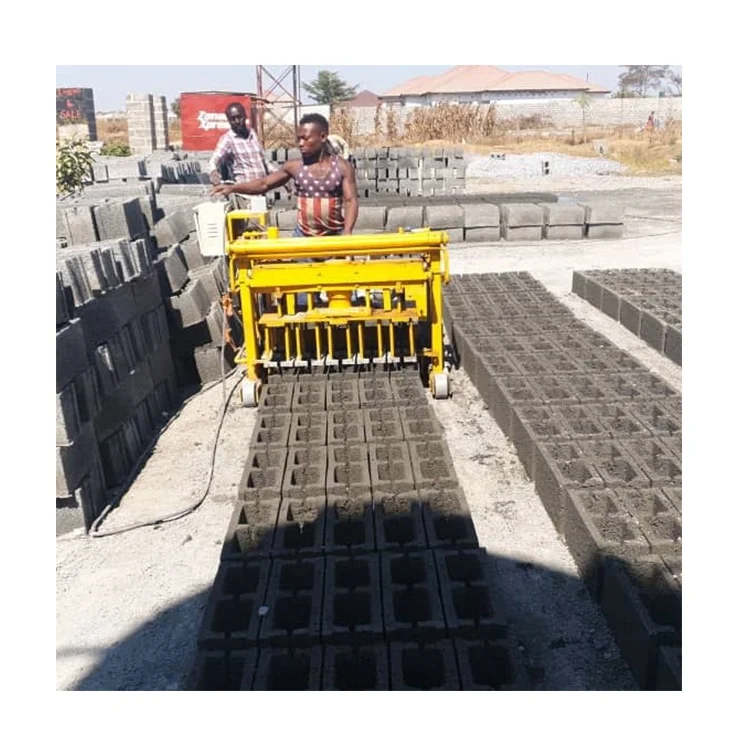
| Product Type | Automatic Concrete Block Making Machine |
| Rated Power | 27.5 kW |
| Voltage & Frequency | Configurable to buyer’s local supply |
| Control System | Full automatic PLC |
| Overall Dimensions | 7100 × 1600 × 2610 mm |
| Net Weight | 5800 kg |
| Moulding Cycle | 15–25 seconds (basis not stated in source) |
| Hydraulic Pressure | 20 MPa |
| Main Vibration Form | Platform Vibration |
| Theoretical Output — Hollow Block | 5760–7680 pcs/day (400×200×200 mm, 4 pcs/mould, 8-hour shift, basis to be confirmed) |
| Theoretical Output — Porous Block | 25200–33600 pcs/day (240×115×90 mm, 14 pcs/mould, 8-hour shift, basis to be confirmed) |
| Theoretical Output — Standard Block | 59300–67200 pcs/day (240×115×53 mm, 28 pcs/mould, 8-hour shift, basis to be confirmed) |
| Mould Types Supported | Hollow block, porous block, standard block, color-face brick, interlocking block, road curb brick |
| Mould Treatment | Precise line cutting with carburizing and heat treatment |
| Machine Frame | Welded thick steel rectangle construction |
| Key Features | Platform vibration, full automatic cycle, interchangeable mould set |
Application Suitability
| Application | Material or Output |
|---|---|
| Hollow block production for load-bearing walls | Crushed stone, cement, sand aggregate |
| Porous brick manufacturing for partition walls | Lightweight aggregate, fly ash blends |
| Standard solid brick for masonry | Cement, sand, quarry dust |
| Interlocking paver for walkways and yards | Crushed granite, cement, color pigment |
| Road curb stone for municipal infrastructure | Dense aggregate, cement |
| Color-face brick for façade applications | Surface layer pigment, base aggregate |
Why the Shipping Date Matters More Than the Cycle Time
When a project deadline is fixed, the QT4-18 block making machine in stock fast delivery promise only holds if every accessory — pallets, moulds, hydraulic spares — ships in the same container. [NEED_CITE: construction project delay penalties in international contracts]
I have watched a container arrive at port with the right machine and the wrong pallet dimensions. The buyer’s forklift could not slide under the stacks, and two days of on-site welding followed before production started. That delay had nothing to do with the press itself. Dispatch coordination is where project timelines are actually won or lost, and that is the layer this page addresses.
Container Loading and Dismantling for Transit
The QT4-18 block making machine in stock fast delivery option ships partially dismantled so the main frame, hydraulic station, and mould rack fit within a standard 40-foot container. Each sub-assembly is bolted rather than welded for field reconnection, which keeps on-site reassembly to a matter of days rather than weeks. The pallet stack is loaded vertically against the container wall to prevent warping during ocean transit.
What "In Stock" Actually Means at Dispatch
A machine listed as available must still pass a factory test run against the buyer’s requested block format before crating. Mould fit, hydraulic pressure holding at 20 MPa, and PLC cycle logic are each verified. [NEED_CITE: standard pre-shipment inspection procedures for heavy machinery exports] Only after that test does the unit move to the packing bay. Stock availability therefore refers to a machine physically present and testable, not simply a frame on the floor waiting for components.
How Hydraulic Pressure and Vibration Shape Block Density
The 20 MPa hydraulic pressure works in concert with platform vibration to compact aggregate into a consistent matrix. Higher pressure alone would leave air pockets; vibration alone would produce a weak surface finish. Together they deliver blocks that meet compressive strength expectations for the buyer’s local standard. The thick steel rectangle welded frame resists the repeated vibration load shift after shift, preventing the frame fatigue that causes misalignment in lighter constructions. Carburized moulds hold their dimensional tolerance through extended runs, so a hollow block produced on day one matches one produced in month six.
The Hidden Cost of Overlooking Pallet and Forklift Compatibility
Choosing a pallet size without checking the curing rack spacing and forklift tine width leads to double-handling once the machine arrives. Blocks stacked by hand because the forklift cannot reach the curing area add labor and slow the curing cycle. [NEED_CITE: manual handling injury rates in concrete product plants] Voltage mismatches between the 27.5 kW rated power and the site supply can stall commissioning entirely until a transformer is sourced locally. These are not machine defects — they are specification gaps that turn a fast delivery into a slow start.
Why Buyers Source This Machine Through This Channel
Block machinery is the single focus here, so the QT4-18 is specified as part of a matched system — press, mould, pallet, and handling — rather than assembled from unrelated suppliers. Configuration is set against the buyer’s actual mix design and local aggregate, not a catalogue default. Mould design covers the formats the buyer’s market sells, with custom drawings available. Automation level is selectable, allowing a semi-automatic start with a path to full stacking and cubing later. Installation support includes operator training so the crew is productive from the first shift.
Documentation & Verification
- Line layout and capacity calculation stating the block format assumed for the QT4-18
- Machine specification sheet covering hydraulic, electrical, and dimensional data
- Mould drawing and format list for every cavity ordered
- Factory test record run on buyer’s target block format before crating
- Packing photographs documenting each sub-assembly inside the container
- Customs documentation package aligned with destination country requirements
Installation, Commissioning & Support
- Foundation must accommodate the 7100 × 1600 mm footprint with leveled anchor points
- Dedicated electrical circuit sized for the 27.5 kW rated power at confirmed local voltage
- Machine arrives partially dismantled; on-site reassembly covers frame, hydraulic station, and mould rack
- First production run verifies 20 MPa hydraulic pressure holding and PLC cycle logic
- Operator training covers mould change procedure and daily lubrication schedule
- Wear parts list identifies hydraulic seals and mould inserts for first reorder
Before You Request a Quote
To move quickly on a QT4-18 dispatch, share the block formats your market requires, the daily volume your project contract specifies, and the curing area dimensions at your site. Confirm your local voltage, frequency, and preferred PLC display language so the control cabinet is wired correctly before it leaves the factory. If you have existing pallets or forklifts, note their dimensions so the pallet specification aligns on arrival.
Frequently Asked Questions
Q: Is the QT4-18 currently in stock, and what is the dispatch lead time?
A: Units are held in the warehouse and can undergo a factory test run against your requested block format before crating. Dispatch lead time covers that test, dismantling, container loading, and customs paperwork. The exact window depends on the mould set and pallet configuration you confirm at order stage.
Q: How is the machine dismantled and loaded into a container for shipment?
A: The main frame, hydraulic station, and mould rack are unbolted into sub-assemblies sized for a standard 40-foot container. Pallets are stacked vertically to prevent warping. Each component is photographed in position before the container doors close, and those images are shared with the buyer.
Q: What is the estimated arrival time from order to destination port?
A: Ocean transit time depends on the destination port and current shipping schedules. An arrival estimate is quoted at the order stage once the loading port and destination are confirmed, so you can plan site preparation and crew mobilization around a known date.
Q: Are standard moulds stocked alongside the machine?
A: Hollow block and interlocking paver moulds are typically available from inventory. Custom moulds — such as specific road curb profiles or non-standard porous brick dimensions — require a production run. Confirming your format list early keeps the machine and moulds on the same shipping schedule.
Q: What customs documentation is provided to support import clearance?
A: Each shipment includes a commercial invoice, packing list, bill of lading, and certificate of origin where applicable. A CE declaration is available for markets that require it. Packing photographs and the factory test record are included so your clearing agent has complete technical documentation on hand.