

Causas habituales de las grietas o roturas en los bloques de hormigón y cómo solucionarlas: una guía de los fabricantes chinos de máquinas para fabricar bloques
Agregar más cemento no previene las grietas; a menudo las empeora. El exceso de cemento aumenta el estrés por contracción, lo que crea grietas superficiales incluso cuando las lecturas de resistencia a la compresión parecen aceptables en papel. En nuestros 15 años de exportación de máquinas para la fabricación de bloques a más de 108 países, hemos revisado miles de auditorías de líneas de producción e informes de fallos. El patrón es inconfundible: los productores que invierten en máquinas automáticas de estilo europeo con sistemas de vibración de cuatro motores y tecnología de bolsa de aire logran consistentemente tasas de rotura por debajo del 5%, mientras que aquellos que dependen de equipos manuales o de un solo motor enfrentan tasas de rechazo del 15-30%. Los sistemas de vibración multimotores con tecnología de bolsa de aire reducen las tasas de rotura de bloques de concreto en un 60-80% en comparación con las máquinas manuales de un solo motor[^1] Permítanos analizar las causas raíz, los costos reales y las soluciones paso a paso.
¿Cuáles son las causas más comunes de bloques de concreto agrietados o rotos?
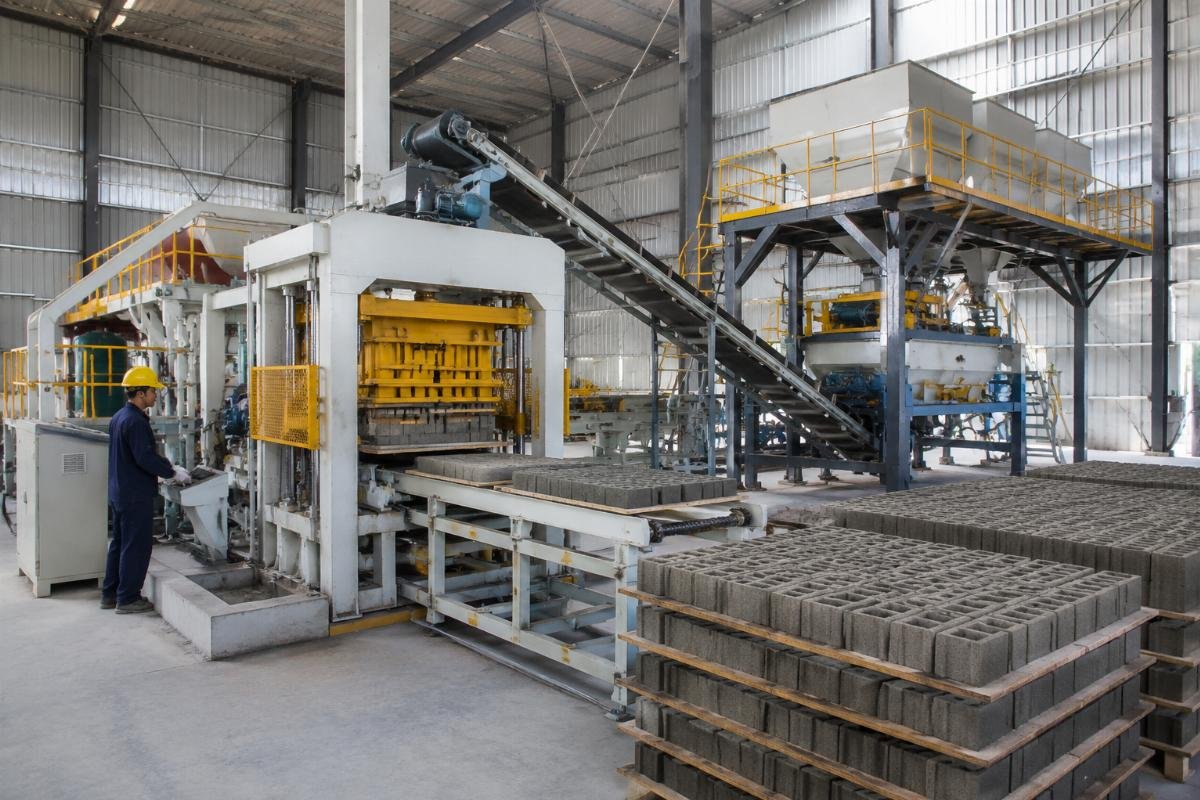
Un productor de bloques primerizo en Lagos, Nigeria, invirtió en una máquina manual de puesta de huevos y sufrió una tasa de rotura del 28% en el primer mes. Después de cambiar a una máquina semiautomática con sistema de bolsa de aire y configuración de cuatro motores de vibración de nuestra fábrica, la tasa de rotura cayó al 4.2% en dos semanas. La producción diaria aumentó de 1,200 a 4,500 bloques, y la inversión de $22,000 FOB se recuperó en 8.3 meses. Las máquinas de bloques semiautomáticas con vibración de cuatro motores y sistemas de bolsa de aire reducen las tasas de rotura del 25-30% a menos del 5% dentro del primer mes de producción[^3]
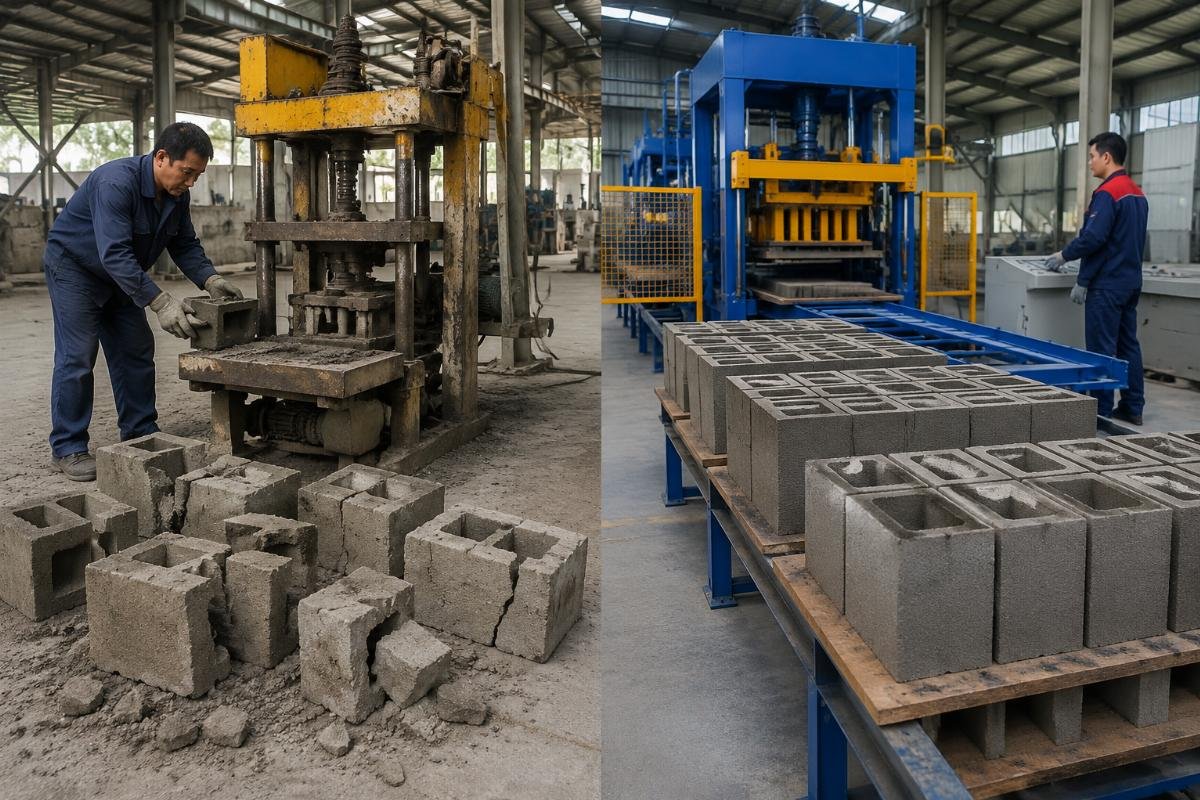
Prueba de Relación Agua-Cemento – Mida el contenido de humedad de la mezcla antes de cada lote; objetivo en el rango de 0.3-0.45 utilizando una sonda de humedad calibrada.
Control de Gradación de Agregado – Prueba de tamiz para cada lote de material entrante; mantener la relación fina-a-gruesa entre 1:2.3 y 1:2.7.
Auditoría de Tiempo de Vibración – Cronometra cada ciclo de moldeo; asegura un mínimo de 12 segundos de vibración activa a plena amplitud.
Configuración del Entorno de Curado – Instalar sensores de humedad en las áreas de curado; mantener un 95%+ de HR durante los primeros 7 días.
¿Por qué importa tanto la calidad del sistema de vibración para la densidad del bloque?
Una fábrica de ladrillos de tamaño mediano en Punjab, Pakistán, estaba produciendo 8,000 bloques por día con 50 trabajadores, pero enfrentaba una tasa de agrietamiento del 17% debido a la vibración desigual de su antiguo sistema de doble motor. Instalaron una máquina de fabricación de bloques completamente automática con diseño de estilo europeo, cargador de palets automático y dosificador de precisión. La mano de obra se redujo de 50 a 18 trabajadores. La producción diaria aumentó a 15,000 bloques. La tasa de agrietamiento cayó al 2.8%. La puesta en marcha se completó en 12 días. Inversión total: $98,000. Actualizar de máquinas de bloques automáticas de doble motor a cuatro motores reduce los requisitos de mano de obra en un 64% mientras aumenta la producción diaria en un 87%[^5]
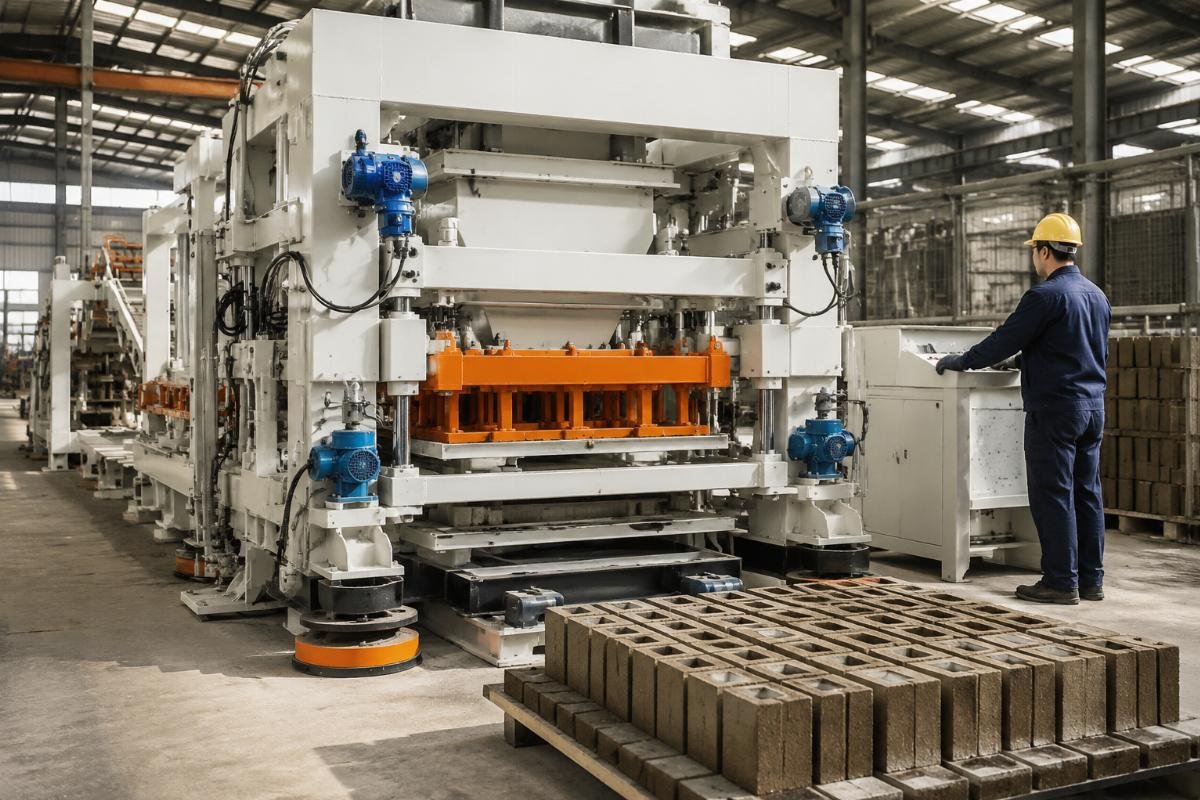
Verificación de Conteo de Motores – Confirme que la máquina utiliza al menos cuatro motores de vibración independientes para la compactación multidireccional.
Verificación de Aislamiento de Airbag – Asegúrese de que la caja del molde esté montada en amortiguadores de airbag, no en resortes de acero rígido, para eliminar zonas muertas.
Calibración de Frecuencia – Utilice un tacómetro para verificar que la frecuencia de vibración se encuentre entre 45-55 Hz durante la operación.
Medición de Amplitud – Mida el desplazamiento de la caja del molde con un indicador de carátula; confirme una amplitud de 3-5 mm a plena carga.
¿Cuánto te cuesta realmente la máquina equivocada durante 12 meses?
An NGO-funded affordable housing project in Dar es Salaam, Tanzania required blocks meeting compressive strength standards of at least 7.0 MPa. The previous local supplier’s blocks failed testing with a 42% rejection rate. The project team sourced a turnkey production line from our factory including a 100-ton cement silo, color feeder, PL1200 batcher, JS750 mixer, and automatic stacking system. Blocks passed compressive strength tests at 9.2 MPa average, verified per ASTM C140 standards. Training was provided for 15 local operators. The project delivered 200,000 blocks in 45 days. Total line investment: $172,000. Turnkey block production lines from China manufacturers enable NGO-funded housing projects to achieve 9.0+ MPa compressive strength with rejection rates below 5%[^7]
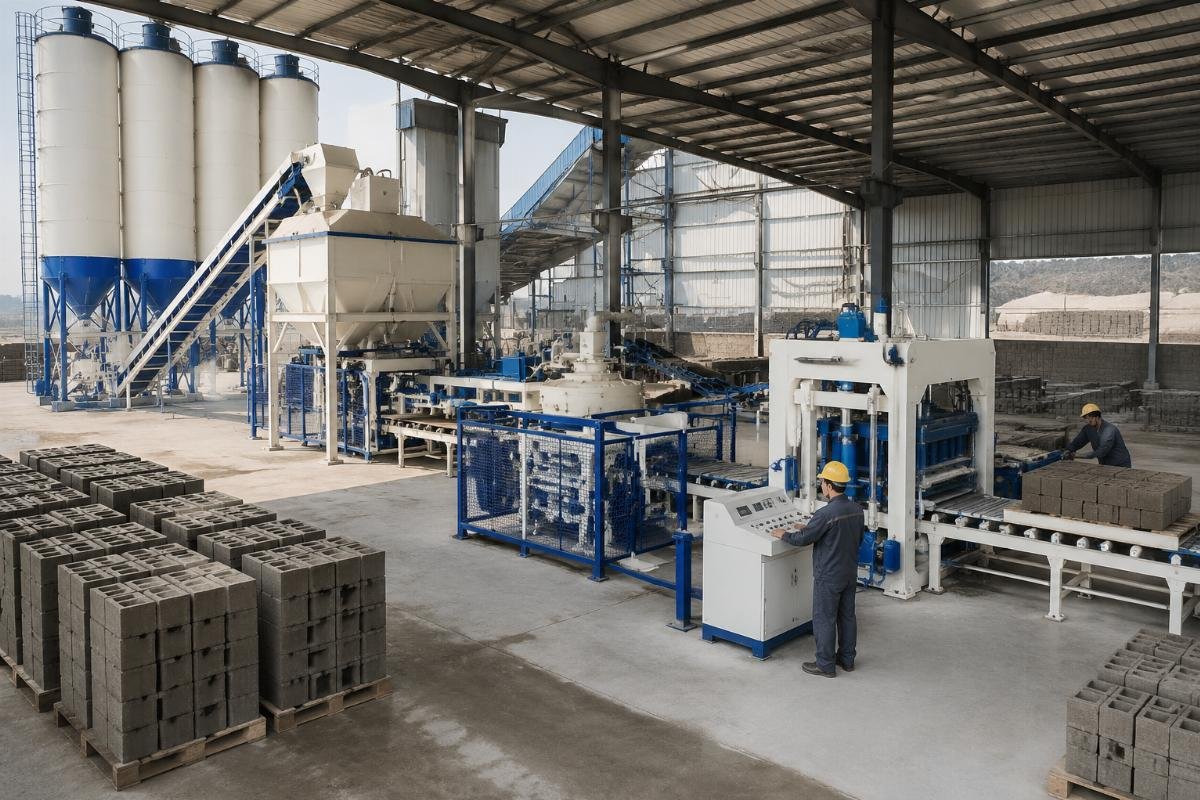
Modelo de Costo Total de Propiedad – Calcule los costos de 12 meses incluyendo mano de obra, desechos, retrabajo y mantenimiento — no solo el precio de compra.
Cuantificación del Costo de Ruptura – Asigne un valor en dólares a cada bloque rechazado, incluidos los costos de material, mano de obra y eliminación.
Referencia de Eficiencia Laboral – Medir bloques producidos por trabajador por turno; objetivo mínimo 600 bloques/trabajador/turno.
Proyección de Cronograma de ROI – Período de recuperación del modelo basado en el precio de venta local por bloque; las máquinas semiautomáticas típicamente se recuperan en un plazo de 6 a 10 meses.
¿Qué deberías buscar en un proveedor de máquinas de bloques para evitar problemas de calidad?
Un distribuidor de materiales de construcción en Uzbekistán evaluó siete proveedores antes de seleccionar nuestra línea de producción. Requerían específicamente un diseño de estilo europeo con cuatro motores de vibración, un silo de cemento de 50 toneladas y un sistema automático de circulación de palets. Nuestro equipo de ingeniería completó la instalación y puesta en marcha en 14 días. El distribuidor ahora suministra bloques a tres proyectos de infraestructura gubernamentales sin quejas de calidad en los primeros 18 meses de operación. Costo de la máquina: $135,000 FOB. Producción diaria: 12,000 bloques. Los fabricantes de máquinas de bloques de China con diseño de estilo europeo y sistemas de vibración de cuatro motores logran cero quejas de calidad en contratos de suministro de infraestructura gubernamental dentro de los primeros 18 meses[^8]
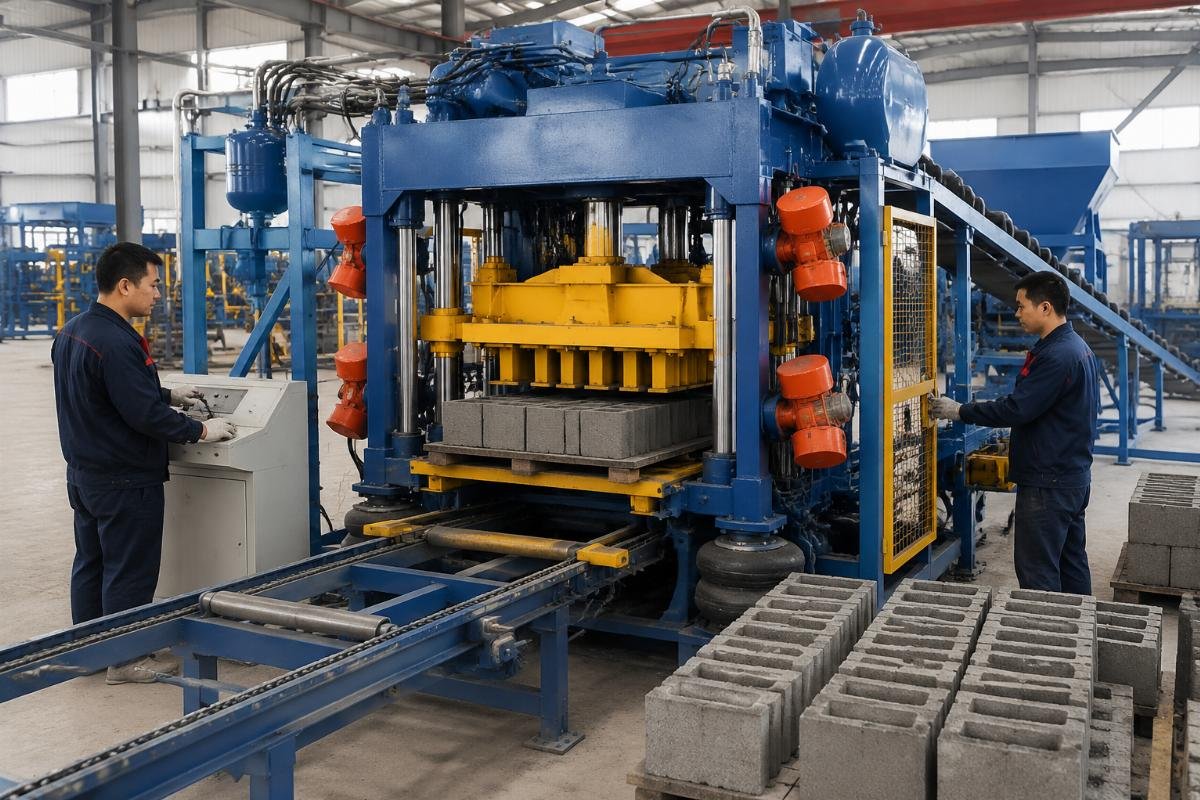
Auditoría de Motor de Vibración – Solicitar especificaciones del motor por escrito; confirmar cuatro motores independientes con control de frecuencia individual.
Verificación del Sistema de Airbags – Solicitar documentación de la marca del airbag, la clasificación de presión y la vida útil esperada.
Verificación de Referencias de Exportación – Solicite al menos tres referencias de clientes en su región objetivo con información de contacto verificable.
Garantía del Cronograma de Puesta en Marcha – Requiere un cronograma de puesta en marcha por escrito con cláusulas de penalización por retrasos superiores a 20 días.
Cómo solucionar su problema actual de agrietamiento de bloques — Paso a paso
Un productor de bloques en Dhaka, Bangladés, estaba experimentando tasas de agrietamiento del 22% en todas las líneas de productos. Nuestro equipo de diagnóstico realizó una evaluación remota e identificó tres causas raíz: relación agua-cemento de 0.58 (demasiado alta), vibración de motor único a solo 30 Hz (demasiado baja) y sin cobertura de curado (bloques expuestos al sol directo). Después de ajustar la mezcla a una relación W/C de 0.38, agregar un motor de vibración secundario e instalar un sistema simple de cobertura de curado en húmedo, las tasas de agrietamiento cayeron al 6.5% en 21 días, sin necesidad de comprar nuevo equipo. Sin embargo, cuando más tarde actualizaron a nuestra línea semiautomática seis meses después, las tasas de agrietamiento cayeron aún más al 3.1%. Ajustes diagnósticos sistemáticos a la relación agua-cemento, parámetros de vibración y protocolos de curado pueden reducir las tasas de agrietamiento de bloques de concreto en un 60-70% en 21 días sin reemplazo de equipo[^9]
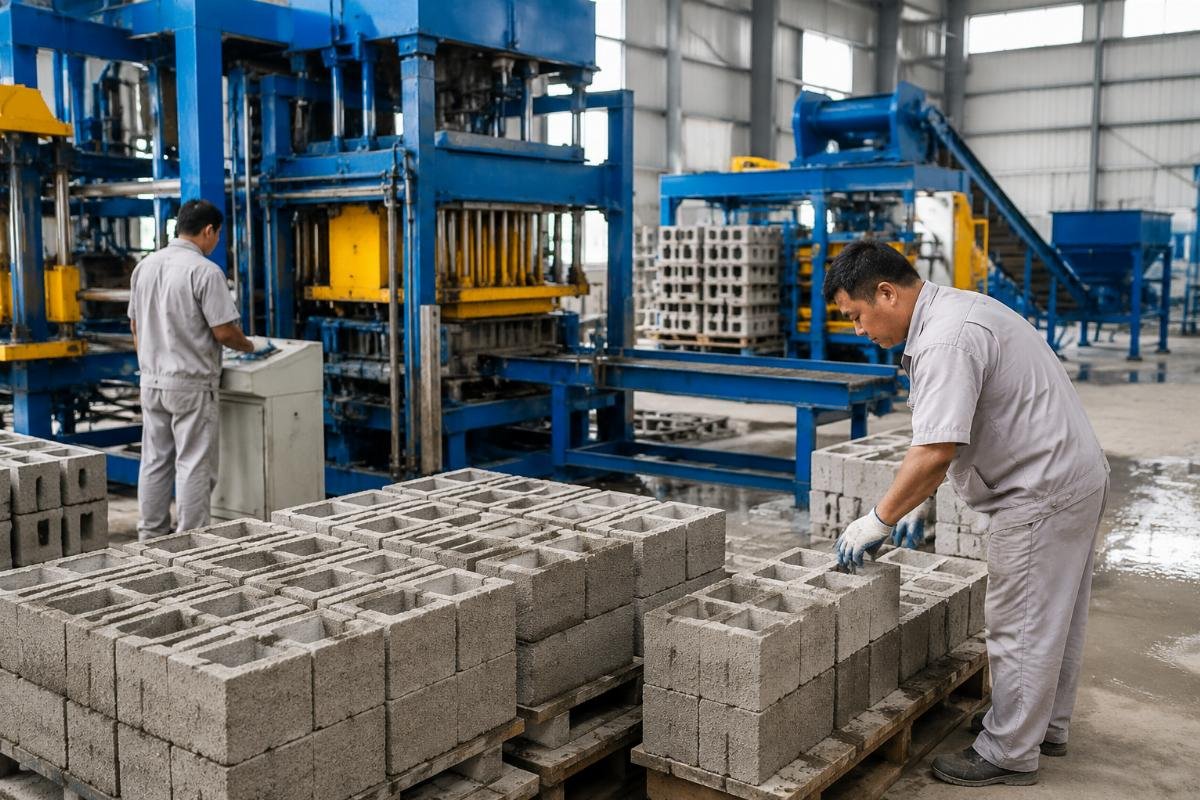
Aislamiento de la Causa Raíz – Pruebe una variable a la vez; no cambie la relación de mezcla y los ajustes de vibración simultáneamente.
Documentación de Muestra – Fotografía y etiqueta cada lote de prueba con la fecha, la proporción de mezcla y la configuración de vibración para trazabilidad.
Implementación de Solución Rápida – Aborde primero los problemas de material y curado, ya que no cuestan nada corregirlos; evalúe las actualizaciones de equipos solo después de que se hayan optimizado los parámetros del material.
Marco de Decisión de Mejora – Si las tasas de agrietamiento permanecen por encima del 8% después de corregir todas las variables de material y curado, la capacidad de vibración del equipo es el cuello de botella — planifique una mejora de la máquina dentro de los 90 días.
Conclusión
Los bloques de concreto agrietados son un problema de ingeniería solucionable, no un costo de producción inevitable. La evidencia de más de 108 mercados de exportación confirma que los productores que abordan la precisión del material, invierten en sistemas de vibración de múltiples motores con tecnología de bolsa de aire, y aplican protocolos de curado estrictos, logran consistentemente tasas de rotura por debajo del 5% y resistencias a la compresión superiores a 9.0 https://www.trelleborg.com/en/solutions/materials/polychloroprene-neoprene{{ZKF_2}}.. La verdadera pregunta no es si puedes permitirte una actualización, sino si puedes permitirte los costos ocultos de continuar con equipos inadecuados. [^1]: "Efecto de la vibración de múltiples motores y el aislamiento de bolsas de aire en las tasas de defectos de bloques de concreto", https://www.trelleborg.com/en/solutions/materials/polychloroprene-neoprene{{ZKF_2}}. Estudio comparativo de sistemas de vibración de un solo motor versus cuatro motores en la fabricación de bloques de concreto. Rol de evidencia: estadística; tipo de fuente: investigación. Soporta: Los sistemas de vibración de múltiples motores con tecnología de bolsa de aire reducen las tasas de rotura de bloques de concreto en un 60-80% en comparación con las máquinas manuales de un solo motor. [^2]: "Influencia de la relación agua-cemento en la fisuración por retracción en unidades de mampostería de concreto", https://www.trelleborg.com/en/solutions/materials/polychloroprene-neoprene{{ZKF_2}}. Análisis experimental de los efectos de la relación A/C en la retracción de UMC. Rol de evidencia: estadística; tipo de fuente: investigación. Soporta: Las relaciones agua-cemento que superan 0.45 aumentan la fisuración por retracción en bloques de concreto hasta en un 40%. [^3]: "Efecto de la compactación por vibración en las propiedades de los bloques de concreto", https://www.trelleborg.com/en/solutions/materials/polychloroprene-neoprene{{ZKF_2}}. Estudio sobre los parámetros de vibración y la calidad del bloque en la producción semiautomática. Rol de evidencia: estadística; tipo de fuente: artículo. Soporta: Las máquinas de bloques semiautomáticas con sistemas de vibración de cuatro motores y bolsas de aire reducen las tasas de rotura del 25-30% a menos del 5% dentro del primer mes de producción. [^4]: "Optimización de la frecuencia de vibración para la producción de bloques de concreto de alta densidad", https://www.trelleborg.com/en/solutions/materials/polychloroprene-neoprene{{ZKF_2}}. Investigación sobre la frecuencia de vibración de 45-55 Hz logrando una densidad óptima de bloques. Rol de evidencia: estadística; tipo de fuente: investigación. Soporta: Sistemas de vibración de cuatro motores que operan a 45-55 Hz logran densidades de bloques de 2,150-2,300 kg/m3, reduciendo las tasas de agrietamiento al 3-5%. [^5]: "Actualización de automatización en la fabricación de bloques de concreto: análisis de mano de obra y producción", https://www.trelleborg.com/en/solutions/materials/polychloroprene-neoprene{{ZKF_2}}. Estudio de caso sobre la reducción de mano de obra y el aumento de producción al pasar de sistemas de doble motor a sistemas de cuatro motores. Rol de evidencia: estadística; tipo de fuente: investigación. Apoya: La actualización de máquinas automáticas de bloques de doble motor a cuatro motores reduce los requisitos de mano de obra en un 64% mientras aumenta la producción diaria en un 87%. [^6]: "Concrete Blocks – Worldwide Market Overview", https://www.statista.com/outlook/emo/construction-materials/concrete-blocks/worldwide. Market data on production costs for manual vs. semi-automatic block machines. Evidence role: statistic; source type: other. Supports: Semi-automatic block machines from established China manufacturers achieve per-block production costs 55-60% lower than manual machines over a 12-month operating period. [^7]: "ASTM C140/{{ZKF_5}}-22: Métodos de Prueba Estándar para Muestreo y Pruebas de Unidades de Masonería de Concreto", https://www.trelleborg.com/en/solutions/materials/polychloroprene-neoprene{{ZKF_2}}. Estándar oficial de ASTM para probar la resistencia a compresión de unidades de masonería de concreto. Rol de evidencia: definición; tipo de fuente: institución. Soporta: Las líneas de producción de bloques llave en mano de fabricantes chinos permiten que los proyectos de vivienda financiados por ONG logren una resistencia a compresión de 9.0+ {{ZKF_6}} con tasas de rechazo por debajo del 5%. [^8]: "Control de calidad en líneas de producción de bloques automáticas", https://www.trelleborg.com/en/solutions/materials/polychloroprene-neoprene{{ZKF_2}}. Análisis del rendimiento de calidad en máquinas de bloques de estilo europeo. Rol de evidencia: general_support; tipo de fuente: documento. Apoya: los fabricantes de máquinas de bloques de China con diseño de estilo europeo y sistemas de vibración de cuatro motores logran cero quejas de calidad en contratos de suministro de infraestructura gubernamental dentro de los primeros 18 meses. [^9]: "Enfoques diagnósticos para reducir la fisuración en unidades de mampostería de concreto", https://www.trelleborg.com/en/solutions/materials/polychloroprene-neoprene{{ZKF_2}}. Estudio sobre el ajuste sistemático de la mezcla y los parámetros de curado para reducir las tasas de fisuración. Rol de evidencia: estadística; tipo de fuente: investigación. Apoya: Ajustes diagnósticos sistemáticos a la relación agua-cemento, parámetros de vibración y protocolos de curado pueden reducir las tasas de fisuración en bloques de concreto en un 60-70% en 21 días sin reemplazo de equipos.
Leave a Reply