

QT10-15 Brick Machine Price in Peru: Factory Wholesale Supplier 2026
The host machine quote is never the final landing cost in Peru.
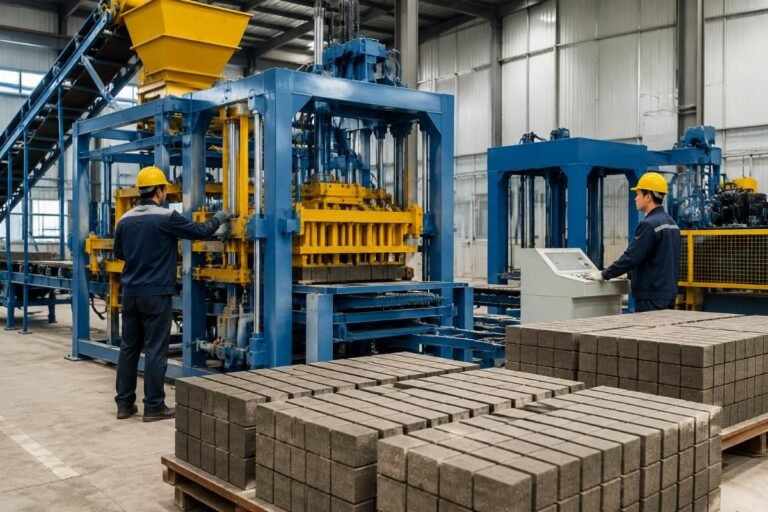
In 2026, a complete QT10-15 brick machine price in Peru for a turnkey automatic line typically sits in the mid-six-figure USD range CIF Callao, while semi-auto QT6-15 configurations land in the low five figures. The real spread is driven not by the steel itself, but by voltage stabilization, raw-material preprocessing, mould customization, and on-site commissioning — four hidden cost blocks that quietly eat up a large share of the total investment.
I still remember a call from a private block plant owner in Lima. He had ordered a standard-configuration line, and within the first week the main mixer motor burned out twice. The local grid in his industrial zone was fluctuating far beyond what a generic control panel could absorb. We later traced the root cause to a missing voltage stabilizer — a component that cost a fraction of the motor replacement and the production downtime combined. That single oversight turned a routine installation into a costly lesson. When buyers search for the QT10-15 brick machine price in Peru, they are usually comparing host-machine numbers on a spreadsheet. What they should be comparing is the total installed cost under their specific site conditions. [NEED_CITE: total cost of ownership model for concrete block production lines in emerging markets]
Let me walk you through what actually determines the numbers, which model fits which project scale, and where the hidden expenses hide.
What Is the Real Price Range of Brick Machines in Peru in 2026?
The QT10-15 brick machine price in Peru spans from entry-level manual units in the low thousands to fully automatic turnkey lines in the mid-six figures, with the majority of serious commercial inquiries landing in the mid five-figure to low six-figure bracket.
The table below maps typical configurations against their cost positioning and operational profile. All cost tiers are qualitative ranges based on configuration completeness, not fixed quotations.
| Configuration Tier | Machine Model | Automation Level | Daily Output Range | Operator Count | Cost Tier |
|---|---|---|---|---|---|
| Entry | QT4-25 mobile egg-layer | Manual / semi-auto | Low | Minimal | Budget |
| Mid-range | QT6-15 semi-auto line | Semi-auto with PLC | Moderate | Small team | Mid |
| Scale | QT10-15 fully auto line | Full PLC + auto pallet system | High | Minimal | Premium |
| Industrial | QT12-15 / QT15-15 line | Full auto + multi-silo batching | Very high | Line supervisors | High-premium |
[NEED_CITE: comparative output data across QT-series block machines per ISO 10605 production testing standards]
A private investor in Arequipa once ordered a batch of QT4-25 mobile units for a distributed paving project. The per-unit FOB price looked attractive, but when we factored in the spare-parts package ratio, the container loading density, and the CIF premium to a secondary port, the effective per-unit cost shifted noticeably. Buyers who only look at the host machine number almost always underestimate the landed price.
The key takeaway: the QT10-15 brick machine price in Peru is not a single number — it is a configuration-dependent range, and the gap between the cheapest quote and the real working system is where most budget overruns originate.
Which Machine Model Fits Your Peruvian Project?
Selection depends on four variables: investment ceiling, available footprint, raw-material condition, and power supply stability — not on the catalogue output number alone.
A contractor in Cusco was preparing to supply blocks for a high-altitude infrastructure project. The sand available locally carried a clay content well above the threshold that a standard feeder could handle. Without a preprocessing screen, the QT10-15 he was considering would have seen its effective output drop noticeably and its mould wear accelerate substantially. The right move was to add a vibrating screen and a washed-aggregate buffer silo before the batching stage — an accessory package that changed the cost structure but protected the production economics.
| Decision Factor | QT4-25 | QT6-15 | QT10-15 |
|---|---|---|---|
| Investment scale | Entry-level | Mid-range | Scale-up |
| Footprint required | Compact | Moderate | Large |
| Raw-material tolerance | Low | Moderate | High (with preprocessing) |
| Power grid stability demand | Low | Moderate | High — voltage stabilization essential |
| Best-fit buyer profile | Trial production, rural paving | Growing private block yard | Infrastructure contractor, industrial supplier |
[NEED_CITE: equipment selection criteria for concrete block plants in high-altitude and unstable-grid environments]
When I review an inquiry for the QT10-15 brick machine price in Peru, the first questions I ask are never about the machine. They are about the site: What is your voltage, and does it fluctuate? What is the clay content in your sand? What is your target daily output, and how many shifts will you run? The answers to those questions determine whether the QT10-15 is the right machine or an overinvestment — and whether a QT6-15 with the right accessory package would actually deliver better ROI.
What Hidden Costs Do Buyers Often Overlook?
Voltage stabilization, raw-material preprocessing, mould customization, and on-site commissioning form the four hidden cost blocks — together they can represent a substantial share of the total project spend.
Voltage stabilization. Peru’s mining and highland regions are known for grid fluctuations that can swing well beyond standard tolerance. A QT10-15 line without a dedicated stabilizer cabinet is effectively gambling with motor life. The Lima case I mentioned earlier is not unique — we have seen similar burnout patterns across multiple Latin American installations where buyers assumed a standard control panel was sufficient. The stabilizer itself is a moderate expense; the motor replacements and production stoppages it prevents are not. [NEED_CITE: industrial motor failure rate correlation with voltage fluctuation in Latin American power grids]
Raw-material preprocessing. The clay and silt content in local sand varies dramatically between coastal Lima, highland Cusco, and southern Arequipa. A standard batching system assumes relatively clean aggregate. When the material is dirty, the options are to accept reduced output and accelerated mould wear, or to invest in a screening and washing stage upfront. The second option adds cost; the first option costs more over time.
Mould customization. Peruvian block standards and market preferences differ from Chinese domestic specs. Paver thickness, hollow-block cavity ratios, and curbstone profiles all require mould adjustments. A generic mould package will produce blocks, but not necessarily the blocks your market will buy at the price you need.
On-site commissioning. A machine shipped in a container is not a machine producing blocks. The gap between arrival and first saleable block includes electrical integration, hydraulic pressure calibration, mix-ratio tuning, and operator training. Buyers who attempt self-commissioning to save on the service fee routinely discover that the cost of off-spec production and mould damage during the learning period far exceeds the commissioning fee they tried to avoid.
How to Verify Supplier Quotes and Avoid Traps?
A low host-machine quote becomes the most expensive quote once you factor in missing certifications, vague accessory lists, and non-existent after-sales terms.
When comparing QT10-15 brick machine price in Peru offers from multiple sources, the due-diligence checklist should cover several non-negotiable items. First, verify international certifications — CE and SGS are baseline requirements for customs clearance in Peru and for any future financing or insurance documentation. Second, request a detailed accessory list, not just a machine name. The difference between a workable line and a collection of disconnected components lives in that list. Third, ask for verifiable installation references in similar markets — not just country names, but operational details you can cross-check. Fourth, confirm the after-sales response structure: remote troubleshooting availability, spare-parts supply commitment, and on-site service terms.
| Verification Item | What to Request | Red Flag |
|---|---|---|
| Certification | CE / SGS / ISO certificates with verifiable numbers | Self-declared compliance only |
| Accessory scope | Itemized list with specifications | "Complete set" without breakdown |
| Reference projects | Contactable cases in similar environments | Generic country lists |
| After-sales terms | Written response-time commitment | Verbal assurance only |
| Mould compatibility | Sample blocks from your raw material test | One-size-fits-all mould offer |
[NEED_CITE: procurement due-diligence checklist for concrete block machinery imports into Latin America]
A distributor in Lima once showed me two quotes he had received for the same machine class. One was significantly cheaper on the host unit. The other included a stabilizer cabinet, a spare-parts package sized for extended operation, and a written commissioning plan. The cheaper quote had none of those. He chose the second option. Six months later, his line was running at full capacity while competitors who had gone with the cheaper option were still troubleshooting electrical faults.
Why Choose Shiyue for Peru Market Entry?
Two decades of export manufacturing, field-tested solutions for unstable grids and dusty environments, and a turnkey delivery model that covers everything from production to on-site commissioning.
Shandong Shiyue Intelligent Machinery operates from a large-scale production facility in Linyi, Shandong Province, with direct access to Qingdao Port. The engineering team has delivered complete block production lines across a wide range of emerging markets, and the Peru-specific challenges — voltage instability, variable raw-material quality, and the need for operator training — are problems the team has solved repeatedly in the field.
The product range covers the full spectrum from QT4-25 mobile units to QT10-15 and larger fully automatic lines, along with complete accessory ecosystems including batching plants, pallet systems, color feeders, and cement silos. Every configuration is adapted to the buyer’s local voltage, raw-material profile, and site layout before shipment — not as an afterthought, but as a standard engineering step.
Certifications include CE, SGS, and ISO compliance, and the delivery model includes on-site installation, commissioning, and operator training as a bundled service. For buyers evaluating the QT10-15 brick machine price in Peru, the comparison should extend beyond the machine invoice to the total installed-and-running cost — and that is where a manufacturer with field-proven Peru experience provides a structural advantage.
Conclusion
The QT10-15 brick machine price in Peru is a configuration story, not a catalogue number. Voltage adaptation, raw-material preprocessing, mould customization, and professional commissioning together determine whether your investment produces blocks on schedule or becomes a costly learning exercise. Choose your configuration based on your actual site conditions, verify your supplier’s claims with documentation, and measure the real cost by what it takes to produce your first saleable block — not by the host-machine figure on a quotation sheet.
Leave a Reply