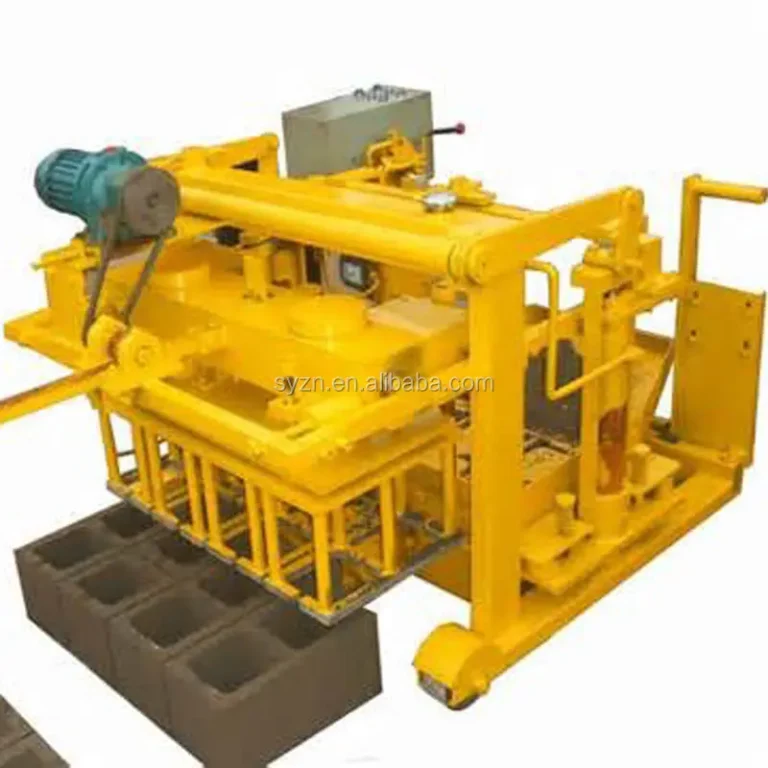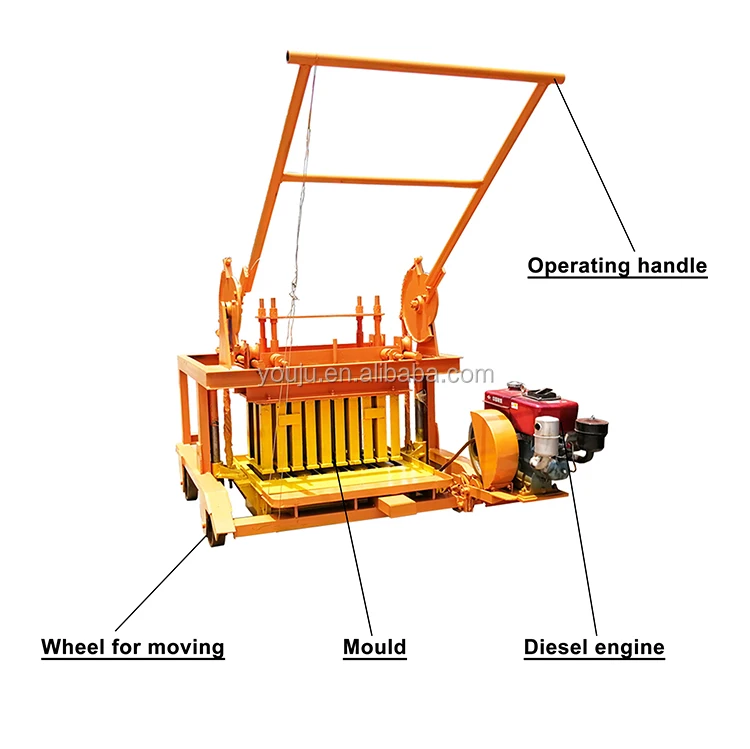
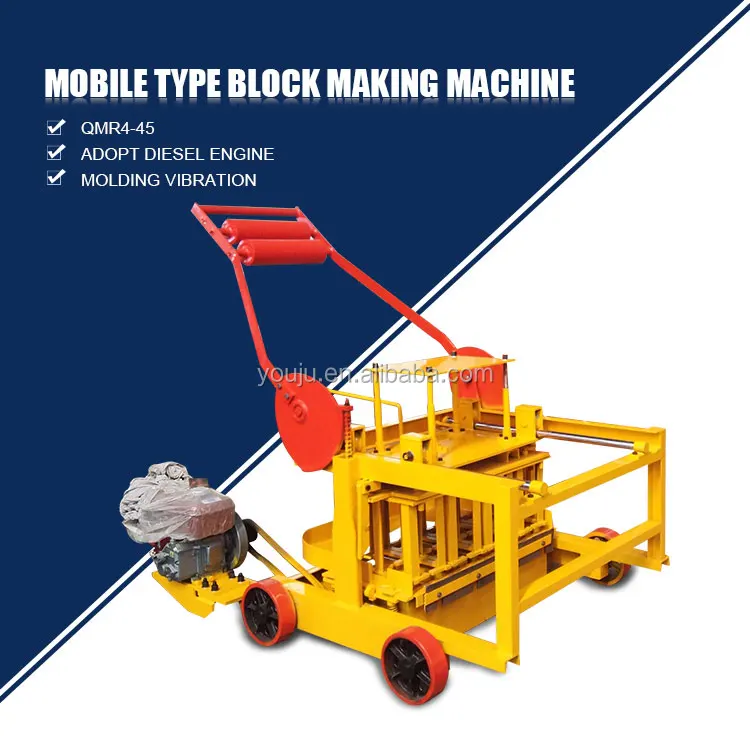
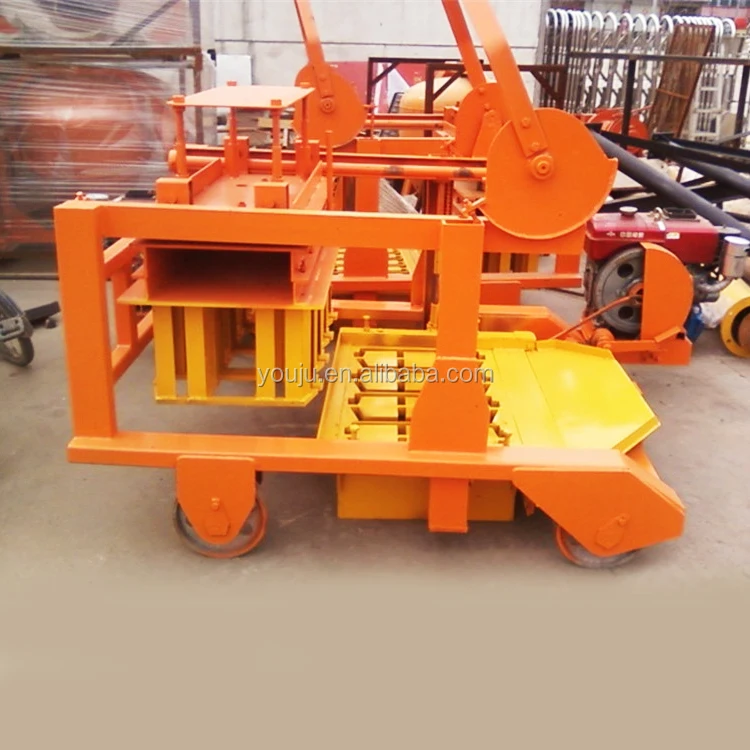


Description
In-Stock Readiness — QMR4-45 diesel movable block machines are assembled and staged for rapid dispatch, eliminating the multi-week production wait that stalls project timelines.
Technical Specifications
| Parameter | Value |
|---|---|
| Model | QMR4-45 |
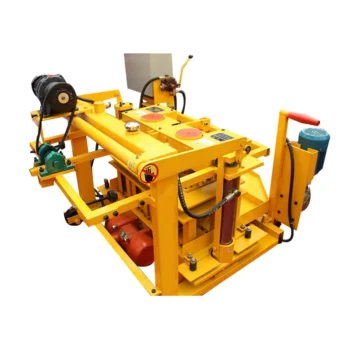
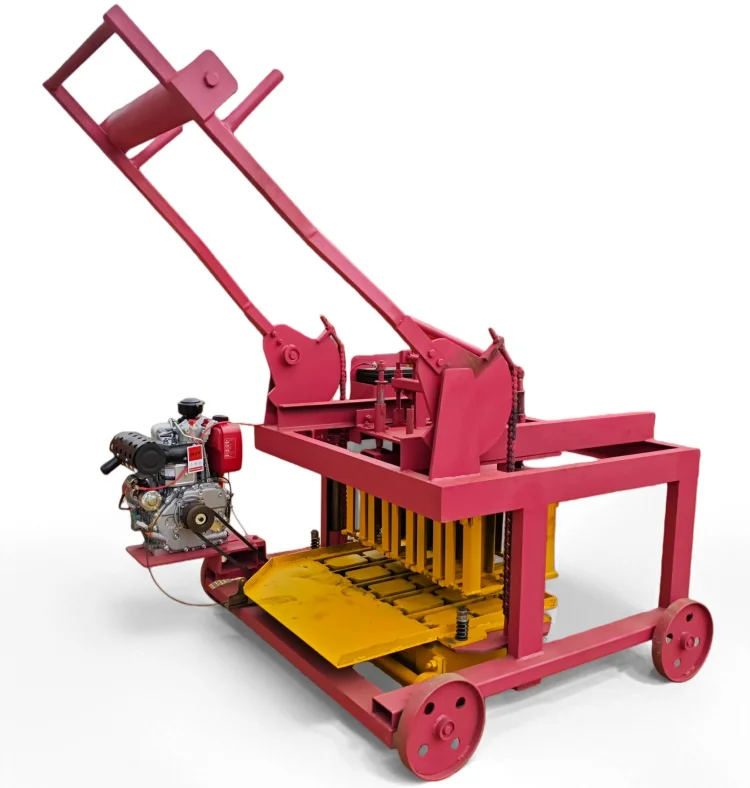
| Product Type | Diesel Movable Egg-Laying Concrete Block Machine |
| Overall Dimensions (L×W×H) | 2420×1320×1650 mm |
| Net Weight | 810 kg |
| Power Source | Diesel Engine |
| Rated Power | 6 kW (6-8 HP) |
| Voltage Options | 220V / 380V / custom to local supply |
| Moulding Cycle | 40-45 s |
| Pallet Requirement | No pallet needed |
| Output (400×200×200 mm) | 3000 pcs/day (4 pcs/mould, 8-hour shift) |
| Output (400×150×200 mm) | 3500 pcs/day (5 pcs/mould, 8-hour shift) |
| Output (400×120×200 mm) | 4500 pcs/day (6 pcs/mould, 8-hour shift) |
| Standard Mould Formats | 400×200×200 / 400×150×200 / 400×120×200 mm hollow block |
| Automation Level | Manual / egg-laying mobile type |
| Assembly State | Fully assembled, mobile on-site operation |
| Certification | CE |
Application Suitability
| Application | Material or Output |
|---|---|
| Remote housing projects | Hollow concrete blocks from crushed stone, sand, and cement without grid power |
| On-site contractor production | Hollow blocks laid directly on cured concrete floor slabs |
| Small-scale block yards | Daily runs of 400×200×200 mm hollow blocks for local sale |
| Development project staging areas | Multiple block formats from a single diesel-powered unit |
Why Dispatch Timing Matters More Than You Think
A machine that sits in a factory for six extra weeks of production costs you more than any discount ever could.
When contractors work against a project deadline, every week of delay means labour crews waiting, cement curing schedules slipping, and penalty clauses ticking. A diesel movable block machine in stock and ready for fast delivery removes that uncertainty entirely. I have watched site managers in East Africa lose entire pouring cycles because the block press arrived late and the masonry crew had already moved to another job. The QMR4-45 ships fully assembled, so the moment it clears customs it can be offloaded and producing on a prepared concrete pad the same afternoon. [NEED_CITE: impact of equipment lead time on construction project penalties]
Stocked Configuration and Immediate Readiness
The QMR4-45 arrives with the diesel engine already mounted, the mould frame assembled, and the vibration mechanism tested under load. For buyers who need a diesel movable block machine in stock, this means no waiting for component sourcing or factory build slots. The standard configuration ships with hollow block moulds in the three most traded sizes across African and South Asian markets, so the unit can begin producing whichever format the local demand requires on the very first shift.
No-Pallet Egg-Laying Design on Site
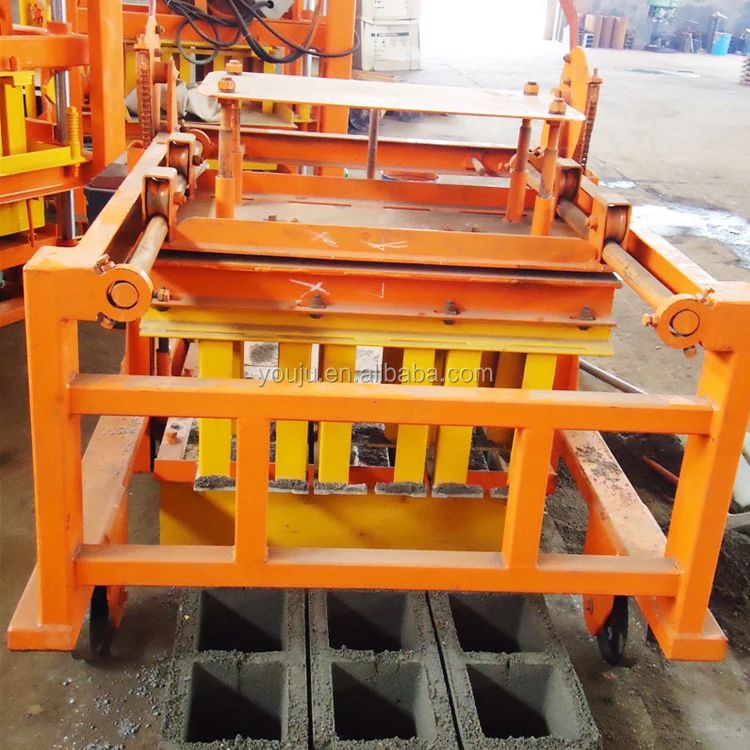
The egg-laying principle is what makes this unit practical for deadline-driven sites. The machine lays each block directly onto the ground or a cured concrete slab and then moves forward on its wheels to the next position. No pallet procurement, no pallet storage area, no pallet return loop — all of which demand extra space and extra labour that a tight site simply does not have. This diesel movable block machine in stock removes the entire pallet logistics chain from your operation, which is one less variable that can delay your first production day. [NEED_CITE: pallet handling costs in small-scale block production]
Reading the Specs That Actually Govern Output
The 40-45 second moulding cycle governs how fast a single block cluster is formed, but real daily volume depends on the operator pace, the concrete mix workability, and the format being run. At 400×200×200 mm with four cavities per mould, the stated 3000 pieces per day assumes an eight-hour shift of steady operation. The 6 kW diesel engine must deliver consistent RPM to keep the vibration force uniform — if the local diesel grade is low-cetane or contaminated with water, combustion becomes uneven and the vibration weakens, producing blocks with lower density. The 810 kg net weight provides the mass needed to keep the machine stable during vibration, but the operator must ensure the ground surface is level and firm enough to absorb the shaking without the unit drifting off-line.
What Happens When Fuel Grade Is Overlooked
One of the most common failures I have seen on African job sites traces back to fuel, not the machine itself. A contractor in Kenya received a diesel egg-laying press and ran it on locally sourced diesel with a cetane rating below what the engine was tuned for. The vibration pressure dropped, the blocks came out soft, and the entire first week of output had to be crushed and recycled. The fix was a fuel filter swap and sourcing from a different supplier, but that was a week of lost production that no one had budgeted for. Always confirm the diesel specification available near your site before the machine ships, and carry spare fuel filters from day one. [NEED_CITE: diesel fuel cetane rating requirements for small industrial engines]
Why Buyers Source From This Inventory
Single-focus block machinery sourcing means the QMR4-45 is specified as a complete system — engine, mould, and vibration mechanism matched together rather than assembled from unrelated suppliers. Configuration is confirmed against the buyer’s local diesel fuel availability and the hollow block format the market actually purchases, not a catalogue default. Stocked moulds cover the three standard hollow block sizes, with custom drawings available for formats outside that range. Dispatch lead time and container loading plans are confirmed at order stage so the arrival date is predictable. Factory test records document the machine running under load before it is dismantled for shipment.
Documentation & Verification
- Factory test record documenting vibration performance under loaded mould conditions before dismantling
- Dispatch lead time and container loading plan confirmed at the order stage
- Voltage and control confirmation sheet signed before final assembly
- Packing photographs showing dismantling state and crate arrangement before container loading
- Operation and maintenance manual covering diesel engine servicing and mould change procedure
- CE declaration documentation for customs clearance in applicable markets
Installation, Commissioning & Support
- Site requires a level, cured concrete pad to support the 810 kg machine weight during vibration
- Diesel fuel specification must be confirmed locally to match the 6 kW engine requirements
- Machine ships fully assembled but may be partially dismantled for container loading efficiency
- First-day commissioning includes vibration force check and mould alignment verification on site
- Operator training covers moulding cycle pacing and diesel engine maintenance intervals
- Spare fuel filters and vibration mechanism wear parts recommended for on-site stock from day one
Before You Send the Inquiry
To match the right QMR4-45 configuration to your project, we need to know which hollow block format your market trades most heavily and what diesel fuel grade is available within hauling distance of your site. Share your target daily output and the shift hours you plan to run, along with the local voltage specification in case auxiliary electrical components need to be aligned. If you have an existing concrete working area, let us know the dimensions so we can confirm the machine footprint and movement path will fit.
Frequently Asked Questions
Q: What is the realistic daily output and which block format does each figure assume?
A: Output is tied directly to the mould format installed. With the 400×200×200 mm hollow block mould at four cavities, expect 3000 pieces over an eight-hour shift. The 400×150×200 mm mould at five cavities yields 3500 pieces per day, and the 400×120×200 mm mould at six cavities reaches 4500 pieces. Each figure assumes a steady 40-45 second moulding cycle.
Q: Is the machine in stock, and what is the dispatch lead time?
A: The QMR4-45 diesel movable block machine is stocked and ready for fast dispatch. Lead time covers the factory test, partial dismantling for container loading, and customs documentation. An arrival estimate is provided upfront based on the destination port so project schedules can be planned with certainty.
Q: What voltage options are available, and is voltage confirmed before shipment?
A: The machine supports 220V, 380V, or custom voltage aligned to the buyer’s local supply. Voltage and frequency are confirmed in writing before the machine ships to prevent commissioning delays. Any auxiliary electrical components are matched to the confirmed specification.
Q: How is the machine packed and loaded into a container?
A: The QMR4-45 ships partially dismantled for efficient container loading while keeping the core assembly intact. Packing photographs are taken before the container is sealed. The loading plan is shared with the buyer so the arrival condition is predictable and the on-site reassembly steps are clear.
Q: What mould formats ship from stock, and can additional moulds be included?
A: Three hollow block mould formats — 400×200×200 mm, 400×150×200 mm, and 400×120×200 mm — are stocked and can ship with the machine. Additional moulds or custom format drawings can be included in the same container if confirmed at the order stage.