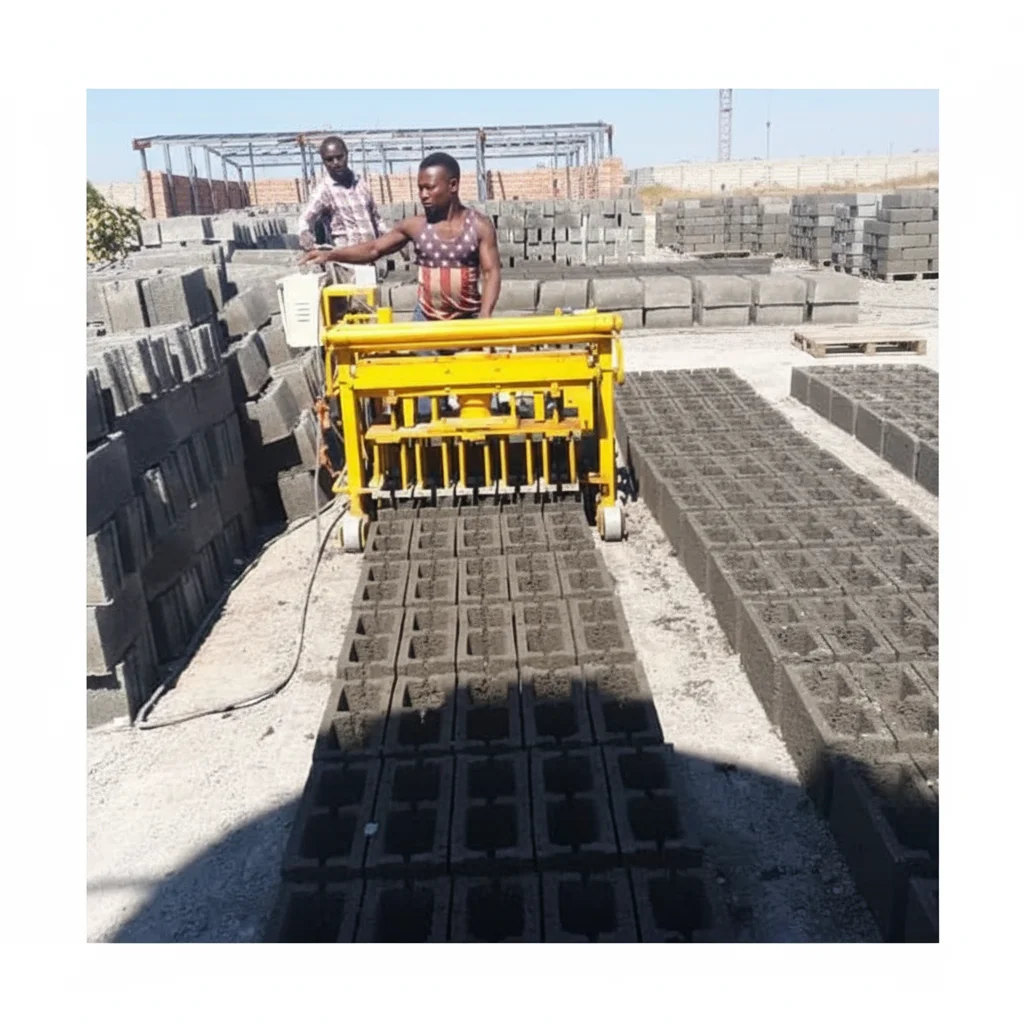
Description
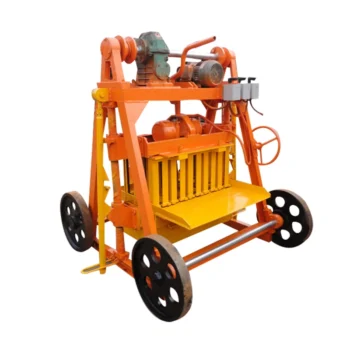
Stocked Dispatch — QMY4-30 mobile block machine is ready for container loading, cutting the typical multi-week production wait down to immediate shipment.
Technical Specifications
| Parameter | Value |
|---|---|
| Model | QMY4-30 |
| Product Type | Mobile Egg-Laying Concrete Block Making Machine |
| Overall Dimensions (L×W×H) | 1300 × 1500 × 1000 mm |
| Net Weight | 950 kg – 1000 kg |
| Vibration Method | Mold Vibration |
| Exciting Power | 28.6 KN |
| Excitation Frequency | 4500 r/min |
| Total Power | 5.95 kW |
| Voltage | 380V ± 10% (basis to be confirmed) |
| Output Capacity | 3000 pcs/day (basis to be confirmed) |
| Automation Level | Manual mobile / egg-laying |
| Pallet Requirement | Not applicable (blocks laid directly on ground) |
| Raw Materials | Concrete, fly ash, cinder, coal gangue, river sand, gravel, cement |
Application Suitability
| Application | Material or Output |
|---|---|
| Remote housing project sites | Solid and hollow blocks from local river sand and cement |
| Small-scale entrepreneur startups | Paving blocks using fly ash and cinder waste residue |
| On-site contractor production | Kerb and interlocking bricks from crushed gravel mixes |
| Rural infrastructure builds | Load-bearing blocks from coal gangue aggregate |
What "Fast Delivery" Actually Means for Your Project Deadline
A Mobile Egg-Laying Block Machine in stock means your equipment is already built, tested, and waiting for a container — not waiting in a production queue.
Buyers working against a hard construction deadline often find that quoted lead times stretch once raw material sourcing or component shortages delay the factory floor. When a project in a remote region waits for block supply, the daily cost of idle labor and delayed follow-on trades accumulates quickly [NEED_CITE: construction delay penalty structures in remote infrastructure projects]. Securing a Mobile Egg-Laying Block Machine in stock eliminates the manufacturing variable, leaving only shipping and customs as the timeline factors you must manage.
Dispatch Readiness and Container Loading
The QMY4-30 is compact enough to ship efficiently. With overall dimensions of 1300 × 1500 × 1000 mm and a net weight under 1000 kg, multiple units or a single unit with a full set of moulds and spare wear parts can be consolidated into one container. The egg-laying design means there are no pallets to ship alongside the press, freeing container volume for mould inventory and consumables that keep the machine running after arrival.
Arrival Estimate and Site Deployment
Once the container clears customs at the destination port, the QMY4-30 can be moved to site and put into production rapidly. There is no fixed plant foundation to pour, no curing rack system to erect, and no complex conveyor line to align [NEED_CITE: site preparation requirements for mobile versus stationary block plants]. The machine lays blocks directly onto the prepared ground surface. An operator connects power, loads the mix, and begins production — a significant advantage when your project schedule does not allow weeks of installation and commissioning.
How Vibration Force and Frequency Shape Block Density
The QMY4-30 delivers 28.6 KN of exciting power at 4500 r/min through mold vibration. For an egg-laying machine that deposits blocks onto the ground without hydraulic clamping pressure, vibration is the sole force compacting the mix into the mould. The frequency and amplitude must be matched to the aggregate particle size in the buyer’s local material — a coarse river sand requires different vibration characteristics than a fine fly ash blend. This matching determines whether the block holds its shape when the mould lifts and whether it achieves sufficient green strength to survive handling after the curing period [NEED_CITE: relationship between vibration parameters and green strength in egg-laying block production].
Mould Vibration Versus Table Vibration
Mould vibration, as used on the QMY4-30, means the vibration motor is mounted directly on the mould assembly. This transmits energy efficiently into the block cavity with less loss than table vibration systems where energy must travel through a larger mass. For a mobile machine operating at 5.95 kW total power, this efficiency matters. The lower power draw makes the machine compatible with portable generator sets often found on remote construction sites where grid power is unavailable or unreliable.
The Hidden Cost of Underspecifying Wear Parts
Buyers who order a mobile block machine without specifying a wear parts package often face their first production stoppage within weeks. Mould liners, vibration motor bearings, and mix contact surfaces wear at rates that depend entirely on the abrasiveness of the local aggregate. When a worn mould liner is not in the site storeroom, production halts until the part arrives internationally — a delay that can stretch into weeks and trigger contractual penalties on the construction project [NEED_CITE: impact of spare parts availability on equipment uptime in remote deployments]. Ordering wear parts with the initial machine shipment ensures the first replacement cycle is already covered.
When the Wrong Voltage Specification Derails Commissioning
The QMY4-30 is listed at 380V ± 10%, but export markets have varying industrial power standards. A machine arriving in a region operating on 220V three-phase or 440V three-phase will not run without a transformer or motor swap — both of which add cost and delay at the destination. Confirming the exact voltage and frequency at the inquiry stage, before production begins, avoids a situation where the machine sits idle on site while electrical modifications are arranged [NEED_CITE: industrial voltage and frequency standards across Latin American and African markets].
Why Procurement Here Reduces Delivery Risk
Block machinery is the single operational focus, meaning the QMY4-30 and its supporting moulds are specified as one matched system rather than assembled from separate supply chains with mismatched lead times. Stock models ship on a timeline measured in days for container booking rather than weeks for production scheduling. Mould design covers the block formats the buyer’s local market actually sells, and custom mould drawings can be processed alongside the machine order so everything arrives in the same container. Configuration is confirmed against the buyer’s available raw materials and site power supply before dispatch, reducing the chance of arriving with a machine that cannot run on what is locally available.
Documentation & Verification
- Machine specification sheet confirming QMY4-30 dimensions, power rating, and vibration parameters
- Mould drawing and format list showing block types included in the shipment
- Voltage and frequency confirmation document matched to the destination market
- Factory test record demonstrating block formation and mould release performance
- Packing photographs documenting container loading and securing arrangement
Installation, Commissioning & Support
- Site requires a level, compacted ground surface — no concrete foundation needed for egg-laying operation
- 380V ± 10% three-phase power connection with dedicated circuit rated for the 5.95 kW total draw
- Machine ships fully assembled; deploy directly from container to production area
- First-run parameter adjustment to match vibration output with the buyer’s specific aggregate mix
- Operator training covers mix consistency, machine travel speed, and mould change procedure
- Wear parts list provided with recommended spares for the first production cycle based on aggregate abrasiveness
Before You Request a Quote
Provide the specific block formats your market requires — hollow, solid, paving, or interlocking — along with the target dimensions so the correct moulds can be included in the shipment. Confirm the industrial voltage and frequency available at your site, and describe the raw materials you plan to use so the machine configuration can be verified against your local aggregate. If you are working to a project deadline, state your required arrival date so shipping options can be matched to your timeline.
Frequently Asked Questions
Q: Is the QMY4-30 currently in stock, and how soon can it ship?
A: Stocked units are available for immediate dispatch. Once the order is confirmed and the container is booked, the machine can typically be loaded and dispatched within days. Exact timing depends on container availability at the port and any custom mould orders included in the shipment.
Q: How is the machine loaded into a container for shipping?
A: The compact dimensions of 1300 × 1500 × 1000 mm allow the QMY4-30 to be loaded into a standard container without dismantling. Moulds, spare wear parts, and documentation are packed alongside the machine to maximize container utilization and keep all components together.
Q: How quickly can I start producing blocks after the machine arrives?
A: Because the QMY4-30 is an egg-laying design with no fixed plant, pallet system, or curing racks to install, production can begin once the machine is moved to a level ground area and connected to power. Site preparation is minimal compared to stationary block plants.
Q: What block formats can the QMY4-30 produce?
A: The machine supports mould changes for hollow blocks, solid blocks, paving blocks, and interlocking bricks. The specific formats available depend on the moulds ordered with the machine. Custom mould designs can be produced to buyer drawings to match local market requirements.
Q: Can the voltage be adapted to my country’s power supply?
A: The standard specification is 380V ± 10%, but voltage and frequency must be confirmed before production to ensure compatibility with the destination market. Providing your site’s exact power specification at the inquiry stage allows the correct motor and electrical configuration to be fitted.