

QT4-25 Block Machine Wholesale Supplier China Factory
Most buyers think the cheapest QT4-25 wins the bid. In reality, the lowest FOB price usually means the voltage protection module was deleted from the control cabinet—a decision that burns out mainboards within weeks on unstable African grids.
Buying a QT4-25 block machine from a China supplier is not about chasing the lowest quotation. It is about matching the machine’s electrical tolerance, mold metallurgy, and peripheral integration to your local voltage reality, aggregate abrasiveness, and operator skill level. A reliable QT4-25 block machine China supplier will ask you about your site’s power fluctuation range before quoting, not after.
I still remember a commissioning job outside Lagos where a buyer had picked the lowest-priced unit available. The machine ran beautifully during factory testing at stable voltage. Three weeks into production, the control board fried during a routine evening pour. The local grid routinely dipped below acceptable thresholds, and the supplier had omitted the surge protection components to shave cost off the invoice. The downtime lasted long enough to wipe out an entire season’s projected margin. That kind of failure is not a machine problem—it is a supplier selection problem. When you evaluate any QT4-25 block machine China supplier, the first question should never be "how much." It should be "what happens when my voltage drops." [NEED_CITE: voltage tolerance standards for industrial machinery per IEC 60038]
Let me walk you through what actually matters when sourcing this machine, based on what I have seen across installation sites in West Africa, East Africa, and Latin America.
What Exactly Is the QT4-25 and Who Should Buy It?
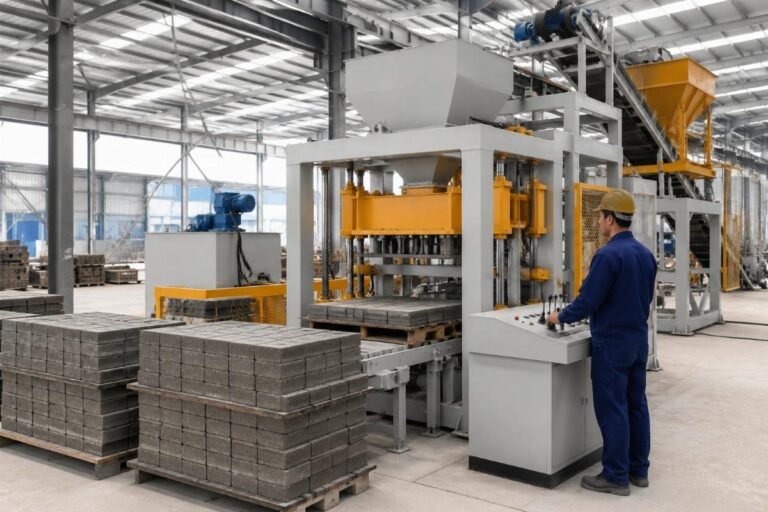
The QT4-25 is a mobile, egg-laying concrete block machine designed for entry-level investors who need low capital expenditure and fast deployment on unpaved or semi-prepared sites.
Unlike stationary lines that require poured foundations, pit installations, and extensive civil works, the QT4-25 moves on wheels across a flat curing yard, laying blocks directly on the ground in a grid pattern—hence the term "egg laying." After one cycle, the machine advances, and the freshly formed blocks cure in place under ambient conditions or light covering.
This design makes it the go-to choice for first-time block plant operators in emerging markets. The production footprint is small, the setup time is measured in days rather than weeks, and the operator count per shift can be kept minimal.
| Parameter | QT4-25 Mobile Egg-Laying | QT4-15 Stationary Semi-Auto | QT6-15 Stationary Semi-Auto |
|---|---|---|---|
| Foundation requirement | Flat ground or light compaction | Reinforced concrete pit | Reinforced concrete pit |
| Pallet system | None (blocks laid on ground) | Required | Required |
| Daily output range | Modest, shift-dependent | Moderate | Substantially higher |
| Operator skill threshold | Basic mechanical familiarity | Moderate | Moderate to advanced |
| Suitability stage | Greenfield micro-plant | Growing single-line operation | Scaling multi-shift operation |
A private investor in East Africa once asked me whether the QT4-25 could handle his target volume. His local market demanded a certain daily output that the QT4-25 could technically reach—but only if the mixer feeding it, the pallet curing system, and the block transportation logistics were all synchronized. He was buying the machine in isolation. I told him plainly: the QT4-25 is the right starting point, but only if you understand it as the heart of a system, not a standalone solution. [NEED_CITE: small-scale block production line configuration guidelines for emerging market investors]
How to Evaluate a China QT4-25 Supplier Beyond Price?
Check voltage customization capability, mold supply chain depth, and on-site installation track record—not just the quotation sheet.
Any trading company can forward you a spec sheet with attractive numbers. A genuine manufacturer will send you a voltage adaptation checklist before you sign anything. Here is what that conversation should look like:
- What is your site’s nominal voltage and actual fluctuation range?
- Is the local frequency 50Hz or 60Hz?
- Do you have phase imbalance issues?
- Is there a history of power surges during rainy seasons?
A qualified QT4-25 block machine China supplier will then configure the control cabinet accordingly—adding stabilizer integration points, specifying contactor ratings with adequate headroom, and selecting PLC components rated for the actual operating environment. I have seen machines shipped to West Africa with control boards rated for a narrow voltage band that simply did not match the reality on the ground. The result was predictable. [NEED_CITE: industrial electrical equipment adaptation requirements for Sub-Saharan power grids]
Beyond electrical configuration, examine the mold supply chain. The QT4-25 uses interchangeable mold sets for different block sizes and shapes. If your local aggregate is highly abrasive—common in regions with high-silica sand or crushed granite—the mold wear rate will be significantly accelerated. A supplier who only offers one mold hardness grade is not thinking about your operating conditions. You need a supplier who can match mold material hardness to your aggregate profile and commit to supplying replacement molds on a predictable lead time.
Then there is the installation question. A QT4-25 block machine China supplier who quotes you a machine but has no record of sending technicians to your region is a red flag. The machine needs calibration on arrival. The vibration motors need tuning to your specific mix design. The mold clearance needs adjustment based on the actual aggregate size you are using. These are not things you learn from a manual translated into English as an afterthought.
Shandong Shiyue, for instance, maintains a track record of on-site commissioning across multiple African and Latin American markets, with engineers who understand that a machine sitting in a container for weeks in humid conditions needs more than just unpacking—it needs systematic recalibration before the first block is poured. [NEED_CITE: concrete block machine commissioning best practices for tropical climate installations]
What Hidden Costs Do Buyers Often Overlook?
Voltage stabilizers, spare mold sets, and pallet or curing integration can add a meaningful percentage to your total investment—but they prevent months of downtime that would cost several times more.
Let me be direct: the machine price on the invoice is never your total cost of ownership. I have sat with buyers who celebrated a low purchase price, only to discover months later that the "savings" were entirely consumed by avoidable downtime and emergency spare parts shipments.
Here are the three most common hidden cost categories:
Voltage protection and stabilization. If your grid is unstable—and in many emerging markets it is—you need external stabilization equipment. This is not optional. A voltage stabilizer sized correctly for your machine’s motor load will cost a fraction of what a burned control board and weeks of idle labor will cost you. Some suppliers include basic protection; others delete it to win the price comparison. Know which one you are buying from.
Spare mold inventory. Mold wear is a function of your aggregate abrasiveness and your daily output volume. If you are running a high-silica sand mix and producing blocks continuously, your mold replacement cycle will be noticeably shorter than the supplier’s standard estimate based on mild aggregate testing. Ordering a spare mold set at the time of initial purchase—rather than scrambling six months later when the original molds are worn beyond acceptable tolerance—saves you emergency air freight costs and production stoppages.
Peripheral system integration. The QT4-25 lays blocks on the ground. But those blocks need to be moved to curing areas, and the mix needs to reach the machine consistently. If you are feeding the hopper by wheelbarrow and moving cured blocks by hand, your effective output will be a fraction of what the machine is rated for. A basic conveyor feed system and a structured curing yard layout are not luxuries—they are the difference between a machine that meets its rated output and one that frustrates your operators daily.
A buyer in Latin America purchased a single QT4-25 unit without any mixer integration or systematic curing layout. For months, output stayed well below expectations. Only after investing in a coordinated mixer-conveyor setup and reorganizing the curing yard did the line approach its designed capacity. The upgrade payback was rapid, but the initial months of underperformance were entirely avoidable. [NEED_CITE: total cost of ownership analysis for small-scale concrete block production in developing economies]
QT4-25 vs. QT4-15/QT6-15: Which Model Fits Your Stage?
The QT4-25 suits greenfield micro-plants with limited capital and unpaved sites. Upgrade to semi-auto stationary lines only after daily output consistently exceeds your current machine’s practical ceiling.
This is a question I get constantly. Buyers see the model numbers and assume higher means better. That is not how it works. The right machine is the one that matches your current stage of development, your site conditions, and your capital availability.
The QT4-25, as discussed, is a mobile egg-laying machine. No foundation needed. No pallet system. Blocks cure where they are laid. Ideal for someone starting a block business on a piece of land with minimal preparation.
The QT4-15 is a stationary semi-automatic machine. It requires a concrete foundation, a pallet circulation system, and a more structured production layout. Output per shift is meaningfully higher. But the civil works investment and the pallet system cost are real. If you are not yet certain about your market demand or your long-term site location, this is premature.
The QT6-15 steps up further in output capacity and automation level. It is designed for operators who have already proven their market, established consistent raw material supply, and need to scale production across multiple shifts.
| Decision Factor | QT4-25 | QT4-15 | QT6-15 |
|---|---|---|---|
| Site preparation level | Minimal | Substantial | Substantial |
| Pallet system needed | None | Yes | Yes |
| Capital commitment tier | Entry | Mid | Higher |
| Best-fit business stage | Market entry and validation | Confirmed demand, scaling | Established operation, multi-shift |
| Upgrade trigger | Consistent output ceiling reached | QT4-25 capacity fully utilized | Market growth demands higher throughput |
I worked with a West African buyer who started with a QT4-25, validated his market for hollow blocks and interlocking pavers over a full construction season, and then upgraded to a QT4-15 with a full pallet loop. The timing was right because he already knew his product mix, his curing cycle, and his labor requirements. Had he started with the QT4-15, he would have carried higher fixed costs through an unproven market phase. [NEED_CITE: phased capital investment strategy for small-scale block manufacturing startups]
What After-Sales Support Should You Demand in the Contract?
Insist on commissioning, operator training, and lifetime spare parts availability—these separate real manufacturers from trading companies who disappear after the container ships.
The contract you sign with a QT4-25 block machine China supplier should contain specific after-sales commitments, not vague promises. Here is what you need written into the agreement:
On-site commissioning by the supplier’s engineer. The machine must be started, calibrated, and run through a production trial in your actual site conditions, with your actual mix design, by someone who knows the machine intimately. This is not a luxury. The vibration frequency, mold clearance, and feed timing all interact with your specific materials. Getting this right on day one prevents weeks of trial-and-error that your operators will pay for in wasted cement and frustrated mornings.
Operator training covering mold adjustment and basic troubleshooting. Most operators in emerging markets have never worked with a block machine before. If they do not understand how to adjust mold间隙 when block edges start chipping, or how to read the basic fault indicators on the control panel, your output will drop noticeably—and your mold wear will accelerate unnecessarily. Training is not a one-day formality. It should cover daily maintenance routines, wear part inspection, and the logic behind mix proportioning.
Spare parts availability with committed lead times. Ask the supplier: if I need a replacement mold, a new vibration motor, or a control board in two years, what is the lead time? A manufacturer who keeps spare parts inventory and has established shipping routes to your region will give you a concrete answer. A trading company will give you a vague "we will check." [NEED_CITE: after-sales service framework expectations for construction machinery exports to emerging markets]
A buyer in East Africa learned this the hard way. He purchased from a supplier who quoted an attractive price but had no service presence in the region. When a hydraulic component failed, the replacement took months to source and ship. The machine sat idle. The local market moved on to a competitor. The lesson was expensive but clear: the supplier relationship does not end at the bill of lading.
This is where the difference between a manufacturer like Shandong Shiyue and a generic trading entity becomes stark. Shiyue’s after-sales structure includes on-site installation support, operator training programs tailored to local skill levels, and a spare parts supply chain built around the regions where their machines actually operate. Their CE and SGS certifications are not just marketing documents—they reflect a manufacturing discipline that extends through the entire product lifecycle. [NEED_CITE: construction equipment manufacturer after-sales service maturity models]
Conclusion
The right QT4-25 block machine China supplier is the one who asks about your grid before quoting your price. Matching voltage tolerance, mold metallurgy, and peripheral integration to your local conditions prevents the downtime that destroys ROI far more reliably than chasing the lowest invoice ever will.

Leave a Reply