

Buy QT10-15 Block Machine for Sale
Most buyers obsess over hydraulic tonnage, but the real bottleneck is pallet circulation speed and batching consistency.
A QT10-15 block machine is a fully automatic medium-output production line capable of producing roughly ten thousand standard blocks per day, making it the go-to choice for commercial block plants targeting daily volumes above that threshold. Purchasing one is not a single-machine transaction but a systems-matching project covering local voltage tolerance, raw material availability, site layout, and after-sales responsiveness. Buying directly from a factory can cut equipment cost by a substantial margin while securing turnkey delivery and on-site commissioning.
I still remember a late afternoon in Lagos when a client pointed at the hydraulic station of his older semi-automatic line and cursed. Oil temperature had climbed past the safe threshold, and the machine simply refused to cycle. After two days crawling under the frame, I traced the problem back to tractor-grade oil bought from a roadside fuel station. Since then, every crate I ship carries a laminated "field-fluid guide" pinned inside the control cabinet door, listing filter codes and viscosity grades in plain English. A workshop-trained mind learns quickly: machines die in the details, not in the brochure specs [NEED_CITE: root cause distribution of hydraulic failures in tropical block plants per ISO 4413 fluid power guidelines].
Moving from that single failure to a full purchasing decision requires a clear picture of what the QT10-15 actually is and who it serves.
What Is the QT10-15 Block Machine and Who Needs It?
The QT10-15 is a fully automatic stationary block forming line engineered for commercial producers who need consistent daily output above the ten-thousand-block mark and plan to scale into interlocking pavers or curbstones.
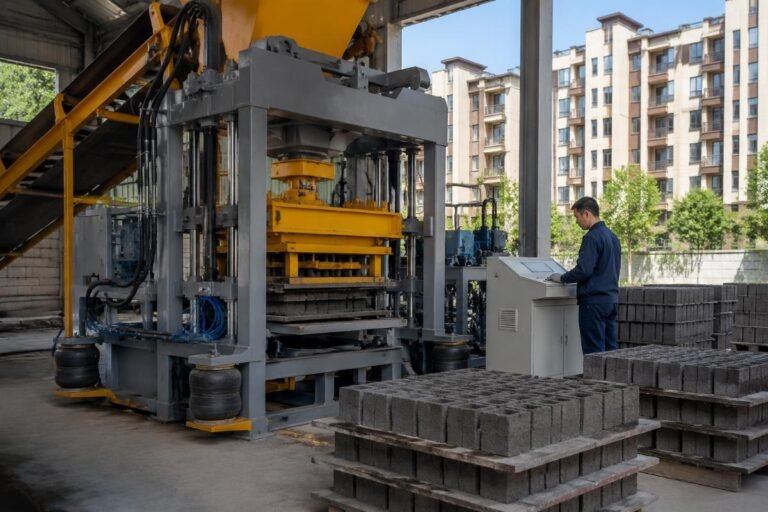
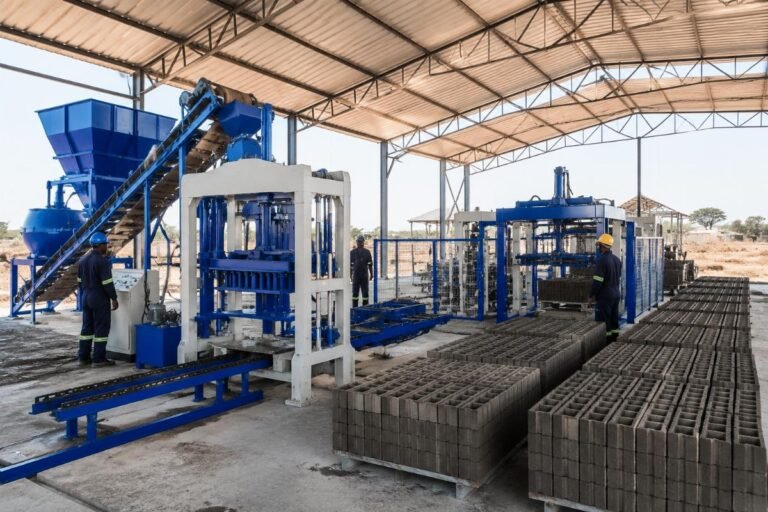
The naming convention itself is a clue. "QT" signals a stationary table-vibration format, "10" refers to the mold area class roughly equivalent to ten standard block cavities, and "15" denotes the cycle time in seconds. This positions the QT10-15 squarely between the smaller QT6-15, which suits start-up yards, and the heavier QT12-15, which targets large industrial plants. The machine integrates a PLC-controlled hydraulic unit, a high-frequency table vibrator, an automated pallet return loop, and a face-mix feeder for decorative products.
In practice, the QT10-15 fits three buyer profiles. First, private investors in emerging markets setting up a new block yard and needing a line that pays back within a reasonable production window. Second, established manufacturers replacing manual or semi-automatic units to eliminate bottlenecks. Third, construction equipment distributors stocking a mid-range model that covers the majority of tender specifications across African and Latin American housing programs [NEED_CITE: market demand mapping for medium-output block lines in Sub-Saharan affordable housing programs].
A Middle East client who upgraded from a QT6-15 to a QT10-15 saw his daily output roughly double without adding a second shift, simply because the pallet loop and batching tower were synchronized to the faster cycle. That kind of leap is invisible on a spec sheet but obvious on the yard.
QT10-15 Specs vs. QT6-15 vs. QT12-15: Which Model Fits Your Output?
Choosing among these three models is less about peak tonnage and more about matching pallet turnover, transformer headroom, and available yard space.
The table below distills the decision into the parameters that actually determine whether a line runs smoothly or stalls during the first month.
| Parameter | QT6-15 Class | QT10-15 Class | QT12-15 Class |
|---|---|---|---|
| Daily output range | Entry-level commercial | Mid-volume commercial | High-volume industrial |
| Vibration system | Table-only | Table plus mold vibration | Multi-point synchronized |
| Pallet loop speed | Standard cycle | Accelerated cycle | High-speed continuous |
| Transformer requirement | Moderate | Substantial | Heavy industrial |
| Yard footprint | Compact | Medium | Extended |
| Face-mix feeder compatibility | Optional | Standard integration | Standard integration |
| Operator skill threshold | Basic | Intermediate | Advanced |
[NEED_CITE: comparative energy consumption per thousand blocks across stationary block machine classes per concrete products industry benchmarks]
A Latin American distributor once ordered a QT12-15 for a client whose site transformer could only support a QT10-15 class load. The result was repeated breaker trips during peak vibration until a dedicated step-down station was installed, at a cost that dwarfed the original price gap between the two models. The lesson is simple: oversizing the machine without sizing the infrastructure is a classic first-time-buyer trap.
Conversely, a West African client running a QT6-15 around the clock could not meet a new road-paving contract because the pallet loop simply could not circulate fast enough. Switching to a QT10-15 eliminated the bottleneck without requiring a second line.
How Much Does a QT10-15 Block Machine Cost in 2026?
The headline price of the host machine is only a fraction of the total investment; molds, batching plant, conveyors, and logistics typically double the outlay.
A realistic budget breakdown for a complete QT10-15 line looks roughly like this, expressed in proportional terms rather than fixed quotes because steel prices and freight rates shift monthly.
- Host machine with standard mold set: forms the core of the investment, including the hydraulic station, PLC cabinet, and pallet feeder.
- Additional molds: each mold set for a different block or paver profile adds a meaningful increment; serious buyers budget for at least three profiles from day one.
- Batching plant and mixer: a properly sized PL series batching unit with a twin-shaft mixer is non-negotiable for consistent concrete quality.
- Conveyors and pallet return system: belt conveyors, chain transfers, and the pallet return loop together determine whether the line actually hits its rated cycle.
- Cement silo and screw feeder: site-specific, but typically one or two silos with corresponding screws.
- FOB or CIF logistics: the Incoterm choice directly affects cash flow; FOB favors buyers with their own forwarders, while CIF simplifies first-time imports.
[NEED_CITE: cost structure breakdown of a complete automatic block production line exported from East China ports]
Factory-direct purchasing consistently delivers a cost advantage that is difficult to replicate through trading companies, because the middleman margin on heavy equipment is substantial. Buyers who source directly also gain leverage on mold customization and voltage adaptation, which trading desks rarely authorize.
A buyer from Southeast Asia once compared a trading-company quote against a factory-direct offer for an identical QT10-15 configuration. The factory price was markedly lower, and the delivery window was compressed from several months to a matter of weeks, because the production slots were already allocated. The trading quote, by contrast, included a buffer that covered neither faster delivery nor better spare-part terms.
What to Verify Before You Buy from a Chinese Supplier?
A supplier’s marketing page is not a due-diligence document; certification copies, factory footage, and spare-part lists must be cross-checked before any deposit is wired.
The following checklist has been refined over years of watching buyers get burned by glossy websites and disappear-ing WhatsApp numbers.
- CE and SGS certification: request the original certificate number and verify it on the issuing body’s database; self-printed PDFs are worthless [NEED_CITE: verification procedure for CE certificates on notified body databases for machinery directive compliance].
- Factory video audit: insist on a live video walk-through of the assembly hall, not a pre-edited promo reel. Look for welding jigs, painted frames curing in racks, and pallets being loaded onto test rigs.
- Reference list with site contacts: a credible supplier will provide at least a few installable references in your region, with phone numbers you can actually dial.
- Spare-part package scope: confirm which wear parts are included in the first shipment. Mold bottoms, vibrator bearings, and hydraulic seals should be bundled, not sold as afterthoughts.
- After-sales response clause: written commitment on response time for remote troubleshooting and the conditions for on-site engineer dispatch.
- Voltage and frequency adaptation: confirm that the PLC cabinet, motors, and vibrator are wound for your exact grid specification, not a generic "380V/50Hz" label.
A government contractor in North Africa once received a machine whose motor nameplate matched the local grid, but the internal contactors were rated for a different voltage. The mismatch caused repeated contactor burnout during the first week. The supplier had simply swapped nameplates without rewiring. This kind of shortcut is invisible until you open the cabinet door.
How to Ensure Smooth Installation and First-Month Production?
Installation is not a one-day event but a two-week process of calibration, training, and spare-part staging that determines whether the line reaches rated output or limps through its first month.
The sequence below reflects what actually works on the ground, distilled from dozens of commissioning trips across dusty yards and unstable grids.
- Foundation and leveling: the concrete pad must cure fully before the frame is bolted down; a laser level is the only acceptable tool for checking flatness across the mold table.
- Electrical termination and phase check: a qualified local electrician must verify phase rotation and ground continuity before the PLC is powered; reversed phase can destroy the vibrator motor within seconds [NEED_CITE: electrical commissioning checklist for three-phase concrete block machinery per IEC 60204].
- Hydraulic fluid fill and bleed: use only the viscosity grade specified by the manufacturer; fill slowly and bleed every cylinder to prevent air-lock, which causes erratic mold movement.
- Mold installation and shim adjustment: the mold must sit square on the table; shim thickness is adjusted until the block height is uniform across all cavities.
- Dry-cycle and wet-cycle tuning: run the machine empty first, then with concrete, adjusting vibration time and hydraulic pressure until block density meets the target.
- Operator training in local language: do not rely on English manuals alone; spend at least several days walking operators through every alarm code and daily maintenance task.
- First-month spare-part staging: keep an accessible shelf of seals, filters, and a spare vibrator motor; waiting for an air-shipped part in a remote yard can idle the entire line.
A client in Central Asia skipped the hydraulic bleed step to save a day. The result was a month of erratic block heights and two service calls before the air was finally purged. The lost production cost far more than the day he tried to save.
Conclusion
Buying a QT10-15 block machine is a systems decision, not a catalog order. Matching output class to site infrastructure, verifying supplier credentials beyond the brochure, and staging installation as a calibration process rather than a one-day event are what separate a profitable yard from a costly lesson. The machine itself is only the starting point; the real investment is in the discipline around it.
Leave a Reply