

Concrete Mixer for Block Line Replacement Schedule Wholesale Supplier
Silent wear is more dangerous than loud failure.
Replace mixer blades and liners based on operational hours and material abrasiveness, not just when they break. A data-driven replacement schedule prevents mixing inconsistency, ensures block strength compliance, and avoids total batch rejection. For a reliable Concrete Mixer for Block Line Replacement Schedule Wholesale Supplier, proactive maintenance is the key to uptime.
I still remember the dust in Riyadh. It was not just sand; it was silica-rich desert aggregate that acted like sandpaper on steel. A client there insisted on running his line until the mixer sounded "wrong." By then, the liners were gone, the blades were thin, and the concrete mix was so inconsistent that an entire day’s production of hollow blocks failed compressive strength tests. The cost of replacing the worn parts was negligible compared to the loss of the rejected batch and the downtime. That incident reinforced a simple truth: in block production, the mixer is the heart, and its wear parts are the pulse. Ignoring the pulse leads to cardiac arrest. [NEED_CITE: impact of mixing homogeneity on concrete compressive strength per ASTM standards]
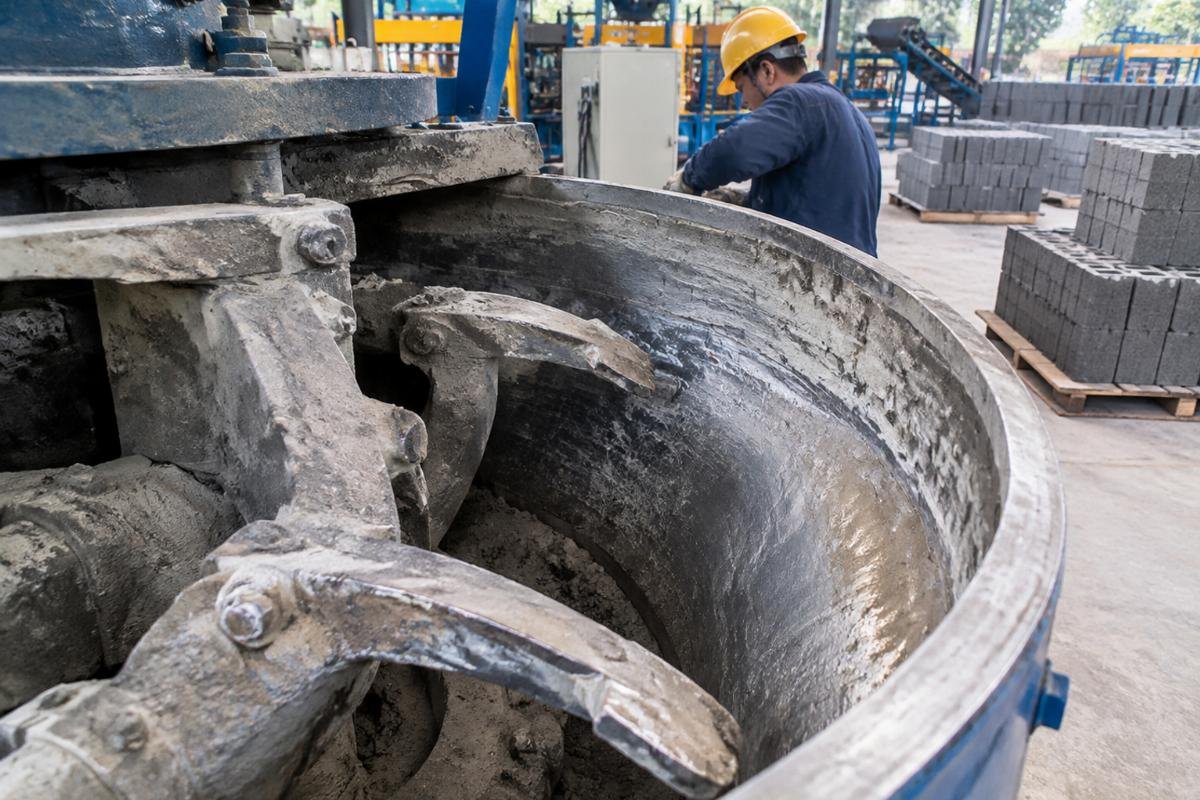
Understanding when to replace these components is not about guessing. It is about measuring. This guide breaks down the wear indicators, calculation methods, and consequences of delay, drawing from field experience across the MENA region and beyond.
Why Do Mixers Fail Before Their Time?
Abrasive materials and lack of scheduled checks cause premature inefficiency, not just mechanical breakdown.
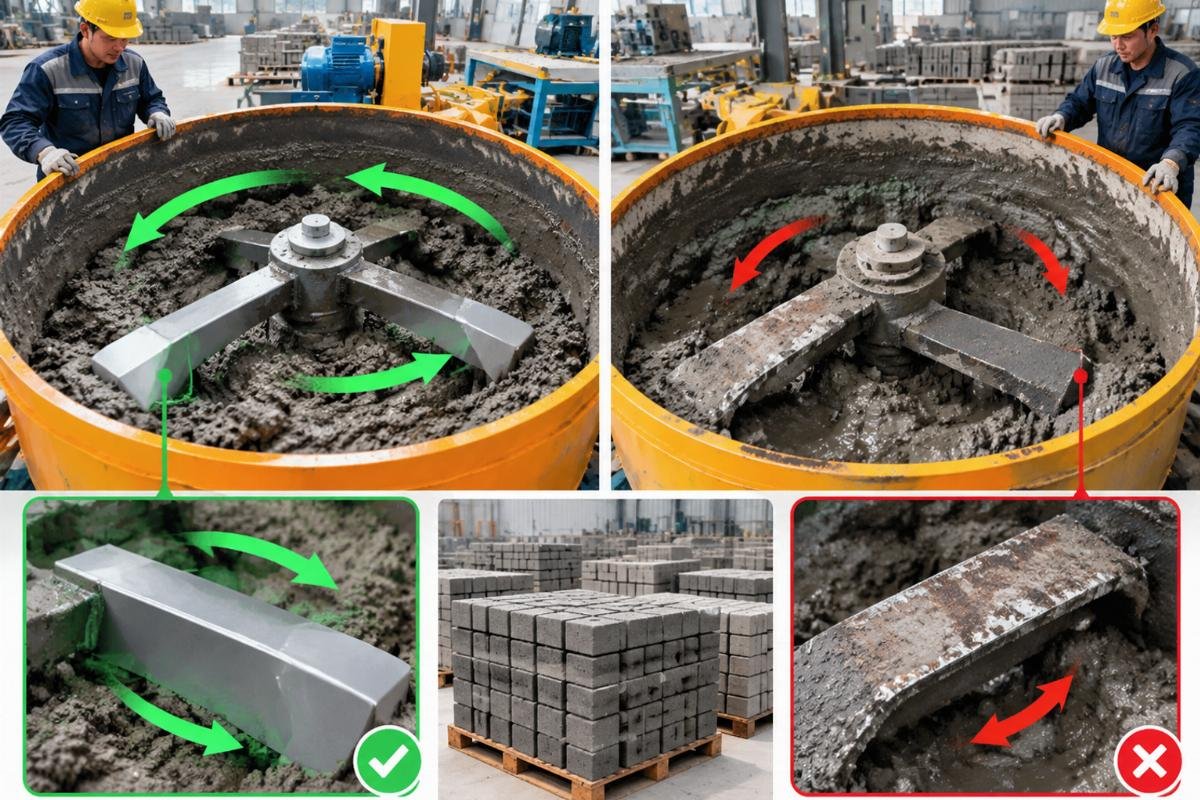
Many plant managers assume that if the motor is running and the drum is turning, the mixer is working. This is a critical error. The primary function of the mixer is not just to move material but to homogenize it. When wear parts degrade, the mixing action changes from a thorough fold-and-cut motion to a superficial sliding motion. [NEED_CITE: principles of concrete mixing efficiency and shear force requirements]
In regions with high-abrasiveness aggregates, such as those using crushed rock or desert sand, the rate of wear accelerates significantly. The steel liners and blades are sacrificial components designed to protect the main drum structure. However, their effectiveness drops sharply once they lose a certain percentage of their original thickness. Waiting for a visible hole or a loud grinding noise means the mixer has already been operating inefficiently for weeks.
The failure mode is rarely sudden catastrophic breakage of the drum itself. Instead, it is a gradual decline in mix quality. The concrete becomes less cohesive, leading to poor compaction in the block machine mold. This results in blocks with surface defects, lower density, and inconsistent strength. For a Concrete Mixer for Block Line Replacement Schedule Wholesale Supplier, educating clients on this gradual decline is essential to preventing costly quality failures.
What Are the Critical Wear Indicators?
Monitor liner thickness, blade edge profile, and discharge consistency daily.
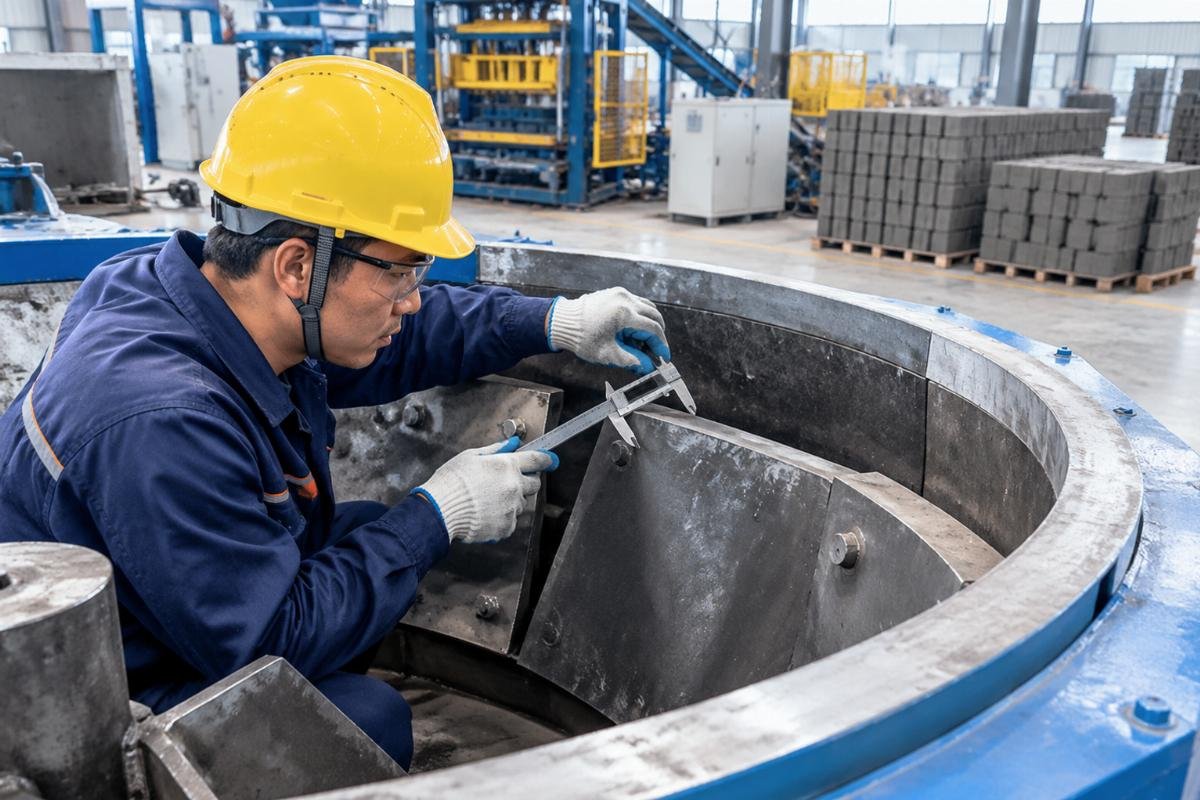
Identifying wear requires a systematic approach. Relying on visual inspection alone is insufficient because internal wear can be hidden by accumulated concrete residue. A proper inspection protocol involves three key checks.
First, measure the liner thickness. Use calipers to check the remaining thickness of the wear plates at multiple points, especially in high-impact zones near the blades. Compare these measurements to the original specifications provided by the manufacturer. A reduction of 30-40% in thickness is typically the threshold for replacement in high-abrasion environments. [NEED_CITE: manufacturer guidelines for wear part replacement thresholds]
Second, inspect the blade edge profile. New blades have a sharp, defined edge that cuts through the aggregate. Worn blades become rounded and blunt. This rounding reduces the shear force applied to the concrete mix, leading to poor dispersion of cement and water. If the blade edge is visibly rounded or if the tip length has decreased significantly, replacement is necessary.
Third, monitor discharge consistency. Perform regular slump tests or visual checks of the discharged concrete. If the mix appears segregated, with aggregates separating from the paste, or if the slump variance exceeds acceptable limits, it indicates that the mixer is no longer achieving proper homogeneity. This is often a direct result of worn blades and liners. [NEED_CITE: standard deviation metrics for aggregate distribution in concrete mixes]
| Wear Indicator | Inspection Method | Action Threshold |
|---|---|---|
| Liner Thickness | Caliper measurement vs. original spec | Replace at 30-40% thickness reduction |
| Blade Edge Profile | Visual inspection for rounding/blunting | Replace when edge is visibly rounded |
| Discharge Consistency | Slump test variance or visual segregation | Investigate if variance exceeds limits |
How to Calculate Your Replacement Cycle?
Use operational hours and material type to set dynamic intervals, not fixed calendar dates.
A fixed calendar-based replacement schedule is ineffective because usage intensity varies widely. A plant running three shifts a day with abrasive aggregate will wear out parts much faster than a plant running one shift with soft limestone. Therefore, the replacement cycle must be dynamic, based on operational hours and material hardness.
Start by establishing a baseline. For standard aggregates, manufacturers often provide a recommended service life in hours. However, this baseline must be adjusted for local conditions. In high-abrasion scenarios, such as those involving recycled concrete aggregate or hard rock, the replacement interval should be shortened significantly. Conversely, for softer materials, the interval may be extended.
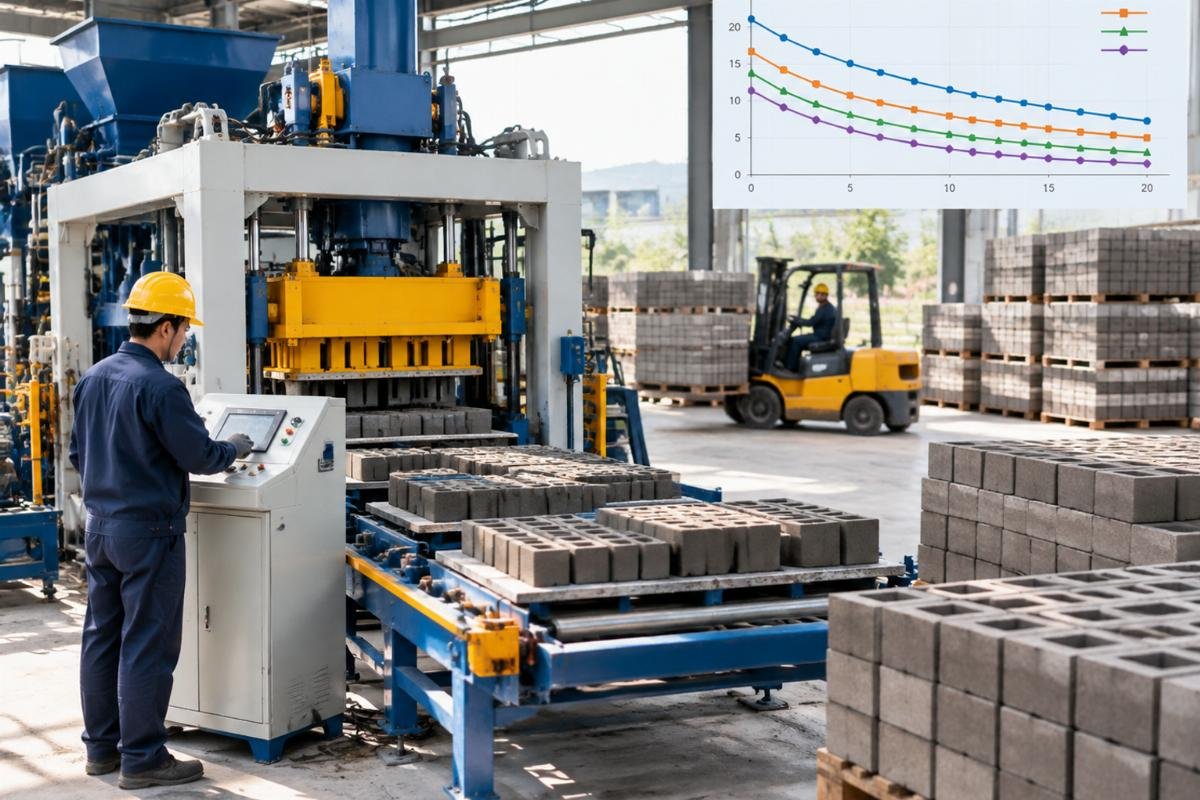
Tracking operational hours is crucial. Most modern PLC-controlled block lines, such as those from Shiyue, include hour meters for the mixer motor. Use this data to log runtime. Combine this with regular wear measurements. For example, if liners show 20% wear after 500 hours of operation with a specific aggregate, you can project that they will reach the 40% replacement threshold at approximately 1000 hours. This allows for proactive ordering of spare parts.
Maintaining detailed maintenance logs simplifies this process. Shiyue provides comprehensive maintenance logs and genuine spare part kits with QT series lines, enabling plant managers to track wear trends accurately. This data-driven approach ensures that parts are replaced just before they compromise mix quality, optimizing both cost and performance. For a Concrete Mixer for Block Line Replacement Schedule Wholesale Supplier, providing these tools is part of the value proposition.
What Happens If You Delay Replacement?
Inconsistent mix leads to structural weakness, batch rejection, and secondary damage to drive systems.
Delaying the replacement of worn mixer parts has cascading negative effects. The most immediate impact is on product quality. An inconsistent mix results in blocks with variable density and strength. This increases the risk of failing quality control tests, leading to batch rejection. In large infrastructure projects, such rejections can halt construction progress and result in significant financial penalties.
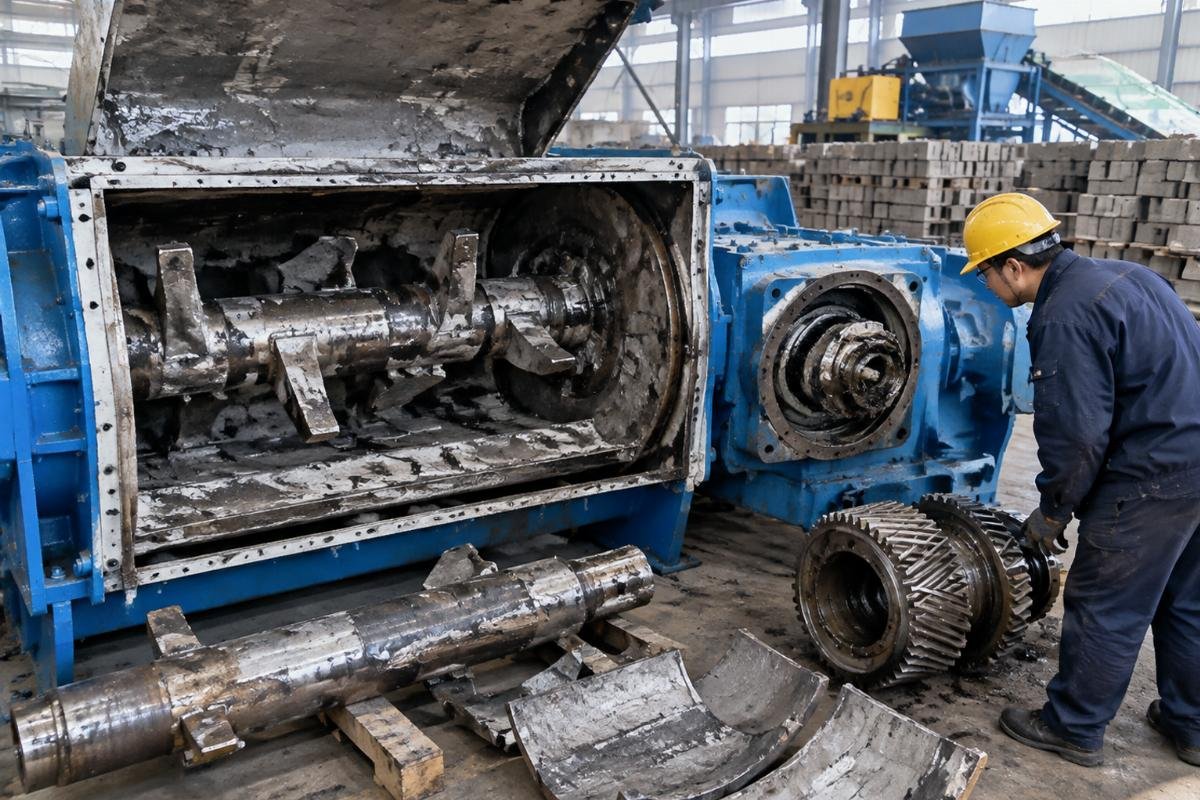
Beyond quality issues, delayed replacement causes mechanical stress on the mixer itself. Worn blades and liners increase the load on the mixer motor and gearbox. The motor must work harder to move the concrete, leading to higher energy consumption and increased heat generation. Over time, this can cause premature failure of the motor bearings, gearbox gears, or even the mixer shaft. [NEED_CITE: correlation between mixer load and drive system failure rates]
Repairing these secondary damages is far more expensive than replacing wear parts. The cost of a new motor or gearbox can exceed several times the price of a timely wear part kit. Additionally, the downtime required for major repairs is significantly longer than the time needed for a routine wear part change. This unplanned downtime disrupts production schedules and affects delivery commitments.
A case in point is a plant in North Africa where delayed liner replacement led to shaft misalignment. The resulting vibration damaged the gearbox, requiring a complete overhaul. The total cost, including lost production, was substantial. This could have been avoided with a simple, scheduled liner replacement. For a Concrete Mixer for Block Line Replacement Schedule Wholesale Supplier, emphasizing these risks helps clients understand the importance of proactive maintenance.
Conclusion
Proactive replacement saves money and ensures quality.
Adhering to a data-driven replacement schedule for mixer wear parts is essential for efficient block production. By monitoring wear indicators, calculating dynamic replacement cycles, and avoiding delays, plant managers can prevent mixing inconsistency, ensure block strength compliance, and avoid costly batch rejections. Partnering with a knowledgeable Concrete Mixer for Block Line Replacement Schedule Wholesale Supplier provides the necessary support and genuine parts to maintain optimal performance.
Leave a Reply