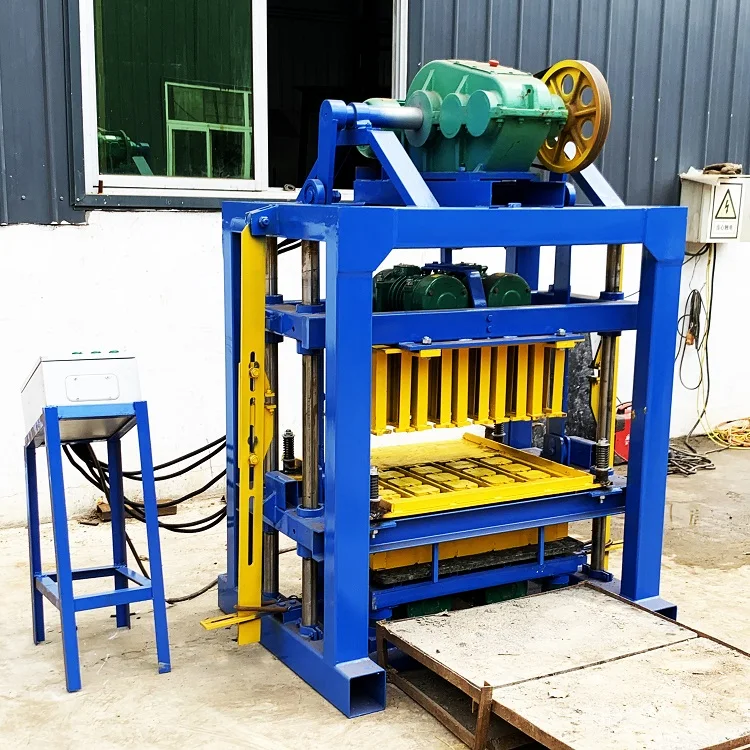
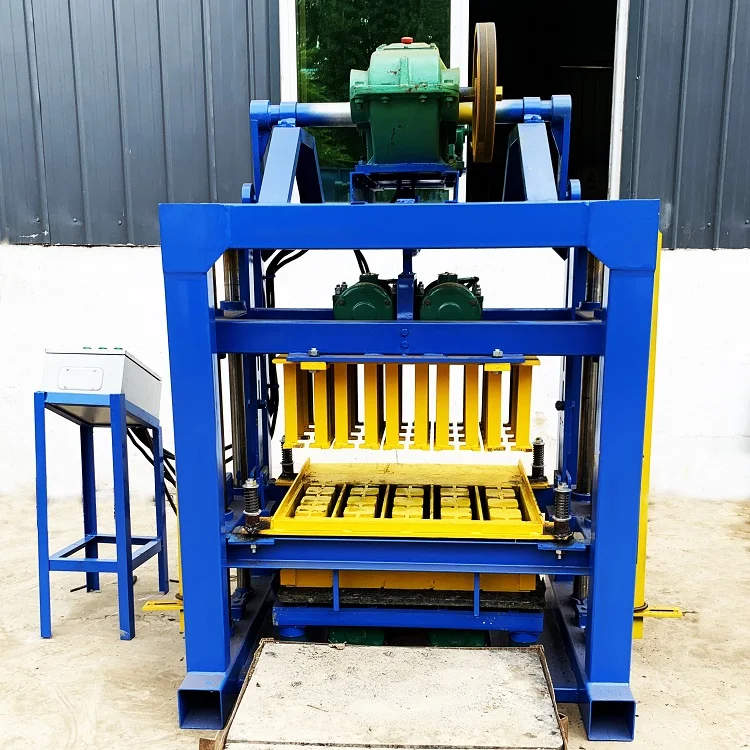

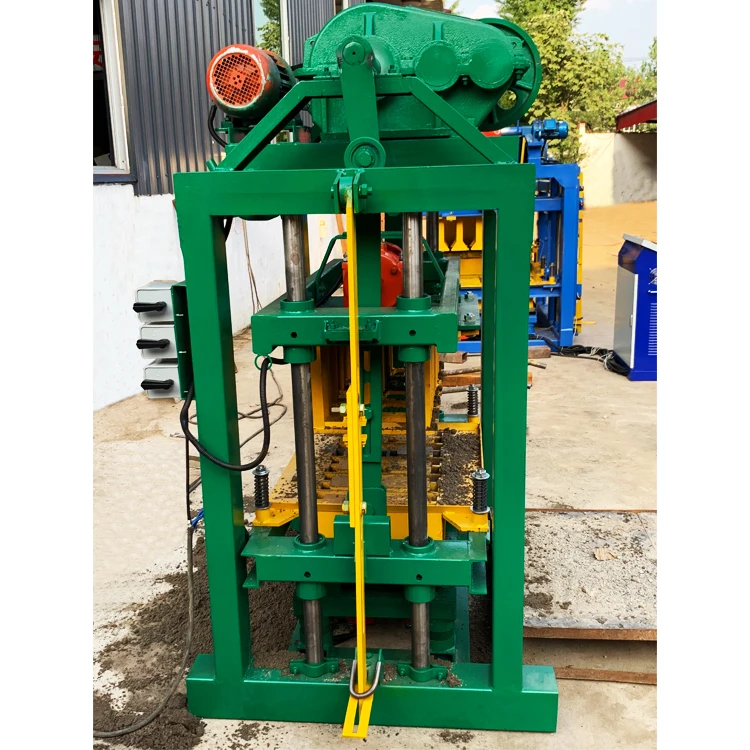
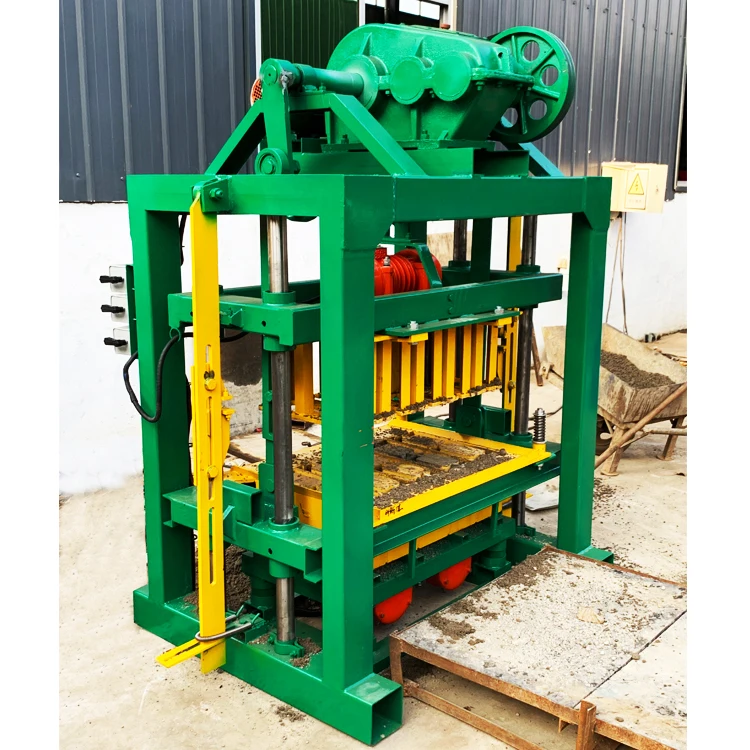
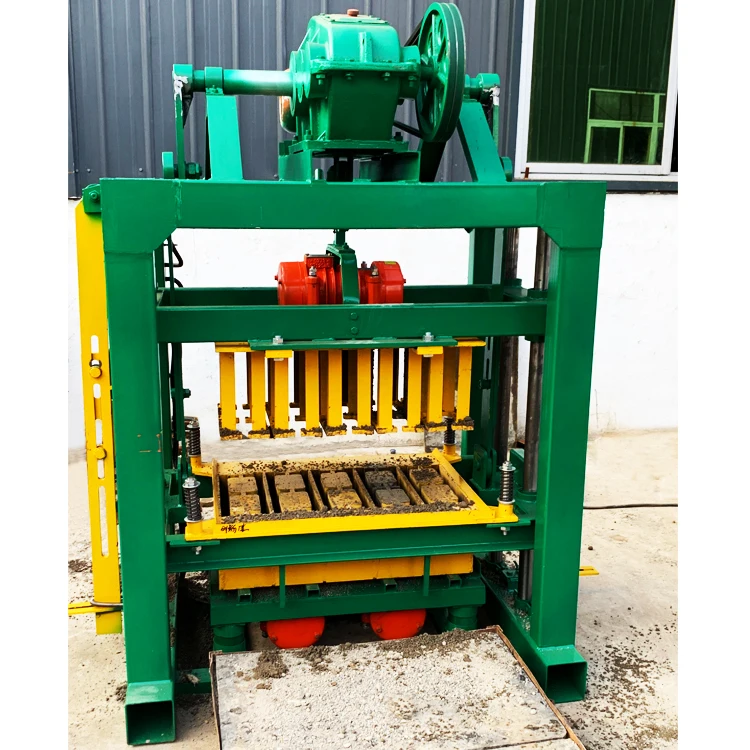
Description
Technical Specifications
| Parameter | Value |
|---|---|
| Model | QTJ4-40 |
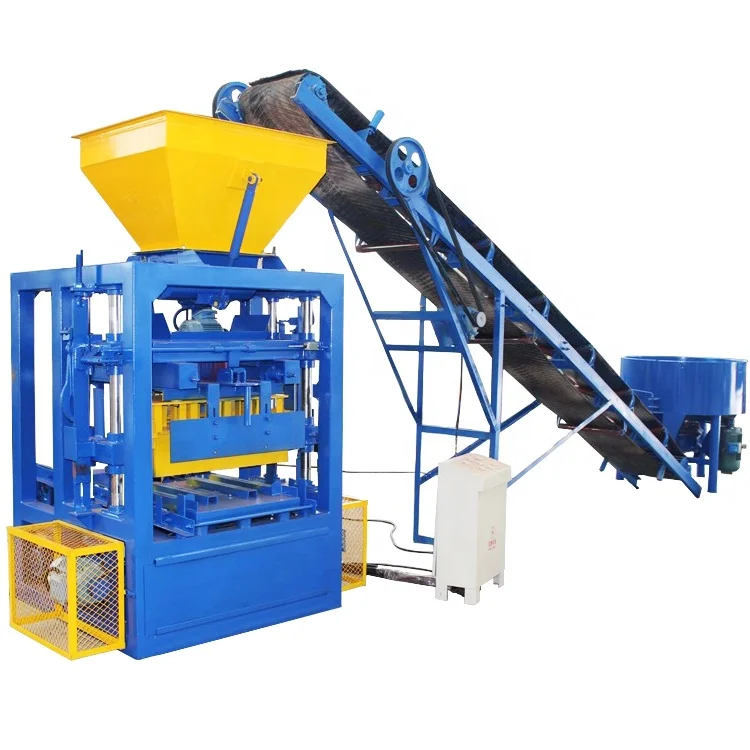
| Product Type | Manual Cement Block Making Machine |
| Vibration Form | Platform Vibration |
| Vibration Frequency | 2800 r/min |
| Pallet Size | 850×450 mm |
| Overall Dimensions | 1350×1460×1800 mm |
| Machine Weight | Approx. 1 T |
| Automation Level | Semi-manual with top die push-pull and automatic scraper |
| Mould Options | 4 pcs (400×200×200mm), 5 pcs (400×150×200mm), 9 pcs (225×112.5×60mm) |
| Daily Output (Hollow Block 400×200×200mm) | 2880 pcs/day (4 pcs per mould) |
| Daily Output (Hollow Block 400×150×200mm) | 4000 pcs/day (5 pcs per mould) |
| Daily Output (Solid Brick 225×112.5×60mm) | 7200 pcs/day (9 pcs per mould) |
| Raw Materials | Concrete, cement, fly ash, crushed stone, sand, dust, gravel, slag |
| Workers Required | 1–3 people |
Application Suitability
| Application | Material or Output |
|---|---|
| Small-Scale Block Plant Startups | Hollow and solid blocks from locally sourced sand and cement |
| On-Site Housing Projects | Rapid deployment for contractors needing blocks without fixed infrastructure |
| Paver and Interlocking Brick Production | Colored pavers and curbstone using fine aggregates and dust |
| Fly Ash Utilization | Eco-friendly bricks incorporating industrial by-products like slag and fly ash |
The Gap Between Catalog Output and Site Reality
Capacity figures on this page are tied to specific block formats, not generic maximums.
When sourcing a block machine, the most common friction point is the discrepancy between the "theoretical capacity" in a brochure and the actual pallets produced during a ten-hour shift. A machine quoted at a high volume often assumes a specific block size—usually a standard hollow block—that may not match your market demand. For the QTJ4-40 block machine in stock, we specify output based on the mould installed: 2880 pieces per day for 400×200×200mm hollow blocks, rising to 7200 pieces per day only when switching to 225×112.5×60mm solid bricks [NEED_CITE: standard block curing cycles and shift durations]. Ignoring these format-specific baselines leads to project delays and missed delivery targets.
Stock Availability and Dispatch Logic
Finding a reliable QTJ4-40 block machine in stock eliminates the typical multi-week production lead time associated with custom orders. For contractors working against a rainy season or a strict handover date, the ability to inspect, test, and load a machine immediately is often more valuable than minor specification tweaks. This model represents a "workshop tier" entry point, designed for buyers who need to start production with minimal capital outlay while retaining the option to expand later.
Logistics and Loading Strategy
Because this is a stationary unit with a compact footprint of 1350×1460×1800 mm, it fits efficiently into standard container space alongside pallets and spare moulds. We dismantle non-structural guards where necessary to maximize load density, ensuring that your first container holds not just the press, but the initial consumable inventory required for the first month of operation. The focus here is on speed: reducing the window between order placement and the first cured block on your site.
Vibration Physics and Block Density
The platform vibration system operates at 2800 r/min, a frequency calibrated to consolidate semi-dry concrete mixes effectively. Unlike top-only vibration which can leave the bottom of the block porous, platform vibration transmits force through the pallet, ensuring the aggregate settles uniformly against the mould walls [NEED_CITE: concrete consolidation principles for semi-dry mixes]. This is critical for load-bearing hollow blocks where wall thickness is minimal and structural integrity relies entirely on consistent compaction.
Pallet Size and Curing Logistics
The 850×450 mm pallet size is not arbitrary; it dictates the layout of your entire curing yard. Before confirming an order, verify that this dimension aligns with your existing forklift fork width and curing rack spacing. Mismatched pallet sizes force manual double-handling, where blocks must be moved from machine pallets to curing racks by hand, effectively doubling your labor cost and increasing breakage rates during the green stage.
The Cost of Ignoring Voltage and Frequency
Specifying a machine without confirming the local grid’s voltage and frequency is a frequent cause of commissioning failure. A motor wound for 380V/50Hz will overheat and burn out rapidly on a 440V/60Hz supply, voiding warranties and halting production. We require confirmation of these parameters against the destination country’s industrial standards before the motor is sourced, ensuring the QTJ4-40 block machine in stock is electrically compatible with your site’s transformer capacity [NEED_CITE: industrial voltage and frequency standards by region].
Why Procurement Focus Matters
Sourcing from a specialist rather than a general trader ensures the machine is treated as a system. We verify that the raw material ratio (approx. 1:4:5 for cement:sand:stone) matches the aggregate available in your region, preventing the "wrong mix" scenario where a machine configured for river sand fails to compact volcanic ash or crushed granite. Our documentation includes specific mould drawings and hydraulic schematics, allowing your maintenance team to source local replacements for wear parts rather than waiting for international shipments.
Documentation & Verification
- Factory test record demonstrating cycle times for your specific block format.
- Mould drawings confirming cavity count and dimensional tolerances.
- Electrical schematic matching the confirmed voltage and frequency.
- Packing list detailing container loading plan and spare parts inventory.
- Operation manual covering daily maintenance and scraper adjustment.
Installation, Commissioning & Support
- Foundation must be level concrete to support the 1-ton vibration load without resonance.
- Power supply requires a dedicated circuit breaker rated for the specific motor amperage.
- Assembly includes reattaching the hopper and scraper mechanism removed for transit.
- Initial run-in involves checking belt tension and vibration motor phase rotation.
- Operator training covers the manual push-pull rhythm required for consistent feeding.
- Wear parts list identifies high-friction areas requiring weekly grease application.
Requesting a Dispatch Quote
To move forward, provide the target block format you intend to produce most frequently and your local voltage specification. Confirming whether you require additional moulds for pavers or kerbstones at the time of loading is essential, as adding these later incurs separate freight costs. We also need to know if your site has existing pallets to determine if our 850×450 mm boards are compatible with your handling equipment.
Frequently Asked Questions
Q: Is the QTJ4-40 block machine in stock ready for immediate shipment?
A: Yes, this model is typically held in ready-to-assemble condition. However, "immediate" depends on the container booking schedule and the time required to configure the electrical system to your local voltage. We prioritize dispatch speed but will not skip the pre-shipment factory test, which verifies the vibration motor and scraper alignment.
Q: Can the machine produce interlocking pavers if I buy the right mould?
A: The platform vibration is suitable for pavers, provided you use the correct mould and a finer aggregate mix. You must confirm the mould dimensions fit within the 850×450 mm pallet working area. Note that paver production often requires a different facing mix layer, which may involve manual feeding on this semi-manual tier.
Q: What happens if my local aggregate is different from the standard river sand?
A: The standard 1:4:5 ratio is a baseline. If you are using stone dust, fly ash, or crushed granite, the water demand and vibration time will change. We recommend sending a sample analysis or photos of your local material so we can advise on mix adjustments before the machine arrives, preventing low-strength output.
Q: How many people are needed to operate this specific model?
A: The QTJ4-40 requires a crew of 1 to 3 people. One operator manages the push-pull mechanism and control, while others handle the feeding of the hopper and the removal of filled pallets to the curing area. It is labor-intensive compared to fully automatic lines, which is the trade-off for the lower initial investment.
Q: Are pallets included in the price of the machine?
A: Pallets are a consumable item and are usually quoted separately or as a "starter pack." Given the 850×450 mm size, you need enough pallets to keep the machine running while others are in the curing yard. We can supply bamboo, PVC, or steel pallets depending on your budget and the weight of your specific block mix.