

QT10-15 Brick Machine Price in Vietnam: 2026 Complete Buyer Guide for Sale
The brick machine price in Vietnam you see on a quotation sheet is never the real brick machine price in Vietnam.
For Vietnamese buyers in 2026, the real brick machine price in Vietnam for a QT10-15 fully automatic line typically lands between a mid-five-figure and low-six-figure USD amount at the factory gate, but the all-in landed cost including shipping, customs, installation, power upgrades, and first-year molds can push the total investment substantially higher. The gap between the FOB quote and the real brick machine price in Vietnam at your site often surprises first-time importers who budget only for the machine itself.
I still remember a buyer near Bien Hoa who called me furious after his container arrived. The brick machine price in Vietnam he had agreed to looked competitive on paper, but nobody had walked him through the transformer upgrade his local grid required, or the fact that the pallet loader needed a foundation pit his contractor had not planned for. By the time the line actually ran blocks, the real brick machine price in Vietnam he had paid was noticeably above what he thought he was signing for. That kind of surprise does not happen because the supplier lied; it happens because the buyer was never shown the full cost stack. [NEED_CITE: Vietnam Ministry of Construction published guidance on imported machinery commissioning costs for building material plants]
Let me walk you through what the real brick machine price in Vietnam actually looks like when every layer is accounted for, and how to read a quotation without getting trapped by the headline number.
What Is the Real Price Range for Brick Machines in Vietnam 2026?
The brick machine price in Vietnam spans from entry-level manual units to fully automatic lines, and the spread is wide enough that comparing two quotations without matching capacity and automation level is meaningless.
A typical range for the most common models Vietnamese buyers inquire about looks like this:
| Model Tier | Automation Level | Typical Output Range | Price Positioning |
|---|---|---|---|
| QT4-25 egg-laying type | Manual to semi-auto | Low daily output, mobile operation | Entry-level |
| QT4-15 / QT6-15 stationary | Semi-automatic | Mid-range daily output | Mid-tier |
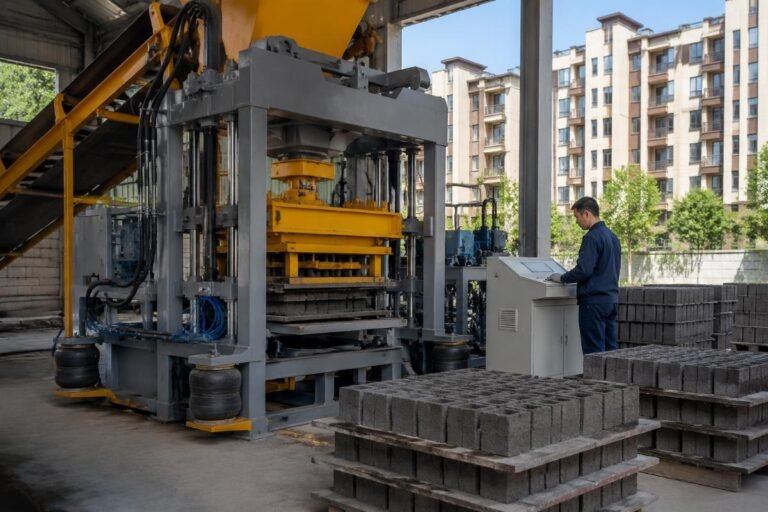
| QT10-15 stationary | Fully automatic with PLC | High daily output | Upper-mid tier |
| QT12-15 / QT15-15 | Fully automatic, multi-product | Large-scale output | Premium tier |
The brick machine price in Vietnam for a QT10-15 line sits in the upper-mid tier, but "upper-mid" does not mean "most expensive." Many buyers who start by requesting a QT12-15 or QT15-15 quote end up realizing that a QT10-15 covers their actual market demand with a noticeably lower total investment and a faster payback curve. [NEED_CITE: Southeast Asia concrete block market demand segmentation by plant capacity tier]
A contractor in the Red River Delta once told me he wanted the biggest line available because he assumed bigger meant better ROI. When we sat down and mapped his real daily order volume against curing time and shift patterns, a QT10-15 was the right fit. The brick machine price in Vietnam for that configuration left him enough budget to invest properly in the batching plant and a color feeder for paver work, which turned out to be his highest-margin product.
FOB vs CIF vs Door-to-Door: Which Shipping Term Saves You Money?
The shipping term you choose can shift the real brick machine price in Vietnam by a meaningful percentage, and the "cheapest" term on paper is rarely the cheapest term at your factory gate.
Most Vietnamese buyers default to FOB because the machine price looks lower. But FOB Qingdao means you are responsible for ocean freight, insurance, Hai Phong or Ho Chi Minh City port charges, customs clearance, inland trucking, and any demurrage if documentation is not ready on time. For a QT10-15 line shipped in multiple containers, those add-ons accumulate quickly.
| Shipping Term | What Is Included | Buyer Responsibility | Risk Exposure |
|---|---|---|---|
| FOB origin port | Machine only, loaded at Chinese port | Ocean freight, insurance, import clearance, inland delivery | High for first-time importers |
| CIF destination port | Machine, ocean freight, insurance | Import clearance, inland delivery, port handling | Moderate |
| Door-to-door / DDP | Machine, freight, insurance, clearance, inland delivery to site | Minimal, mostly unloading | Low, but higher headline price |
I worked with a buyer in Binh Duong who insisted on FOB to keep the brick machine price in Vietnam looking low. His forwarder then quoted him ocean freight at a rate substantially above what we could arrange through our regular partners, and a customs broker delay at Cat Lai port added demurrage costs that ate the entire FOB discount. The real brick machine price in Vietnam he ended up paying was higher than if he had taken a CIF quote from the start. [NEED_CITE: Vietnam customs clearance average timeline and port demurrage cost structure for machinery imports]
For a single QT6-15 or QT4-25, FOB can work if you have a reliable forwarder. For a full QT10-15 line with batching plant, silo, and pallet system going into multiple containers, CIF or a door-to-door arrangement usually gives a more predictable real brick machine price in Vietnam.
Hidden Costs Buyers Forget: Installation, Power, Molds & Spare Parts
The machine is the starting line, not the finish line. Installation, power infrastructure, mold sets, and first-year spare parts routinely form a substantial share of the real brick machine price in Vietnam.
Four cost layers catch buyers off guard more than any others:
- Installation and commissioning. A QT10-15 line needs mechanical alignment, hydraulic calibration, PLC parameter tuning, and trial runs. Sending technicians from China involves flights, per diems, and visa processing. Some buyers try to skip this and use local electricians, but PLC logic errors on a fully automatic line can produce weeks of defective blocks before the root cause is found. [NEED_CITE: industry best practice for on-site commissioning of imported concrete block lines]
- Power infrastructure. Vietnam’s industrial grid in some provinces still experiences voltage fluctuation. A QT10-15 line with its hydraulic pump station, vibrator motors, and control panel often requires a dedicated transformer and soft-start or variable frequency drive setup. The transformer alone can represent a noticeable share of the total project cost.
- Mold sets. The machine ships with one standard mold configuration. If you plan to produce multiple block sizes, pavers, or curbstones, each additional mold set adds to the real brick machine price in Vietnam. Mold steel quality and heat treatment determine how many shots you get before re-machining, and that varies substantially between suppliers.
- First-year spare parts. Seals, hoses, vibrator bearings, pallet feed rollers, and sensor units wear on a schedule. Ordering a recommended spare parts package with the machine avoids production stoppages later when a single broken seal halts the line and air-freighting a replacement costs several times its value.
A buyer in Nghe An province purchased a QT10-15 line and budgeted carefully for the machine and shipping. He did not budget for the transformer upgrade his industrial zone required, and he ordered only the standard mold. By the time he added a second mold set, a spare parts kit, and the electrical upgrade, the real brick machine price in Vietnam he had paid was substantially above the quotation figure he originally celebrated.
Which Machine Model Fits Your Vietnam Block Plant?
Choosing the right model is the single biggest lever controlling whether your real brick machine price in Vietnam turns into a profitable operation or an underutilized asset.
The decision comes down to three variables: your daily target output in standard block equivalents, the product mix your local market demands, and the labor and power conditions at your site.
| Decision Factor | QT4-25 / QT4-15 | QT6-15 | QT10-15 | QT12-15 / QT15-15 |
|---|---|---|---|---|
| Daily output range | Low | Mid | High | Very high |
| Automation level | Manual to semi-auto | Semi-auto | Fully automatic | Fully automatic, multi-product |
| Power demand | Low to moderate | Moderate | High, transformer likely needed | Very high |
| Labor requirement | Minimal | Moderate | Skilled operators needed | Skilled team plus maintenance |
| Best fit | Rural, low-volume, mobile work | Growing suburban yards | Established plants scaling up | Large industrial operations |
A client in Long An was producing with a QT6-15 and winning contracts steadily. When he came to me asking about upgrading, the instinct was to jump to a QT15-15. But his order book and curing yard space pointed to a QT10-15 as the right step. The brick machine price in Vietnam for a QT10-15 was noticeably lower than the QT15-15, and his ROI payback period shortened because the capacity matched actual demand instead of theoretical maximum.
At Shandong Shiyue Intelligent Machinery, the QT series covers every tier from the QT4-25 egg-laying machine through the QT15-15 large-scale line. Each configuration is adapted to the voltage standard, raw material conditions, and site layout of the buyer’s location, and the complete line is delivered with installation, commissioning, and operator training included. CE and SGS certification is standard across the range, and the pricing structure sits substantially below comparable European and Turkish offerings, which matters when you are calculating the real brick machine price in Vietnam against your projected revenue. [NEED_CITE: CE and SGS certification requirements for concrete block machinery exported to Southeast Asia]
How to Calculate ROI and Payback Period for Your Brick Business?
The only honest way to evaluate the brick machine price in Vietnam is to run it through a total cost of ownership model and compare the result against your local block selling price.
A working ROI framework for a Vietnamese block plant looks like this:
- Calculate total investment. Add the machine price, shipping and customs, installation and technician costs, transformer and electrical work, mold sets, spare parts package, and the first six months of working capital for cement, aggregate, and labor.
- Estimate daily net output. Factor in shift length, maintenance downtime, and curing cycle time. A QT10-15 running two shifts in stable conditions produces a high daily volume, but real-world output is always below theoretical maximum. [NEED_CITE: concrete block plant operational efficiency benchmarks for Southeast Asian markets]
- Determine unit cost. Divide daily operating cost (cement, sand, stone dust, labor, electricity, mold wear allocation) by net daily output.
- Compare to local selling price. The margin per block, multiplied by daily net output, gives daily gross profit. Divide total investment by daily gross profit to estimate payback period.
A buyer in the Mekong Delta ran this exercise before committing. His local block price was competitive, cement costs were moderate, and he had reliable aggregate supply. His calculated payback period landed in the range most Vietnamese operators consider healthy. The brick machine price in Vietnam for his QT10-15 line, once all layers were included, was recovered well within the first year of stable operation.
The mistake most first-time buyers make is comparing the machine quotation alone against monthly revenue. That comparison is fiction. The real brick machine price in Vietnam is the number that goes into the ROI model, and only that number tells you whether the investment makes sense.
Conclusion
The brick machine price in Vietnam is a layered number, not a single line item. Match your model to actual demand, choose a shipping term that reflects your import experience, budget for installation and power infrastructure from day one, and run every decision through a total cost of ownership model. The buyers who do this are the ones whose QT10-15 lines are still running profitably years later, while the buyers who chase the lowest headline quotation are the ones calling for help when the real costs arrive.
Leave a Reply