

QT10-15 Brick Machine Price in Germany: 2026 Wholesale Buyer Guide
The real brick machine price in Germany is never the number on the proforma invoice. What you actually pay includes shipping, customs clearance, on-site commissioning, spare parts markup, and the hidden cost of downtime when a hydraulic valve fails and the replacement takes weeks to arrive.
For a fully automatic QT10-15 brick machine price in Germany in 2026, buyers should expect a landed cost range that spans from the mid-five-figure to the low-six-figure euro bracket, depending entirely on configuration depth, automation level, and whether the supplier includes turnkey installation with operator training. A manual or semi-automatic entry-level unit sits at the lower end, while a complete turnkey line with European-brand PLC, Siemens-class hydraulic components, and heat-treated mould steel pushes toward the upper range. The gap between a bare-machine quote and a functional production line is where most first-time importers lose money.
I still remember a meeting in Düsseldorf where a North Rhine-Westphalia buyer slid a Turkish quotation across the table and asked if we could match it minus eight percent. I opened their spec sheet right there. The hydraulic station listed no brand for the proportional valves. The PLC field just said "imported brand." The mould steel thickness was written as a range with no heat treatment specification mentioned. That is not a cheaper machine; that is a machine with costs deferred to the day it breaks down on your factory floor. German buyers are sharp enough to see through that, and they respect a supplier who dissects the configuration line by line instead of just cutting the price. [NEED_CITE: total cost of ownership methodology for capital equipment imports into the EU]
Let me walk you through what actually determines the brick machine price in Germany this year, how to read a quotation like an engineer rather than a procurement clerk, and where the real money hides.
What Is the Real Price Range for Brick Machines in Germany in 2026?
The brick machine price in Germany in 2026 breaks down into three clear tiers based on automation level, daily output capacity, and component origin.
At the entry tier, manual and semi-automatic machines such as the QT4-15 or QT6-15 serve small-scale investors and pilot plants. These units are priced in the low five figures and are suitable for entrepreneurs testing the market or contractors with limited initial capital. The trade-off is labor intensity and lower daily output.
The mid-tier covers fully automatic single machines like the QT10-15 and QT12-15, which form the backbone of most commercial block plants in Germany. At this level, the brick machine price in Germany climbs noticeably because you are paying for a Siemens or equivalent-class PLC, a proportional hydraulic system with traceable valve brands, and mould assemblies built from heat-treated alloy steel that resists abrasion over hundreds of thousands of cycles. [NEED_CITE: European concrete block production equipment market segmentation by automation tier]
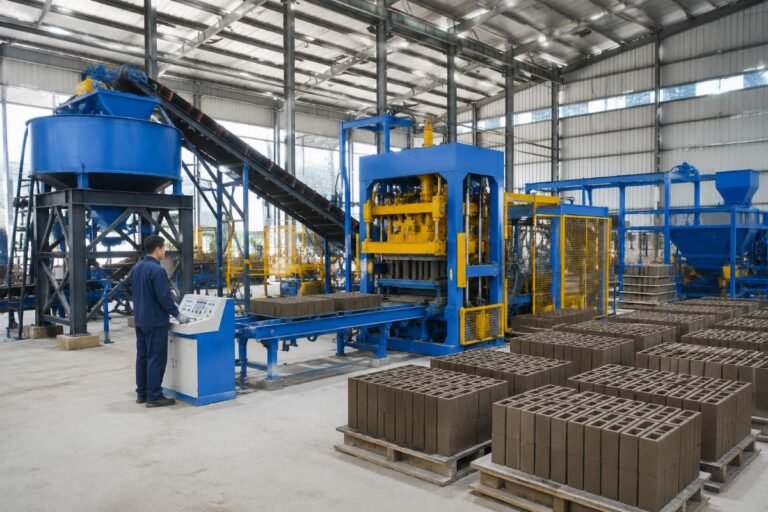
The upper tier includes complete turnkey production lines: batching plant, mixer, conveyor system, pallet circulation, stacker, and the brick machine itself, all integrated under one control platform. For a German buyer importing from China, the landed price of such a line is substantially higher than the machine alone, but it eliminates the integration headaches of sourcing components from multiple vendors.
| Tier | Machine Type | Automation | Component Origin | Typical Buyer Profile |
|---|---|---|---|---|
| Entry | QT4-15 / QT6-15 | Semi-auto / Manual | Mixed, basic | Pilot plant, small investor |
| Mid | QT10-15 / QT12-15 | Fully automatic | Configurable, European options available | Commercial block plant |
| Upper | Complete turnkey line | Fully integrated | Full line from single manufacturer | Established manufacturer, distributor |
The key insight: when you see a brick machine price in Germany quoted by different suppliers, the number means almost nothing until you know which tier it belongs to and what is included in the scope of supply.
How to Compare Chinese vs European Brick Machine Quotes?
The price gap between a Chinese quotation and a European or Turkish quotation for the same nominal machine class is real, but the root cause is not quality—it is supply chain structure and labor cost differentials.
Chinese manufacturers operate within dense industrial clusters where steel fabrication, hydraulic assembly, electrical cabinet wiring, and mould machining are all within a short logistics radius. This cluster effect compresses production costs substantially. Meanwhile, core components like PLCs, hydraulic pumps, and proportional valves can be specified from European brands on request. The machine is assembled in China, but its nervous system and circulatory system can be entirely European. [NEED_CITE: industrial cluster cost advantage analysis for Chinese construction machinery manufacturing]
Here is how a configuration-level comparison actually works, using the QT10-15 as the reference model:
| Component | Low-Cost Quote (Opaque) | Transparent Quote (Chinese Supplier with EU Options) | European Native Quote |
|---|---|---|---|
| PLC | "Imported brand" (unspecified) | Specified brand, model, and I/O count listed | Specified, integrated |
| Hydraulic valves | No brand, no origin | Proportional valves from recognized EU or Japanese brand, verifiable | Native EU brand, integrated |
| Mould steel | Thickness stated as a range, no heat treatment spec | Exact thickness, steel grade, and heat treatment process documented | Documented, often premium alloy |
| Welding structure | Not mentioned | Stress-relieved, shot-blasted, painted with marine-grade coating | Documented |
| Spare parts pricing | Quoted separately at high markup | Priced at transparent rates, bundled options available | Typically high, bundled in service contracts |
| After-sales response | Vague "online support" | Named engineer pool, response commitment, spare parts warehouse location | Local service team, fast response |
A buyer in Hannover once told me that European brands feel safer because "the engineer shows up the next day." That is a fair expectation. But Chinese头部 manufacturers have established spare parts warehouses and resident engineers in Europe, and response commitments of one to two days are now standard for serious suppliers. The old assumption that Chinese equipment means slow after-sales is outdated. [NEED_CITE: after-sales service infrastructure of Chinese construction machinery exporters in the EU]
The honest comparison is not brand against brand. It is configuration against configuration, component by component, with verifiable part numbers and documented material certificates.
What Hidden Costs Should German Buyers Expect Beyond the Machine Price?
The brick machine price in Germany is only the starting point. The total cost of ownership includes at least five cost layers that never appear on the machine quotation.
First, ocean freight. A fully loaded QT10-15 line requires multiple containers, and freight rates fluctuate with global shipping conditions. Second, EU import duties and VAT, which are calculated on the CIF value and must be factored into your cash flow before the machine even reaches your site. Third, on-site installation and commissioning, which includes the supplier’s engineer travel, accommodation, and daily allowance for the duration of the setup and training period. Fourth, spare parts inventory, because running a production line without a critical spare on the shelf is a gamble with your revenue. Fifth, energy consumption and maintenance labor, which compound over the life of the machine. [NEED_CITE: total cost of ownership framework for imported capital equipment in the European Union]
I have seen buyers celebrate a low machine price and then discover that the spare parts markup alone erased the savings within the first year. One buyer in Bavaria ordered a machine at a price that looked attractive, only to find that a single mould replacement cost several times what it would have from a transparent supplier. The lesson was expensive.
| Cost Layer | Visibility on Quotation | Impact if Ignored |
|---|---|---|
| Ocean freight | Separate line item, variable | Budget overrun |
| Import duties and VAT | Calculated on CIF value | Cash flow surprise |
| Installation and commissioning | May be excluded or vague | Delayed production start |
| Spare parts | Often quoted separately at high markup | Margin erosion over time |
| Energy and maintenance labor | Rarely included | Underestimated operating cost |
The discipline is to build a total cost of ownership model before you sign anything. Add the machine price, freight, duties, installation, a realistic spare parts budget for the first year, and estimated energy consumption. Only then can you compare two quotations on an honest basis.
How to Verify a Chinese Brick Machine Supplier’s Credibility?
Credibility is not proven by a glossy brochure. It is proven by verifiable certifications, documented European reference sites, and a willingness to let you inspect the configuration details under a microscope.
Start with certifications. CE marking is mandatory for machinery sold into the EU, and SGS or TÜV third-party inspection reports add a layer of independent verification. ISO certification speaks to the manufacturer’s quality management system. These documents should be available for download or verification, not just mentioned in passing. [NEED_CITE: CE marking requirements for concrete block making machinery in the European Union]
Next, ask for European reference sites. A credible supplier will have machines running in Germany or neighboring countries and will allow you to contact those buyers or arrange a site visit. If the supplier hesitates or can only name projects in regions with no independent verification infrastructure, treat that as a yellow flag.
Then, test their technical transparency. Ask for the exact PLC model, the hydraulic valve brand and origin, the mould steel grade and thickness, and the heat treatment process. A supplier who answers with specifics and provides material certificates is operating at a different level than one who answers with generalities.
Finally, evaluate the after-sales commitment. How many engineers are available for overseas dispatch? What is the committed response time for critical faults? Is there a spare parts warehouse in Europe, and where exactly is it located? These are not marketing questions; they are operational risk questions.
What Is the ROI Timeline for a Block Production Line in Germany?
The return on investment for a block production line in Germany depends on three variables: daily capacity utilization, unit margin driven by raw material and energy costs, and local market demand for concrete block products.
A fully automatic QT10-15 line running at reasonable capacity utilization in a market with steady construction demand can recover its total investment within a period that typically falls in the range of one and a half to three years. The upper end of that range applies when the buyer has underestimated operating costs or overestimated market absorption. The lower end applies when the buyer has negotiated a transparent total cost of ownership, secured competitive raw material supply, and maintains high machine uptime through disciplined preventive maintenance. [NEED_CITE: return on investment benchmarks for concrete block production lines in Western Europe]
The critical discipline is to model the ROI before purchase, not after. Calculate your expected daily output, multiply by the net margin per block after raw material, energy, and labor costs, multiply by the number of working days per year, and divide by the total landed and operational cost of the line. If the result is a payback period that meets your investment criteria, proceed. If it does not, no amount of negotiation on the machine price alone will fix the economics.
Conclusion
The brick machine price in Germany is a function of configuration depth, supply chain transparency, and total cost of ownership discipline—not just the number on the proforma invoice. Compare quotations component by component, model your hidden costs before signing, verify supplier credibility through certifications and European references, and calculate your ROI with realistic operating assumptions. The buyers who do this work upfront are the ones who run profitable plants for decades.
Leave a Reply