

QT10-15 Brick Machine Price in Malaysia: 2026 Wholesale Supplier Guide
Most buyers fixate on the FOB price tag, then get blindsided by voltage mismatches, hidden freight surcharges, and hydraulic failures in tropical humidity.
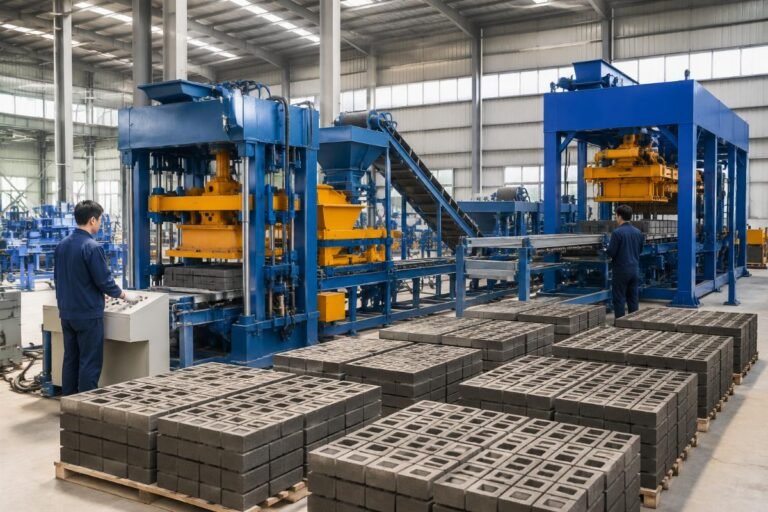
The real brick machine price in Malaysia for 2026 is not a single number—it is a layered cost structure: base equipment (FOB), ocean freight to Port Klang, SST import duties, 415V motor rewinding or replacement, and on-site commissioning. A QT10-15 automatic line typically lands at a mid-six-figure USD equivalent once all local adaptation costs are included, while a semi-auto QT6-15 entry package stays comfortably within reach for first-time investors.
I still remember a container that arrived in Johor Bahru a few years back. The buyer had ordered a fully automatic line based purely on the cheapest quotation he could find online. Within weeks, the main hydraulic pump seized. The root cause was not poor manufacturing—it was that the machine’s electrical cabinet was wired for a voltage grid that did not match Malaysia’s industrial standard, and the local ambient temperature pushed the hydraulic oil beyond its thermal threshold during continuous summer operation. The replacement parts, emergency technician flights, and weeks of idle production cost several times the original savings he thought he had secured. That is the reality behind every brick machine price in Malaysia discussion. [NEED_CITE: Malaysia’s industrial voltage standard specification for three-phase equipment]
Let us break down what actually determines the brick machine price in Malaysia this year, which model fits which budget, and where the hidden costs hide.
What is the Real Cost of a Brick Machine in Malaysia in 2026?
The brick machine price in Malaysia must be evaluated on a CIF-to-factory basis, not just the FOB invoice.
When Malaysian buyers request a quotation, the first number they see is almost always the FOB price at a Chinese port. But the FOB figure excludes ocean freight, marine insurance, Malaysian import duties under the SST framework, customs clearance fees, inland transport from Port Klang or Tanjung Pelepas to the factory site, and—critically—any electrical or mechanical modifications required to meet local standards. [NEED_CITE: Malaysia’s SST tariff classification for concrete block making machinery]
A typical cost stack for a complete automatic line looks like this:
| Cost Layer | Typical Composition | Risk if Ignored |
|---|---|---|
| FOB Equipment Price | Base machine, standard moulds, basic control panel | Low—this is the transparent part |
| Ocean Freight | FCL shipping to Port Klang or Tanjung Pelepas | Moderate—freight rates fluctuate seasonally |
| Import Duty & SST | Malaysian customs classification and sales tax | High—misclassification triggers penalties |
| Voltage Adaptation | Motor rewinding, contactor replacement, PLC rewiring | Severe—can destroy the main drive system |
| Inland Transport & Rigging | Crane hire, flatbed truck, foundation prep | Moderate—often underestimated |
| Commissioning & Training | Overseas engineer deployment, local operator training | High—untrained operators cause premature wear |
A private investor in Selangor once compared three quotations side by side. The cheapest FOB offer was noticeably lower than the other two. But when we added the freight, the SST duty, and the cost of replacing all motors to match the local 415V three-phase standard, the "cheap" option ended up costing substantially more than the mid-range quotation that had already included voltage adaptation in the base price. The brick machine price in Malaysia is only honest when it is presented as a landed cost. [NEED_CITE: comparative landed cost analysis for concrete block machinery imports into Malaysia]
Which Model Fits Your Budget: QT6-15 vs. QT10-15?
The right model depends on your daily output target, available floor space, and willingness to manage manual labor—not on which machine looks more impressive.
Malaysia’s construction sector continues to demand concrete blocks, interlocking pavers, and hollow blocks for both public housing projects and private developments. [NEED_CITE: Malaysia’s construction output demand trends for concrete masonry units] The two most commonly requested models for the Malaysian market are the semi-automatic QT6-15 and the fully automatic QT10-15. Here is how they compare across the dimensions that actually matter to a buyer:
| Parameter | QT6-15 (Semi-Auto) | QT10-15 (Full-Auto) |
|---|---|---|
| Daily Output Capacity | Moderate—suitable for small-to-medium yards | High—designed for large-scale commercial plants |
| Operator Requirement | Noticeably higher manual involvement | Substantially reduced—PLC-controlled cycle |
| Floor Space | Compact—fits tighter urban industrial lots | Larger—requires dedicated batching and stacking zones |
| Mould Changeover | Relatively quick—good for mixed product runs | Longer—optimized for sustained single-product runs |
| Maintenance Complexity | Lower—fewer automated subsystems | Higher—hydraulic and servo systems need disciplined upkeep |
| Ideal Buyer Profile | First-time investors, small yards, flexible product mix | Established plants, government tender contractors, high-volume paver producers |
A contractor in Perak initially wanted the QT10-15 because he assumed bigger meant more profitable. After walking through his actual daily order volume, his available shed space, and the fact that he would be producing four different block sizes in rotating weekly batches, the QT6-15 turned out to deliver a faster payback. The flexibility to swap moulds without extended downtime, combined with lower electrical consumption and simpler maintenance, matched his operational reality far better. The brick machine price in Malaysia for a QT6-15 line is meaningfully lower, but more importantly, the operating cost per block in his specific scenario was also lower.
Conversely, a government housing contractor in Sabah needed the QT10-15 because his tender required certified daily output volumes that only a fully automatic line with integrated batching, conveying, and stacking could reliably deliver. For him, the higher brick machine price in Malaysia for the QT10-15 configuration was justified by the contractual volume guarantees and the reduced labor dependency in a region where skilled machine operators are harder to retain.
Hidden Costs: Voltage, Raw Materials, and Shipping
Three budget items routinely catch Malaysian buyers off guard: 415V electrical compliance, tropical hydraulic thermal management, and ocean freight insurance for heavy machinery.
Let me address each one directly.
Voltage mismatch is the single most expensive mistake. Malaysia’s industrial three-phase supply runs at 415V/50Hz. Many standard Chinese factory configurations ship with 380V motors and contactors. The difference looks small on paper. In practice, running a 380V motor on a 415V grid without proper adaptation causes insulation stress, overheating, and eventual burnout—especially under the continuous heavy-load cycles of a block machine. Rewinding or replacing every motor, contactor, and variable frequency drive after the machine arrives on site costs several times more than specifying the correct voltage at the order stage. Reputable manufacturers handle this during production by wiring the control cabinet and selecting motors rated for the destination grid. [NEED_CITE: Malaysia’s industrial electrical supply standard for three-phase machinery]
Tropical climate demands hydraulic system adaptation. Malaysia’s year-round high temperature and humidity push hydraulic oil temperatures well beyond what a temperate-climate machine design expects. Without an adequately sized oil cooler and heat-resistant seals, the hydraulic system will degrade prematurely. I have seen machines where the hydraulic oil turned dark and sludgy within months because the cooling circuit was sized for a northern Chinese winter, not a Malaysian dry season. Specifying an oversized hydraulic oil cooler and high-temperature-rated hoses at the order stage is a minor line item that prevents major downtime.
Freight and insurance are not optional extras. A complete QT10-15 line fills multiple containers. Ocean freight rates fluctuate, and marine insurance for heavy industrial equipment is calculated on the CIF value, not the FOB value. Buyers who skip insurance to save a small percentage occasionally discover that a single container damaged during rough seas—saltwater intrusion into the electrical cabinet, for example—results in a mid-six-figure replacement bill. [NEED_CITE: marine cargo insurance claim frequency for heavy machinery shipments to Southeast Asia]
The brick machine price in Malaysia only becomes predictable when these three factors are addressed before the purchase order is signed, not after the machine arrives at the port.
ROI Analysis: How Fast Can You Break Even?
Payback period in Malaysia is driven by block selling price, cement cost, labor cost, and machine uptime—not by the purchase price alone.
A realistic ROI calculation for a Malaysian block yard needs to account for the following variables:
- Revenue side: Current market selling price per piece for standard hollow blocks, solid blocks, and interlocking pavers in your specific state. Prices vary noticeably between Klang Valley, Penang, Johor, and East Malaysia. [NEED_CITE: average market price per concrete block unit in Malaysia by region]
- Cost side: Cement, sand, aggregate, fly ash or quarry dust (Malaysia has abundant coal-fired power station byproducts that can partially replace cement at meaningful cost savings), water, electricity, and labor.
- Machine uptime: A well-maintained machine with correct voltage adaptation and tropical-spec hydraulics runs substantially more hours per month than one that suffers recurring electrical or hydraulic failures. Every day of unplanned downtime represents lost revenue against fixed costs like land lease and loan repayments.
A first-time investor running a QT6-15 in a semi-urban yard near Ipoh, producing standard hollow blocks with a local sand-quarry dust mix, can expect the equipment cost to be recovered within a timeframe that is considered healthy for this asset class in Malaysia. The key variables that compress or extend that payback window are raw material sourcing efficiency and machine uptime.
For a QT10-15 operation supplying a government housing project, the daily volume is much higher, the per-block margin may be tighter due to tender pricing, but the absolute monthly revenue is substantially larger. Payback in that scenario is driven by consistent order flow and the machine’s ability to sustain high-shift operation without breakdowns.
The brick machine price in Malaysia is only one input to this equation. The other inputs—what you pay for raw materials, what you sell each block for, and how many hours per month the machine actually runs—determine whether your investment pays back quickly or drags.
Conclusion
The brick machine price in Malaysia is a composite figure, not a catalog number. Evaluating it honestly means adding freight, duties, voltage adaptation, tropical climate modifications, and commissioning costs to the base equipment price. Choosing between a QT6-15 and a QT10-15 depends on your actual production volume, product mix flexibility, and labor situation—not on assumptions about automation always being better. And calculating ROI requires local selling prices, local raw material costs, and a realistic estimate of machine uptime under Malaysian operating conditions. Get these inputs right before you sign, and the numbers will work.
Leave a Reply