

Buy QT4-25 Block Machine Full Line Package from Manufacturer
The mainframe is the cheapest part of your block plant. The real money sinks into auxiliary equipment, moulds, electrical adaptation, and on-site commissioning that most suppliers conveniently leave off the quotation sheet.
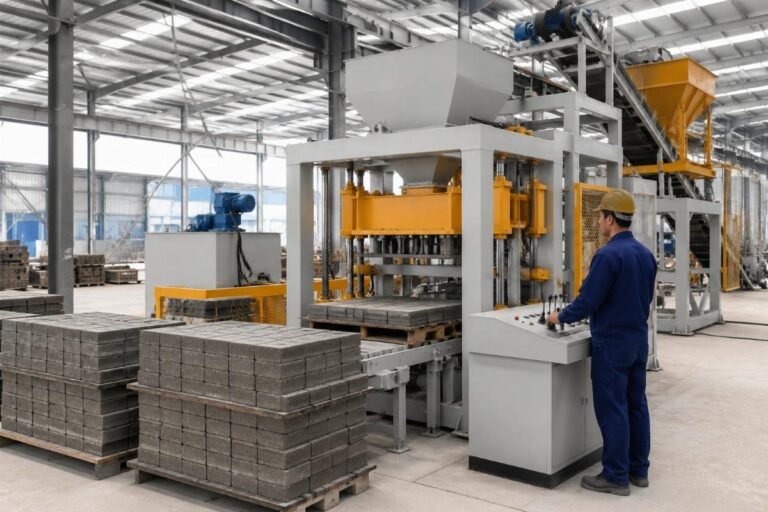
A complete QT4-25 block machine full line package includes the egg-laying mobile host, a matched concrete mixer, cement silo, belt conveyors, pallet circulation system, a set of moulds for your target brick profiles, a localized control panel, and—critically—on-site installation with operator training. Buying the host alone and sourcing auxiliaries locally almost always ends in mismatched cycle times, burnt PLC boards, and months of idle downtime.
I still remember the first time I flew to Lagos to debug a line we had shipped. The client kept calling me at midnight, shouting that the control board had fried again. We had spec’d a standard voltage panel, but the local grid in his industrial zone swung between levels that would trip most sensitive electronics within minutes. We ended up redesigning the entire electrical cabinet with wide-tolerance components and adding galvanic isolation before the line finally ran stable. That job taught me something no brochure mentions: a QT4-25 block machine full line package only works if every component is validated against the actual site conditions where it will operate, not the conditions assumed in a factory test bay. [NEED_CITE: voltage fluctuation impact on industrial control equipment in Sub-Saharan Africa per IEC standards]
Let me walk you through what actually matters when you are putting together a working line, not just a shopping list.
What Exactly Is Included in a QT4-25 Full Line Package?
A genuine full line package covers five functional modules: material preparation, forming, curing support, mould variety, and electrical control—plus the human element of commissioning and training.
Too many first-time buyers compare only the host machine price across quotations, then discover later that the mixer is undersized, the pallet loop cannot keep up with the cycle time, or the mould set only produces one brick shape when their market demands several. Here is how a properly scoped package breaks down:
| Module | Basic Quotation | Full Line Package |
|---|---|---|
| Mobile egg-laying host | Included | Included, with matched output rating |
| Concrete mixer | Not included | Batch mixer sized to host cycle |
| Cement silo & screw feeder | Not included | Sized to daily output target |
| Belt conveyors | Not included | Length matched to site layout |
| Pallet circulation | Not included | Loader, return conveyor, buffer |
| Mould set | One standard mould | Multiple profiles for market mix |
| Control panel | Standard generic | Localized voltage & protection |
| Installation & training | Buyer arranges | Engineer dispatched, operator trained |
[NEED_CITE: typical component breakdown of semi-automatic concrete block production lines in emerging market exports]
A private investor in Tanzania once told me he bought a cheap host from one supplier, a mixer from another, and fabricated the conveyor frame locally. The mixer discharge height did not match the host hopper inlet. The pallet return conveyor ran at a different speed than the host cycle. He spent months retrofitting before daily output reached even half of what the host nameplate suggested. A QT4-25 block machine full line package eliminates that integration risk because one engineering team designs the entire material flow as a single system.
How Do You Match the Line to Your Local Power Grid and Site Conditions?
Voltage instability is the single most underestimated cause of premature component failure in emerging market block plants, and no amount of external stabilizers fully replaces proper electrical design at the source.
When I spec a QT4-25 block machine full line package for a new market, the first question I ask is not about brick size—it is about the transformer capacity at the site boundary and the actual measured voltage swing during peak hours. In many parts of West Africa and South Asia, the grid can drop well below nominal during rainy season or surge when large industrial neighbors cycle their equipment. A standard control panel designed for stable three-phase supply will see its PLC boards, contactors, and frequency inverters fail in rapid succession under those conditions.
The correct approach involves several layers of adaptation:
- Transformer sizing: Calculate total connected load of the full line including motor starting surge, then add a margin for grid headroom. Under-specifying the transformer causes voltage dip at every motor start, accelerating insulation breakdown across the entire line. [NEED_CITE: transformer sizing methodology for industrial motor loads with high inrush current]
- Wide-tolerance PLC and VFD selection: Components rated for narrow voltage bands will trip or burn. Specify units with broad input tolerance and built-in surge suppression.
- Galvanic isolation: Separate the control circuit power from the motor circuit power using isolation transformers. This prevents motor-start voltage dips from resetting the PLC mid-cycle.
- Dust and humidity protection: In dusty environments common at block yards, the control cabinet must be sealed to a protection rating that prevents conductive dust from bridging circuit board traces.
A client in Ethiopia had a site on a slope. Instead of flattening the ground—which would have cost a small fortune in earthworks—we designed the layout so the mixer platform sat at the higher elevation and gravity fed the batch into the host hopper. The belt conveyor length dropped noticeably, cutting both the motor load and the daily electricity cost. That kind of site-specific thinking is what separates a QT4-25 block machine full line package engineered for your yard from one copied from a catalog.
What Are the Hidden Costs and Realistic ROI Timeline for a Semi-Auto Block Plant?
The equipment invoice is only the opening chapter of your total investment. Logistics, foundation work, electrical upgrades, mould expansion, and consumable wear all shape when you actually start profiting.
First-time buyers often fixate on the FOB price of the QT4-25 block machine full line package and then get blindsided by costs they never budgeted for. Let me list the items that routinely surprise my clients:
- Ocean freight and inland haulage: A full line fills multiple containers or requires flat-rack shipping for oversized items like the silo. Inland transport from port to site in landlocked countries can rival the ocean freight cost itself. [NEED_CITE: freight cost structure for heavy machinery exports to landlocked African destinations]
- Foundation and steelwork: The mixer platform, silo base, and host running track all require reinforced concrete foundations. Local civil work costs vary enormously and are never included in the machine price.
- Electrical infrastructure: Bringing adequate three-phase power to a greenfield site, installing the transformer, and laying armored cable can represent a significant line item in countries where the grid connection point is far from the yard.
- Mould expansion: You start with a few mould profiles, but market demand will push you to add interlocking shapes, paving stones, or hollow blocks of different cell counts. Each mould is a separate purchase.
- Pallet consumption: Wooden or bamboo pallets are wear items. In a humid climate, expect to replace a portion of your pallet stock periodically. Concrete-stick residue accelerates this wear.
- Cement and aggregate cost per block: Your ROI model lives or dies on the gap between your production cost per block and the local selling price. Raw material sourcing distance, cement bag price volatility, and aggregate quality all feed into this margin.
[NEED_CITE: investment return modeling methodology for small-scale concrete block manufacturing in developing economies]
A buyer in Ghana ran his numbers assuming the host would run at maximum theoretical cycle time around the clock. In reality, mixer batching, pallet loading, and worker shift changes created gaps. His actual daily output was noticeably lower than the nameplate claim. When we sat down and re-modeled with realistic cycle allowances, his payback period extended, but the project still made sense—because we also identified that switching to a locally available volcanic aggregate blend cut his material cost per block substantially. The QT4-25 block machine full line package had to be adjusted to handle that aggregate’s different density and abrasiveness, which meant tweaking the mixer blade configuration and vibration duration.
How to Verify a Supplier’s Turnkey Capability Before Placing an Order?
Ask for evidence of past installations in your region, request the electrical adaptation documentation they prepared for those sites, and confirm that on-site training is contractually binding—not a verbal promise.
The gap between a supplier who says "turnkey" and one who actually delivers a running plant is enormous. I have seen buyers receive machines at the port with no installation manual in their language, no wiring diagram matching their local voltage, and a training "offer" that turned into a daily billing surprise. When you are evaluating who to trust with your QT4-25 block machine full line package, here is what I recommend you check:
- Reference installations in similar grid and climate conditions: Ask for at least a few sites in countries with comparable voltage stability, dust levels, and ambient temperature. A supplier who has only shipped to markets with perfect infrastructure has not stress-tested their engineering.
- Electrical customization documentation: Before order confirmation, request a sample single-line diagram showing how they adapt the control panel for your voltage range. If they cannot produce one, or if it looks identical to their standard offering regardless of country, walk away. [NEED_CITE: electrical customization requirements for industrial machinery exported to regions with unstable power supply]
- Mould trial and recipe support: A credible turnkey supplier will offer to test your local raw materials in their lab, propose a mix design, and cast trial blocks to verify compressive strength before you commit. This step alone prevents months of on-site trial and error.
- Contractual commissioning scope: The installation clause should specify the number of engineer days included, what "successful commissioning" means in measurable terms, and what operator training covers. Vague language here is where disputes are born.
- Spare parts availability and pricing: Confirm the cost and lead time for critical wear parts—mould liners, vibration motor bearings, conveyor belt segments, PLC modules. A QT4-25 block machine full line package is only as reliable as the supply chain behind it.
At our facility in Linyi, we have built and shipped complete lines to clients across multiple regions in Africa, the Middle East, Latin America, and Southeast Asia. Each order goes through a site-condition review before engineering sign-off. The electrical cabinet gets built to the specific voltage tolerance documented for that client’s grid. The mould set gets matched to the brick profiles that sell in that market. And the commissioning engineer stays on-site until the local crew can run the line independently. That is what a real QT4-25 block machine full line package looks like when it leaves our floor.
Conclusion
Buying a QT4-25 block machine full line package is an exercise in system thinking, not component shopping. Validate every element against your actual voltage, your actual site layout, and your actual market demand. Confirm that your supplier has proven experience adapting lines to conditions like yours—not just shipping boxes to your port. When the engineering is done right before the machines leave the factory, the difference shows up in daily output, in maintenance intervals, and in how quickly your investment starts paying you back.
Leave a Reply