

QT10-15 Block Machine Supplier for USA: China Factory Direct
European premium pricing is not quality—it is localized service cost baked into the invoice.
The right block machine supplier for USA operations must deliver NEMA-rated electrical enclosures, PLC systems with open communication protocols compatible with North American batch plants, and voltage configurations engineered for 480V 3-phase 60Hz grids—not just a transformer bolted onto a 380V design.
I still remember standing in a Texas warehouse, watching a customer’s electrician trace wires with a multimeter because he could not read our Chinese-labeled control panel. We spent three days on video calls while he matched terminal numbers to schematics. That project shipped on time, but the commissioning delay cost both of us money and patience. Since then, every machine leaving our Linyi facility for North America gets NEMA-rated enclosures, fully English HMI screens, and wiring diagrams drawn to NEC color codes [NEED_CITE: NEC Article 310 conductor color identification standards].
If you are evaluating a block machine supplier for USA production, the conversation must start with three non-negotiable technical requirements before anyone talks about price or delivery.
What Three Hard Specs Should US Buyers Check First?
Voltage compliance, PLC protocol openness, and electrical enclosure rating are the three filters that separate a working production line from a paperweight.
Most buyers assume voltage adaptation means swapping a transformer. The reality is more complex. The US 480V 3-phase grid experiences voltage fluctuations that can trigger PLC shutdowns if the power conditioning is inadequate [NEED_CITE: IEEE 141 voltage tolerance recommendations for industrial motor loads]. A standard 380V motor rewound for 480V without proper insulation class upgrades will overheat under continuous production cycles. The solution requires custom voltage stabilization modules, not just transformer taps.
The second filter is PLC communication. American batch plants typically run on Modbus TCP, Profibus, or EtherNet/IP. If your block machine’s PLC speaks a proprietary protocol or lacks open interface ports, integration with existing silo weighing systems and cement conveyors becomes a custom engineering project—charged at American hourly rates.
The third filter is enclosure protection. NEMA 4X ratings provide corrosion resistance and watertight sealing that IP65 does not fully replicate in outdoor American plant environments [NEED_CITE: NEMA 250 enclosure type ratings comparison with IEC IP codes]. Dust from aggregate storage, humidity from curing areas, and temperature swings demand enclosures built to NEMA standards, not adapted IP ratings.
| Specification | NEMA-Compliant Configuration | Standard Export Configuration |
|---|---|---|
| Enclosure Rating | NEMA 4X certified | IP55 basic protection |
| PLC Protocol | Modbus/Profibus/EtherNet/IP open | Proprietary or single-protocol |
| Voltage Handling | 480V 60Hz with stabilization module | 380V 50Hz with transformer adapter |
| HMI Language | Full English with NEC wiring labels | Chinese primary with English overlay |
| Commissioning Support | On-site with English-speaking technicians | Remote guidance only |
A block machine supplier for USA markets who cannot check all three boxes is selling you a machine, not a production solution.
QT10-15 vs QT12-15: Which Model Fits Your US Operation?
The choice between QT10-15 and QT12-15 depends on daily output targets, available footprint, and payback timeline—not on which model sounds more powerful.
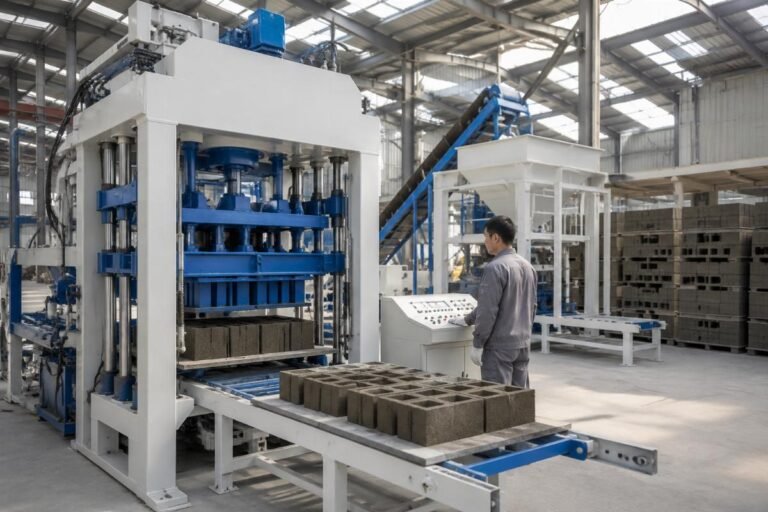
The QT10-15 produces roughly ten standard blocks per cycle with a mold area suited for medium-volume operations. The QT12-15 increases mold coverage for higher daily tonnage but demands more raw material staging space, larger curing areas, and higher electrical capacity.
| Parameter | QT10-15 | QT12-15 |
|---|---|---|
| Daily Output Capacity | Medium-volume production | High-volume production |
| Mold Area | Standard block formats | Extended mold coverage |
| Footprint Requirement | Moderate | Substantially larger |
| Electrical Load | Standard industrial service | Higher capacity demand |
| Curing Area Need | Standard | Noticeably expanded |
| Investment Recovery | Shorter cycle for entry operations | Extended cycle for scaling operations |
A concrete products manufacturer in the Southeast considered the QT12-15 for a facility expansion. Their existing curing yard could not accommodate the increased pallet flow without civil construction. We recommended the QT10-15 paired with an accelerated curing protocol, which met their daily tonnage target within their current footprint. The QT12-15 would have required a mid-six-figure site modification before the machine could reach rated output.
Another buyer in the Midwest operated a two-shift operation targeting municipal contracts. Their volume commitments justified the QT12-15’s higher throughput, and their facility had the staging capacity to support it. The investment recovery timeline stretched longer, but the per-unit production cost dropped noticeably at scale.
The right block machine supplier for USA projects will ask about your curing layout before quoting model numbers.
Where Does China Factory Direct Actually Save Money?
The price gap between Chinese-manufactured and European-branded block lines is not about labor cost arbitrage—it is about stripping out localization overhead that American buyers do not need.
European manufacturers build service networks, regional warehouses, and dealer margins into their pricing structures. These costs are legitimate for buyers who need same-day technician dispatch. But for operators who can handle routine maintenance and have access to local electrical contractors, paying for a European service infrastructure that sits idle most of the year is pure overhead [NEED_CITE: total cost of ownership analysis for capital equipment with regional service networks].
When you source directly from a Chinese factory, you eliminate the regional distributor margin, the brand premium, and the cost of maintaining a North American parts warehouse that turns inventory slowly. What remains is the engineering, manufacturing, and commissioning capability—delivered at a price point that reflects actual production cost rather than service network amortization.
A block machine supplier for USA operations working on a factory-direct model typically offers pricing substantially below European equivalents. The savings can fund on-site commissioning support, spare parts inventory, and operator training—services that European brands charge separately or bundle into higher base pricing.
The trade-off is clear: factory-direct sourcing requires the buyer to take ownership of routine maintenance, local electrical compliance verification, and day-to-day operational decisions. For operators with technical capability or access to local mechanical talent, this trade-off delivers significant capital efficiency.
How Does a Chinese Supplier Deliver Turnkey Installation in the US?
Fifteen to thirty days from order to container loading, followed by on-site commissioning and operator training, is the delivery model that makes factory-direct sourcing viable for American buyers.
The process begins with site layout consultation. Before steel is cut, the supplier reviews your facility dimensions, raw material storage locations, curing area configuration, and electrical service capacity. This prevents the common failure mode where a machine arrives and does not fit the planned workflow.
Electrical engineering follows. The supplier’s technical team designs the control system to match your specific voltage service, coordinates with your local electrician on NEC-compliant wiring, and prepares English-language schematics. This step eliminates the Texas warehouse scenario I described earlier.
Container loading is planned for complete line delivery—machine, batching system, conveyors, pallet handling, and cement silos in coordinated shipments. Partial shipments create installation delays and demurrage charges.
On-site commissioning requires English-speaking technicians who understand both the machine and American electrical codes. The commissioning team calibrates vibration systems, verifies PLC communication with your batch plant, trains operators on daily maintenance, and stays through the first full production shift.
A block machine supplier for USA projects who offers remote-only support is asking you to solve integration problems that their technicians could resolve in days. The difference between remote guidance and on-site presence is measured in lost production days, not in service fee invoices.
Conclusion
Technical compliance with American electrical standards, open PLC architecture, and on-site commissioning support are the three pillars that make Chinese factory-direct block machine sourcing viable for US production.
Choosing the right block machine supplier for USA operations means prioritizing integration capability over lowest invoice price. The QT10-15 and QT12-15 models serve different production scales, and the right choice depends on your facility constraints and volume targets. Factory-direct pricing delivers capital efficiency when buyers accept operational ownership, and turnkey delivery with on-site support closes the gap between equipment arrival and first profitable shift.
Leave a Reply