

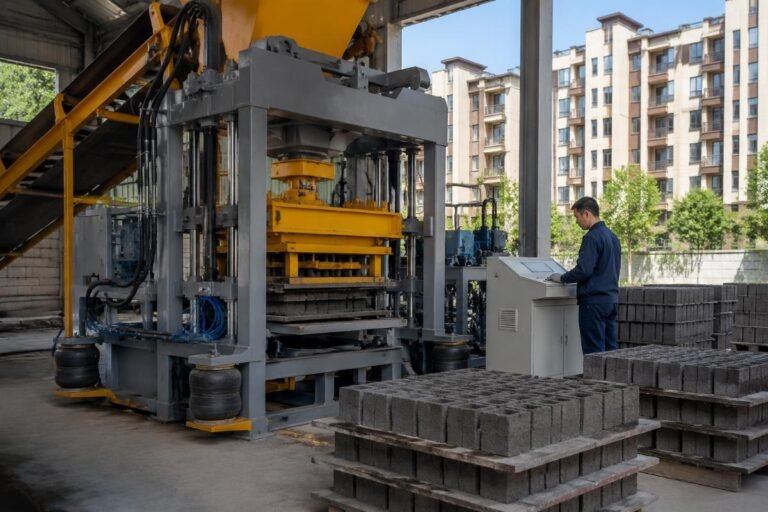
QT10-15 Concrete Block Machine Wholesale Supplier China Factory
Cheaper upfront pricing often masks total ownership costs that multiply across shipping, voltage adaptation, spare parts, and unplanned downtime. Selecting a reliable concrete block machine China supplier requires verifying factory credentials, matching equipment specifications to local production targets, and confirming after-sales infrastructure—never choosing on unit price alone.
A qualified concrete block machine China supplier must pass four verification checkpoints: documented factory scale, export history across multiple regions, certification coverage for the complete production line rather than isolated components, and proven after-sales response capability including on-site commissioning and lifetime spare parts supply.
I still remember a shipment that went sideways early in my career. A West African buyer ordered a full automatic line, and everything looked perfect on paper—specs matched, payment cleared, containers loaded. But when the machines landed and powered up, the local grid fluctuated so violently that control boards fried within the first week. The buyer was furious. The root cause had nothing to do with manufacturing quality; it was a failure to ask about transformer capacity and backup power availability before shipping. That situation could have been prevented with a simple pre-order checklist covering site conditions. [NEED_CITE: common causes of PLC failure in industrial equipment across unstable power grids]
The lesson stuck: evaluating a concrete block machine China supplier means looking far beyond the quotation sheet.
What Types of Concrete Block Machines Do Chinese Suppliers Offer?
Chinese manufacturers cover the full spectrum from manual egg-laying units to fully automated PLC-controlled production lines, and matching machine type to daily output targets is the single most important decision in the purchasing process.
The market is broadly segmented into three tiers. Manual and semi-automatic machines suit startups with limited capital and smaller daily volumes. Semi-automatic lines with basic PLC control serve growing operations that need consistency but cannot yet justify full automation. Fully automatic lines with integrated batching, mixing, conveying, stacking, and pallet cycling target industrial-scale producers and government tender projects.
| Machine Category | Daily Output Range | Operator Requirement | Automation Level | Site Footprint |
|---|---|---|---|---|
| Manual Egg-Laying | Low | Minimal | Basic mechanical | Compact |
| Semi-Auto Stationary | Moderate | Small team | Partial PLC | Standard |
| Fully Auto Production Line | High | Compact crew | Full PLC integration | Large |
A private investor in East Africa once reached out after purchasing a fully automatic line based purely on maximum output claims. The machine was technically capable, but the local market demand and raw material supply chain could not sustain that volume. The equipment sat underutilized for months, and the return on investment stalled. A smaller semi-automatic unit would have matched actual demand perfectly and paid back much faster. [NEED_CITE: production capacity matching principles for small-scale block manufacturing]
When you approach a concrete block machine China supplier, bring your realistic daily target—not the theoretical maximum. A credible supplier will recommend the tier that fits your actual market, not the most expensive option in their catalog.
How to Verify a China Block Machine Supplier’s Credentials?
Credential verification must go deeper than website claims and require cross-referencing factory scale, export documentation, certification scope, and after-sales network evidence.
Start with factory scale. Request a live video walkthrough of the production floor—not a staged showroom tour. Look for actual welding stations, machining centers, assembly areas, and testing bays. A supplier with genuine manufacturing capability will have visible work-in-progress across multiple stages simultaneously. [NEED_CITE: methods to verify manufacturing facility claims of Chinese industrial equipment suppliers]
Next, examine export history. Ask for a list of destination countries and request references from at least two or three buyers in your region. A supplier who has shipped across multiple regions understands the variability of local conditions—voltage standards, climate extremes, raw material differences—and has engineered solutions accordingly.
Then scrutinize certifications. CE marking is frequently cited as a quality guarantee, but the critical question is whether the certification covers the entire production line or only a single electrical component. I have seen cases where a supplier presented a CE certificate that applied exclusively to the motor, while the structural frame, hydraulic system, and control panel had zero third-party verification. Always request the full certificate scope documentation. [NEED_CITE: CE certification scope verification for imported industrial machinery]
Finally, assess after-sales infrastructure. Does the supplier send engineers for on-site installation and commissioning? Is remote diagnostic support available? Can spare parts be shipped within a reasonable timeframe? A concrete block machine China supplier without a structured after-sales system is essentially selling you equipment and walking away.
What Are the Hidden Costs When Buying from China?
The quoted machine price typically represents only a portion of total investment; freight, voltage adaptation, spare parts reserves, installation, training, and downtime losses collectively determine true cost of ownership.
Freight is the most visible add-on. A full production line requires multiple containers, and ocean freight rates fluctuate. Port handling, customs clearance, and inland transport to your site add further layers. These costs are unavoidable but predictable if you plan ahead.
Voltage adaptation is less obvious but potentially more expensive. Industrial power standards vary significantly across regions. Equipment designed for one voltage frequency combination may require transformer upgrades, soft-start systems, or complete control panel rewiring at the destination. In regions with chronic grid instability, investing in voltage regulators and backup power systems becomes mandatory. I have seen adaptation costs rival the machine price itself when buyers discovered the mismatch too late. [NEED_CITE: industrial equipment voltage compatibility requirements for emerging market installations]
Spare parts reserves deserve separate budgeting. Wear parts—moulds, vibrator motors, hydraulic seals, conveyor belts—degrade with use. If you do not order an initial spare parts package with the machine, you will face extended downtime waiting for emergency shipments. Mould wear is particularly significant; mould lifespan depends on aggregate hardness, production volume, and maintenance practices. A buyer in Latin America reported mould replacement costs consuming a surprisingly large share of operating expenses because the local aggregate was far more abrasive than what was used in factory testing.
Training costs are often overlooked. Sending operators to the factory for pre-shipment training, or flying engineers to your site for commissioning and hands-on instruction, involves travel, accommodation, and lost production time during the learning curve.
| Cost Category | Visibility at Quotation Stage | Impact on Total Investment |
|---|---|---|
| Machine unit price | High | Moderate |
| Freight and logistics | Moderate | Noticeable |
| Voltage adaptation | Low | Substantially extended if unprepared |
| Spare parts reserve | Low | Noticeable |
| Installation and training | Moderate | Moderate |
| Downtime from mismatch | Very low | Potentially severe |
A credible concrete block machine China supplier will help you estimate these hidden costs transparently rather than presenting an artificially low headline price.
How to Ensure Equipment Works in Your Local Conditions?
Equipment reliability in the field depends on pre-order communication of site-specific parameters including power grid characteristics, ambient climate conditions, raw material properties, and available space layout.
Power supply details come first. Document your exact voltage, frequency, phase configuration, and—critically—the typical fluctuation range. If your grid experiences frequent drops or surges, the supplier needs to know so they can specify appropriate protection components, oversized transformers, or alternative control architectures. Standard electrical designs assume stable supply; emerging market realities often demand reinforced solutions.
Climate data matters more than most buyers realize. High ambient temperatures affect hydraulic oil viscosity and cooling system performance. Excessive dust infiltrates electrical cabinets and accelerates wear on moving parts. Coastal humidity promotes corrosion on untreated surfaces. A supplier who has exported to similar environments will already have design modifications available—enhanced filtration, tropical-grade hydraulics, corrosion-resistant coatings. [NEED_CITE: environmental factors affecting concrete block machine performance in tropical and arid climates]
Raw material characteristics directly influence mould design, mix ratios, and vibration parameters. The same machine setting that produces excellent blocks with crushed limestone may yield poor results with laterite or volcanic scoria. Share your aggregate sources, cement type, and water quality with the supplier before finalizing the order. Request test batches using your actual materials if possible.
Site layout constraints should be communicated early. Ceiling height, column spacing, door dimensions, and foundation conditions determine whether a standard production line configuration fits or requires customization. A supplier offering turnkey solutions should request your site drawings and provide a customized layout proposal before contract signing.
What After-Sales Support Should You Expect?
Professional after-sales support encompasses on-site installation, operator training, remote troubleshooting, and guaranteed spare parts availability throughout the equipment lifecycle.
On-site commissioning is non-negotiable for any line above basic manual equipment. A factory-trained engineer should supervise assembly, verify calibration, run test production, and confirm output quality before handing over the machine. This process typically spans multiple days and includes systematic adjustment of vibration intensity, pressing pressure, cycle timing, and mould alignment.
Operator training should cover daily startup procedures, routine maintenance schedules, troubleshooting common faults, and safety protocols. Insist on training multiple operators—not just one—so your production does not halt when a trained person is unavailable. Training in the local language, or at least with a translator present, dramatically improves knowledge retention. [NEED_CITE: best practices for operator training on imported industrial manufacturing equipment]
Remote diagnostic capability has become increasingly valuable. Modern PLC-controlled lines can transmit fault codes and operational data to the supplier’s engineering team for analysis. This enables faster problem resolution without waiting for a site visit. Verify that the control system supports this feature and that communication protocols are compatible with your local internet infrastructure.
Spare parts availability is the ultimate test of a supplier’s long-term commitment. Ask about standard lead times for common wear parts and critical components. A supplier maintaining dedicated spare parts inventory can ship within days; one relying on make-to-order production may leave you waiting for weeks. The concrete block machine China supplier you choose should treat spare parts supply as a core service, not an afterthought.
Conclusion
Selecting a concrete block machine China supplier is a multi-dimensional evaluation that extends well beyond price comparison. Verify factory credentials through direct evidence, match machine specifications to realistic production targets, budget for all hidden ownership costs, communicate site conditions before ordering, and confirm comprehensive after-sales support. Equipment that performs reliably in your specific environment—delivered by a supplier who understands local challenges—will generate returns far beyond what the cheapest quotation promises.
Leave a Reply