

Solid Block Machine Technical Data Sheet: Factory Direct Wholesale
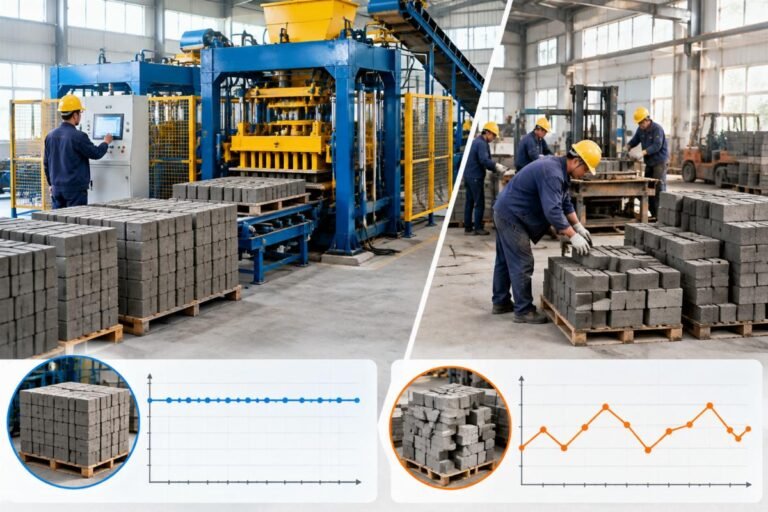
Higher tonnage does not guarantee better blocks; consistent vibration frequency and mold precision do.
A Solid Block Machine Technical Data Sheet is not merely a list of specifications; it is a critical site readiness checklist. Misinterpreting power requirements, hydraulic pressure settings, or foundation mass leads to immediate operational failure in emerging markets. Buyers must verify voltage stability, transformer capacity, and concrete curing times against the machine’s rated parameters before purchase to avoid costly downtime.
I have installed more block production lines in the industrial zones of Lagos and the suburbs of Addis Ababa than I have sold. Early in my career, during a售后 deployment in Nigeria, a client connected a QT8-15 unit directly to a local 220V single-phase supply, ignoring the required 380V three-phase input. The variable frequency drive burned out instantly, leaving the entire line dormant for weeks while the investor faced daily pressure from project stakeholders. That incident shifted my focus from simple sales to rigorous pre-delivery validation. Today, every technical discussion begins with an audit of the local infrastructure. [NEED_CITE: common electrical mismatch causes in industrial machinery]
This guide decodes the essential parameters found in a Solid Block Machine Technical Data Sheet, translating factory specs into actionable site preparation steps. By understanding the interplay between electrical loads, hydraulic consistency, and structural foundation, investors can ensure their facility is ready for high-efficiency production from day one.
Why Do Standard Spec Sheets Fail in Local Contexts?
Site-specific variables like voltage stability and ambient temperature matter more than rated power output.
Standard data sheets often assume ideal operating conditions that rarely exist in remote or developing industrial zones. A machine rated for continuous operation may fail prematurely if the local power grid fluctuates beyond acceptable tolerances or if the ambient temperature affects hydraulic fluid viscosity. [NEED_CITE: impact of environmental factors on hydraulic system performance]
In many regions across Africa and Latin America, power quality is inconsistent. A Solid Block Machine Technical Data Sheet might specify a nominal voltage, but it rarely details the tolerance for frequency drift. If a plant operates on a generator rather than a stable grid, the frequency may shift between 50Hz and 60Hz, causing motors to overheat or PLCs to malfunction. Furthermore, tropical climates require different hydraulic oil viscosities compared to temperate zones. Using standard ISO VG 46 oil in high heat can lead to thinning and pressure loss, while overly viscous oil in cooler mornings causes pump cavitation.
Consider a case in Southeast Asia where a plant experienced repeated seal failures. The issue was not mechanical defect but thermal expansion due to inadequate ventilation around the hydraulic power pack. The spec sheet listed maximum operating temperature, but the site layout blocked airflow, creating a microclimate that exceeded safe limits. Validating these environmental constraints against the Solid Block Machine Technical Data Sheet prevents such avoidable breakdowns.
How to Verify Electrical Compatibility Before Shipping?
Confirm transformer KVA rating and phase sequence to prevent inverter burnout and motor damage.
Electrical compatibility is the most frequent cause of startup delays. A Solid Block Machine Technical Data Sheet provides the rated power of the main vibrator motor, mixer, and conveyor systems, but it does not account for the start-up current surge. This surge can be several times the running current, requiring a transformer with sufficient headroom. [NEED_CITE: calculation methods for motor starting current surges]
To verify compatibility, follow these steps:
- Calculate Total Load: Sum the rated power of all auxiliary equipment, including mixers, conveyors, and palletizers, not just the main block machine.
- Check Transformer Capacity: Ensure the site transformer has a KVA rating at least 20-30% higher than the total calculated load to handle start-up spikes.
- Verify Phase Sequence: Three-phase motors will run in reverse if the phase sequence is incorrect, potentially damaging pumps and mixers. Use a phase rotation meter before connecting the main cabinet.
- Assess Voltage Stability: If voltage drops below 90% of the rated value during operation, install a voltage stabilizer or upgrade the supply line.
A buyer in East Africa once purchased a fully automatic line without checking the local transformer capacity. When the mixer and vibrator started simultaneously, the voltage dropped significantly, causing the PLC to reset repeatedly. The solution required upgrading the local substation, a cost far exceeding the price of a proper pre-purchase audit. By treating the Solid Block Machine Technical Data Sheet as a baseline for electrical engineering rather than just a product description, investors can avoid such infrastructure gaps.
What Hydraulic Parameters Dictate Block Density?
Pressure consistency ensures uniform strength, not just maximum force application.
Many buyers focus on the maximum hydraulic pressure listed in a Solid Block Machine Technical Data Sheet, assuming higher numbers mean denser blocks. However, block density is determined by the consistency of pressure application and the duration of the compression cycle, not just the peak MPa. [NEED_CITE: relationship between hydraulic pressure consistency and concrete compressive strength]
For QT series machines, standard operating pressures typically range within specific MPa bands designed to compact the mixture without expelling too much water. If the pressure is too high, the mix becomes dry and crumbly; if too low, the block lacks structural integrity. The key parameter to monitor is the response time of the hydraulic valves and the stability of the pressure gauge during the molding cycle.
Safety valve checks are critical. Operators often ignore pressure limits during mold changes or maintenance, leading to overload situations. Regular calibration of the relief valves ensures that the system operates within the design parameters specified in the Solid Block Machine Technical Data Sheet. In tropical climates, monitoring oil temperature is equally important, as overheating reduces hydraulic efficiency and accelerates seal wear. Using the correct viscosity grade, as recommended for the local climate, maintains pressure stability throughout the shift.
Which Foundation Specs Prevent Structural Drift?
Mass and isolation pads are critical for high-frequency vibration units to maintain alignment.
A common misconception is that a flat concrete slab is sufficient for a block machine. In reality, the high-frequency vibration generated by the molding process requires a foundation with significant mass to absorb energy and prevent structural drift. [NEED_CITE: engineering principles for vibration isolation in heavy machinery]
The Solid Block Machine Technical Data Sheet usually specifies the minimum foundation depth and concrete grade. A general rule is that the foundation mass should be several times the weight of the machine to dampen vibrations effectively. Additionally, the concrete must be fully cured before installation. Rushing this step leads to cracking and uneven settling, which misaligns the mold and causes premature wear on guide rods and bearings.
Installation checklists for regions like Africa often emphasize the use of isolation pads or rubber mounts between the machine frame and the foundation. These components decouple the vibration from the building structure, protecting both the machine and the surrounding facility. A plant in West Africa experienced persistent mold misalignment because the foundation was poured just days before installation. The concrete had not reached full strength, and the vibration caused micro-fractures that shifted the machine base. Adhering to the curing time and mass ratios in the Solid Block Machine Technical Data Sheet is non-negotiable for long-term stability.
Conclusion
A technical data sheet is a blueprint for site readiness, not just a product label.
Mastering the details of a Solid Block Machine Technical Data Sheet allows investors to align their infrastructure with the machine’s demands. By verifying electrical capacity, ensuring hydraulic consistency, and constructing a robust foundation, plants can achieve optimal performance and longevity. This proactive approach transforms technical specifications into a competitive advantage, minimizing downtime and maximizing return on investment.
Leave a Reply