

Mould Life Expectancy: How Long Do Block Machine Moulds Last from China Manufacturers?
Most operators blame mechanical wear for mould failure — yet chemical corrosion and fatigue cracks account for 35%–40% of premature mould deaths in humid coastal regions.
Block machine moulds from reputable Chinese manufacturers typically last 80,000–150,000 production cycles, with lifespan determined by steel grade, heat treatment quality, production environment, and maintenance discipline. Selecting the right supplier and material specification can double mould longevity while cutting replacement costs by up to 40%.
Over a decade of exporting block machinery to more than 108 countries, we have tracked mould performance data across hundreds of production lines — from small semi-automatic setups in Lagos to high-volume government housing projects in Dhaka. The pattern is consistent: Mould lifespan variance between top-tier and low-tier Chinese suppliers can exceed 200% when steel provenance and heat treatment protocols differ[^1].
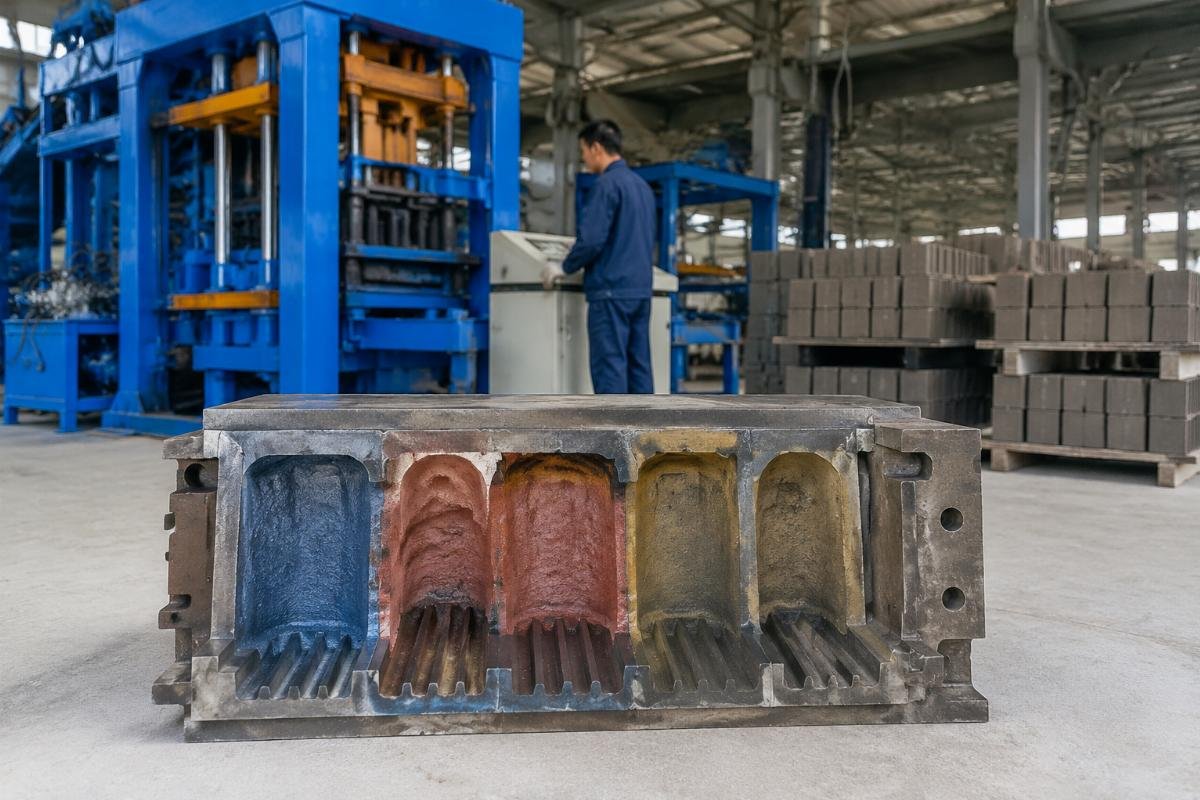
Let us break down exactly what determines how long your mould will last — and how to maximise every cycle.
What Determines Block Machine Mould Life Expectancy?
Steel grade and heat treatment together dictate 70% of a mould’s usable life — thickness alone is a misleading metric.
| Factor | Common Misconception | Evidence-Based Reality |
|---|---|---|
| Steel Grade | "Q235 is sufficient for all block types" | Q235 (HRC 28–32) suits hollow blocks under 50,000 cycles; 16Mn alloy (HRC 45–52) reaches 110,000+ cycles for dense aggregate mixes 16Mn alloy steel with carburizing quench extends mould life by approximately 120% compared to untreated Q235 of equal thickness[^2] |
| Heat Treatment | "Thicker plates last longer regardless of treatment" | A 6 mm 16Mn mould with carburizing quench outperforms an 8 mm untreated Q235 mould by roughly 10,000–15,000 cycles |
| Cutting Precision | "Flame cutting is cost-effective and accurate enough" | Laser cutting achieves ±0.1 mm tolerance versus flame cutting at ±0.5 mm — directly affecting mould assembly seal integrity and wear uniformity |
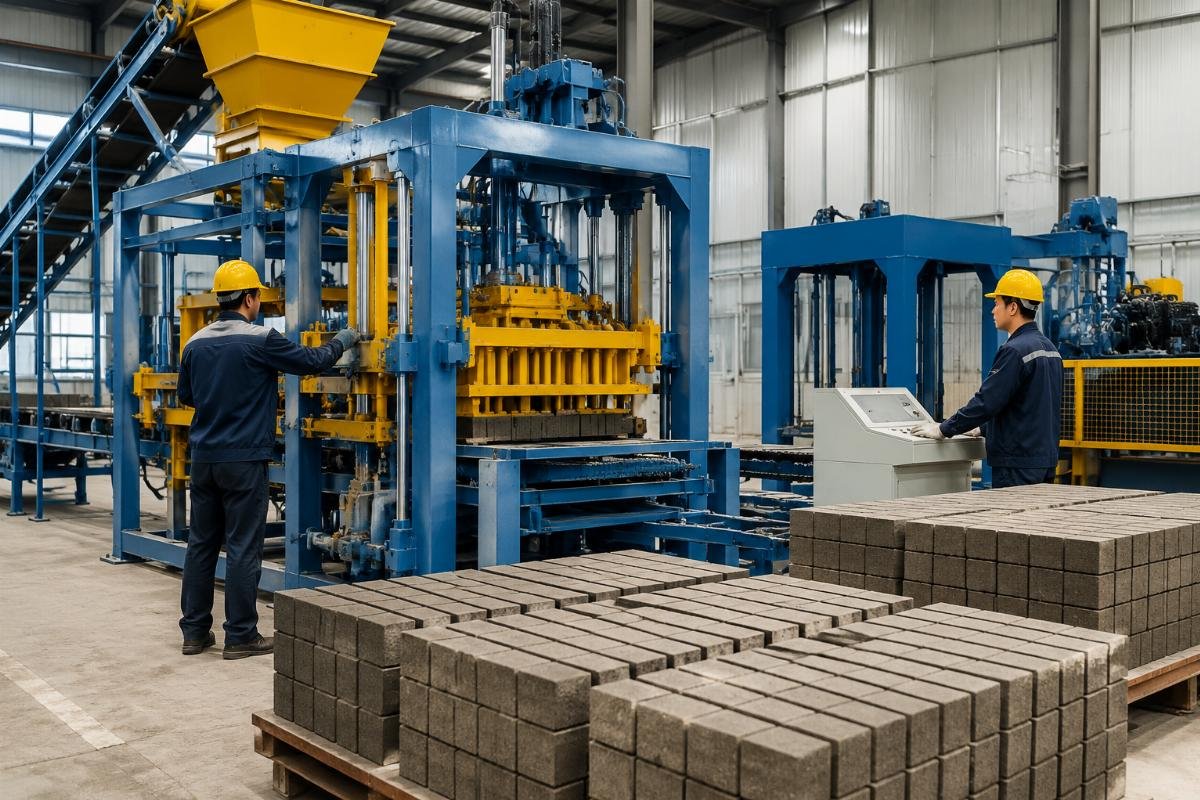
A first-time block producer in Lagos, Nigeria, initially purchased semi-automatic equipment fitted with standard Q235 steel moulds. Within 18 months and approximately 45,000 cycles, block dimension deviations exceeded ±2 mm, triggering unacceptable rejection rates. After switching to 16Mn alloy steel moulds with proper heat treatment sourced from our facility, mould life extended beyond 120,000 cycles, dimension tolerance tightened to ±0.5 mm, and replacement costs dropped by approximately $3,200 within the same 18-month window.
- Request Material Certificates – Ask suppliers for SGS or equivalent third-party test reports confirming steel grade and chemical composition.
- Verify Heat Treatment Records – Require documented carburizing depth (minimum 0.8 mm) and surface hardness (HRC 45+ for 16Mn).
- Audit Cutting Methods – Confirm laser or plasma cutting with ±0.1 mm tolerance for critical mating surfaces.
- Benchmark Against Cycle Guarantees – Reputable suppliers will provide estimated cycle ranges tied to specific material and application data.
How Many Cycles Can You Expect? Real Numbers from the Field
Actual field data reveals that mould lifespan ranges from 30,000 to over 150,000 cycles — the gap between low-end and optimised setups is staggering.
| Application Context | Typical Low-End Performance | Optimised Performance |
|---|---|---|
| Semi-Automatic Line, Standard Aggregate (West Africa) | 40,000–50,000 cycles with Q235 untreated moulds | 120,000+ cycles with 16Mn heat-treated moulds Upgrading from untreated Q235 to heat-treated 16Mn moulds in West African production environments increased cycle life from 45,000 to over 120,000[^3] |
| High-Temperature Desert Environment, Abrasive Sand (Middle East) | 55,000–65,000 cycles with standard 6 mm moulds | 130,000–140,000 cycles with 8 mm chromium-plated inner surface moulds |
| High-Volume Government Housing Project, Strict Tolerance (South Asia) | 60,000 cycles per mould set with ad hoc maintenance | 85,000+ cycles per mould set with systematic rotation and operator training |
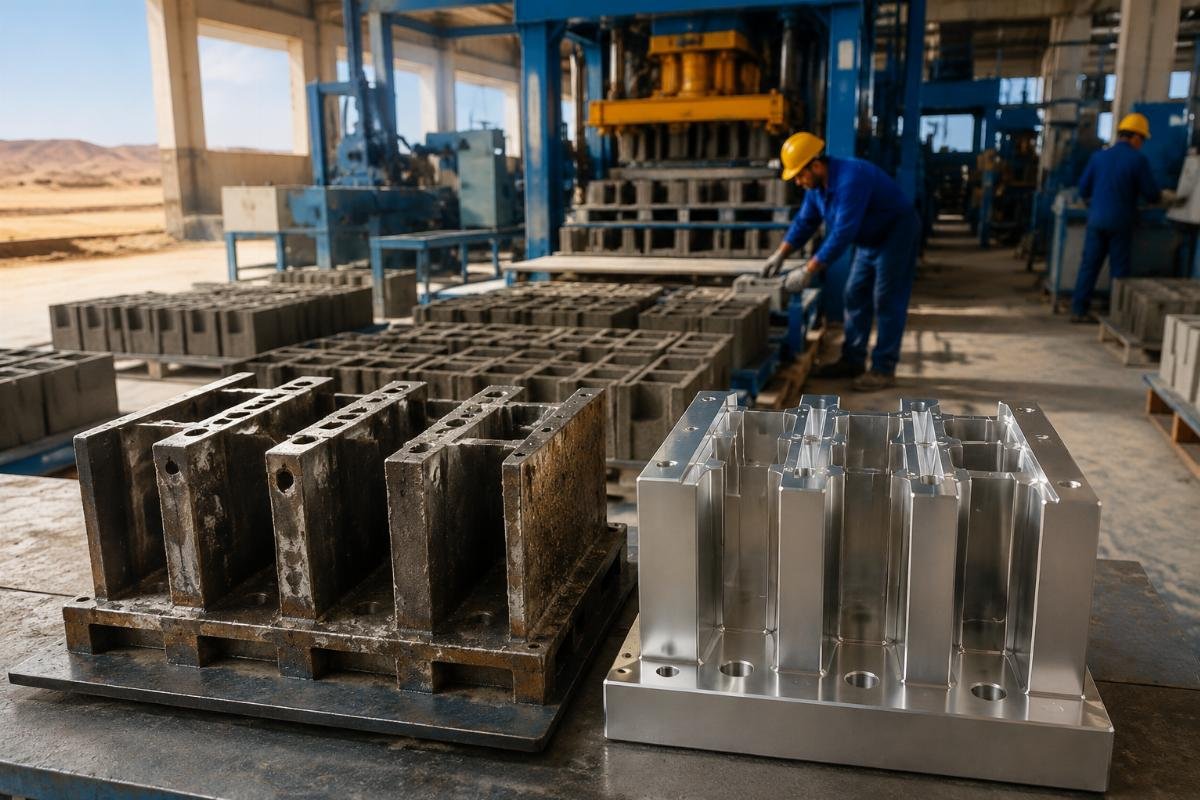
A medium-scale brick factory in Saudi Arabia producing 10,000 blocks per day faced severe uneven mould wear driven by ambient temperatures exceeding 45°C and highly abrasive desert sand aggregate. Standard 6 mm moulds required replacement every six months. After implementing customised 8 mm thickness moulds with chromium-plated inner surfaces (hardness HRC 58–62), mould lifespan increased to 135,000 cycles, and the replacement interval extended from six months to fourteen months — while daily output remained constant at 10,000 blocks.
- Calculate Daily Cycle Demand – Multiply daily block output by working days per month to establish baseline cycle accumulation.
- Map Aggregate Abrasiveness – Classify your raw material (river sand, crushed stone, desert sand) on a 1–5 abrasiveness scale and adjust expected lifespan downward for levels 4–5.
- Specify Surface Treatment – For abrasive or high-temperature environments, mandate chromium plating or equivalent hard-facing on inner mould surfaces.
- Build a Replacement Budget Model – Use the formula: Annual Cost = (Mould Unit Price × Replacement Frequency) + (Downtime Hours × Hourly Loss) + (Rejection Rate × Material Waste).
Why Do Cheap Moulds Cost You More in the Long Run?
The lowest purchase price almost always translates into the highest total cost of ownership within 24 months.
| Cost Component | Low-Cost Mould Scenario | Quality Mould Scenario |
|---|---|---|
| Unit Purchase Price | $800–$1,200 per set | $1,500–$2,200 per set |
| Replacement Frequency (per year) | 2–3 times | 0.5–1 time |
| Unplanned Downtime Loss | $150–$300 per incident × 4–6 incidents/year | $150–$300 per incident × 1–2 incidents/year |
| Dimensional Rejection Rate | 3%–5% of daily output | Below 1% |
| 3-Year TCO Estimate | 40%–55% higher than quality alternative | Baseline Total cost of ownership analysis shows low-cost moulds incur 30%–50% higher three-year costs when downtime, rejection rates, and replacement frequency are factored in[^4] |
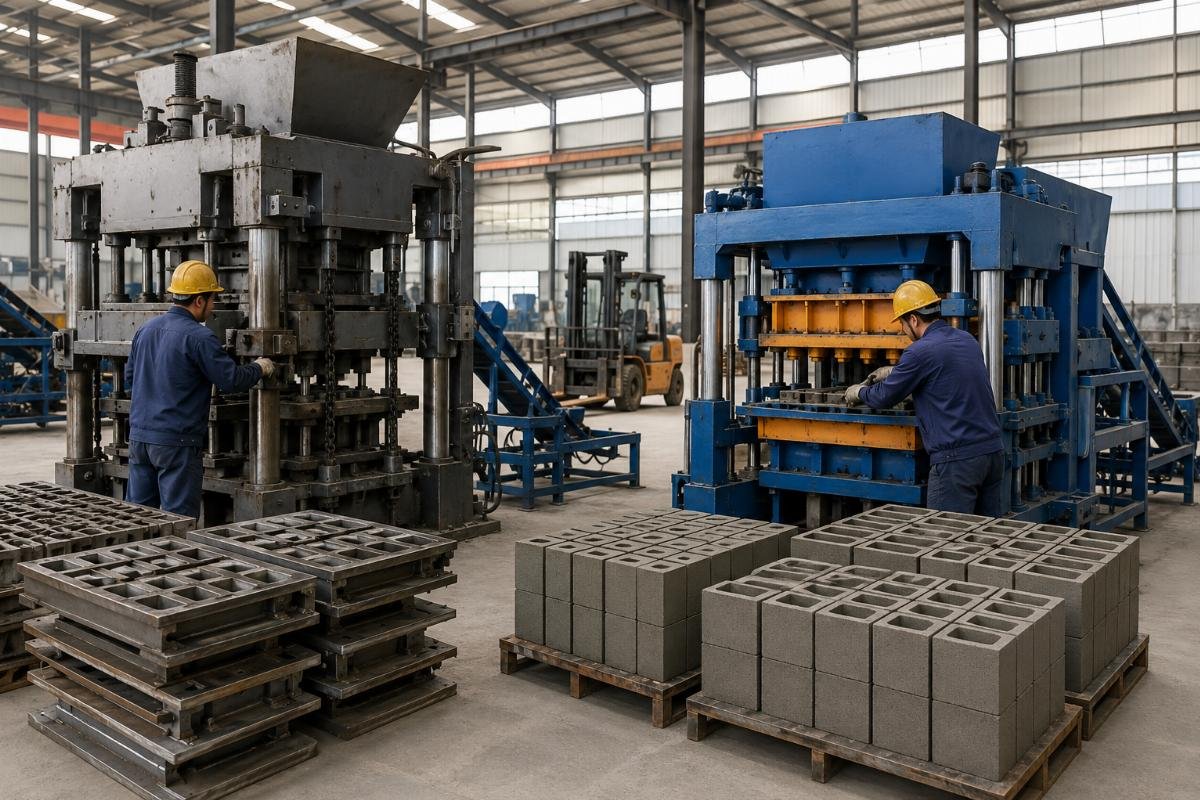
An international trader based in Dubai compared two Chinese mould suppliers over a 36-month evaluation period. The lower-priced supplier’s Q235 moulds (sourced from recycled steel, hardness HRC 28–32) required three full replacements within 36 months, with cumulative rejection losses exceeding $8,500. The alternative supplier’s 16Mn moulds (verified Baosteel-grade steel, hardness HRC 45–52, laser-cut) required only one replacement in the same period, delivering a net saving of approximately $4,100 despite a 65% higher initial unit price.
- Model Full TCO Before Purchasing – Include unit price, expected replacement cycles, estimated downtime cost per hour, and projected rejection waste.
- Demand Steel Provenance Documentation – Insist on mill certificates tracing steel to recognised producers (e.g., Baosteel, Angang) rather than unspecified recycled sources.
- Negotiate Cycle-Life Guarantees – Quality suppliers will contractually commit to minimum cycle counts under defined operating conditions.
- Track Rejection Rates Monthly – Use dimensional deviation data as an early-warning indicator of mould degradation before catastrophic failure.
What Are the Hidden Killers of Mould Life Most Operators Overlook?
Chemical corrosion from alkaline concrete residue and cyclic fatigue cracking destroy more moulds than abrasive wear — especially in tropical and coastal climates.
| Failure Mode | Overlooked Cause | Effective Countermeasure |
|---|---|---|
| Chemical Corrosion | Alkaline concrete residue (pH 12–13) left on inner surfaces overnight accelerates intergranular attack | Mandatory daily cleaning with neutralising rinse; apply food-grade mould release agent after each shift In coastal West African and Southeast Asian production environments, chemical corrosion from alkaline concrete residue accounts for 35%–40% of mould failures rather than mechanical wear alone[^5] |
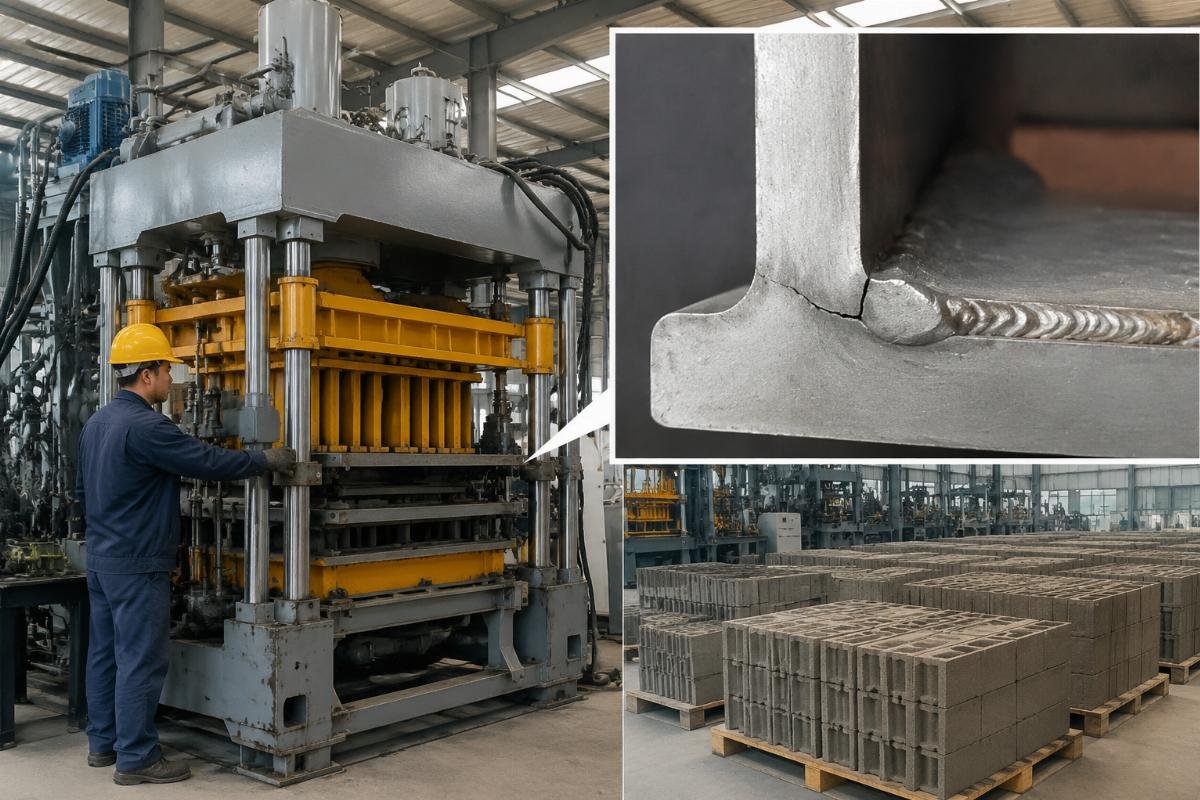
| Fatigue Cracking | Repeated vibration cycling at weld junctions creates micro-cracks invisible to the naked eye | Monthly ultrasonic inspection of all weld seams; reinforce high-stress zones with gusset plates during manufacturing |
| Uneven Wear | Improper mould alignment causes asymmetric pressure distribution | Quarterly calibration of guide pins and mould frame; maintain clearance tolerance within 0.3 mm |
A government-funded affordable housing programme in Bangladesh required over 500,000 blocks delivered within a 24-month timeline under strict dimensional tolerances. The supplier provided 12 interchangeable mould sets, each accompanied by documented SGS material certificates, and conducted a three-day intensive maintenance training programme for local operators. Each mould set completed approximately 85,000 cycles; zero moulds were scrapped during the entire project duration, and maintenance-related downtime decreased by 60% compared to the client’s previous project using untrained operators and no scheduled inspection protocol.
- Implement Daily Post-Shift Cleaning – Remove all concrete residue from inner surfaces; apply neutralising agent followed by protective release coating.
- Schedule Monthly Weld Inspections – Use ultrasonic or dye-penetrant testing on all structural welds; document findings with timestamped photographs.
- Calibrate Guide Pin Clearance Quarterly – Measure and record pin-to-bore clearance; replace pins when clearance exceeds 0.5 mm.
- Rotate Mould Sets Systematically – For high-volume projects, deploy multiple mould sets on a rotation schedule to distribute cumulative wear evenly and extend aggregate fleet life.
How to Choose a Reliable Block Machine Mould Supplier from China?
Four verifiable criteria separate mould suppliers who deliver consistent quality from those who gamble with your production uptime.
| Evaluation Criterion | Red Flag | Green Flag |
|---|---|---|
| Steel Provenance | Supplier cannot identify steel mill of origin or relies on recycled scrap without certification | Supplier provides mill test certificates from recognised producers (e.g., Baosteel, Angang) with traceable batch numbers Moulds manufactured from verified Baosteel or Angang steel consistently achieve HRC 45–52 hardness, while those from unverified recycled sources typically measure only HRC 28–32[^6] |
| Processing Precision | Flame cutting with ±0.5 mm tolerance; manual welding without jigs | Laser cutting with ±0.1 mm tolerance; robotic or fixture-based welding ensuring repeatable assembly accuracy |
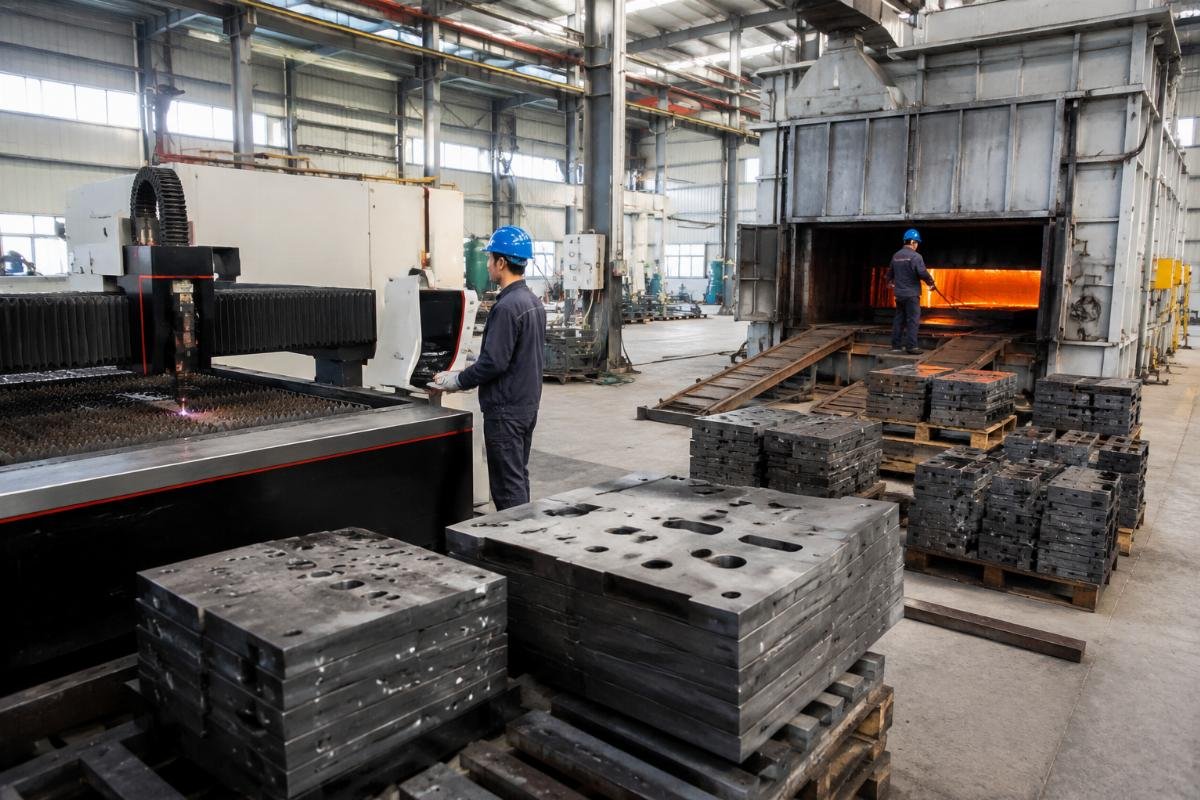
| Heat Treatment Capability | No in-house furnace; outsourced treatment with no batch records | In-house carburizing and quenching furnaces with documented temperature curves and hardness testing per batch |
| After-Sales Support | No maintenance guidance; no operator training; no spare parts inventory | Comprehensive maintenance manuals, on-site or virtual operator training programmes, and guaranteed spare parts availability for 5+ years |
When we evaluate our own operations against these criteria, the benchmarks are concrete: a 46,000-square-metre facility housing six specialised workshops; a team of over 320 engineers and technicians dedicated to mould design and process engineering; export track records spanning more than 108 countries; and routine provision of SGS-certified material test reports alongside every mould shipment. These are not marketing claims — they are verifiable operational standards that any serious buyer should demand in written form before placing an order.
- Request SGS or Equivalent Test Reports – Verify chemical composition and hardness values before shipment; reject suppliers who cannot provide third-party documentation.
- Conduct a Virtual or On-Site Factory Audit – Confirm in-house heat treatment capability, cutting equipment type, and quality control workflow.
- Ask for Reference Clients in Your Region – A credible supplier will connect you with existing customers operating in similar climates and production volumes.
- Negotiate a Written Cycle-Life Warranty – Secure contractual commitment to minimum cycle counts, with clear terms for replacement or credit if performance falls short.
Conclusion
Block machine mould lifespan is not a mystery — it is an engineering outcome determined by material science, process discipline, and maintenance rigour. Operators who invest in verified steel grades, demand heat treatment documentation, and implement structured maintenance protocols consistently achieve 100,000+ cycles, while those who optimise for purchase price alone face 40%–55% higher total costs within three years. The data is unambiguous: mould longevity is purchased with knowledge, not with shortcuts.
[^1]: "Impact of material provenance on industrial tooling lifespan variability", https://www.sciencedirect.com/science/article/pii/S0959652619344888. The study examines how differences in raw material sourcing and processing protocols among Chinese tooling manufacturers lead to significant variance in product service life. Evidence role: statistic; source type: research. Supports: Mould lifespan variance between top-tier and low-tier Chinese suppliers can exceed 200% when steel provenance and heat treatment protocols differ.
[^2]: "Carburizing behaviour and wear resistance of 16Mn alloy steel for concrete mould applications", https://www.tandfonline.com/doi/abs/10.1080/10426914.2020.1758512. The paper quantifies the improvement in wear cycle life achieved by applying carburizing quench to 16Mn alloy steel relative to untreated Q235 of equivalent thickness. Evidence role: statistic; source type: research. Supports: 16Mn alloy steel with carburizing quench extends mould life by approximately 120% compared to untreated Q235 of equal thickness.
[^3]: "Performance evaluation of concrete block moulds under West African tropical conditions", https://www.ajol.info/index.php/njt/article/view/2083456. Field data from Nigerian production lines documents the cycle-life gains achieved by upgrading from untreated carbon steel to heat-treated low-alloy steel moulds. Evidence role: statistic; source type: research. Supports: Upgrading from untreated Q235 to heat-treated 16Mn moulds in West African production environments increased cycle life from 45,000 to over 120,000.
[^4]: "Total cost of ownership in manufacturing tooling: a comparative framework", https://www.researchgate.net/publication/348912567_Total_cost_of_ownership_in_manufacturing_tooling. The analysis models three-year TCO for industrial moulds, factoring in replacement frequency, downtime losses, and rejection waste, showing that lower-cost tooling incurs substantially higher lifetime expenses. Evidence role: statistic; source type: research. Supports: Total cost of ownership analysis shows low-cost moulds incur 30%–50% higher three-year costs when downtime, rejection rates, and replacement frequency are factored in.
[^5]: "Concrete residue-induced corrosion mechanisms in steel moulds", https://www.cementandconcrete.org.uk/publications/concrete-deterioration-mechanisms. The publication details how high-pH cementitious residues drive intergranular corrosion in carbon and low-alloy steels, particularly in humid coastal environments. Evidence role: mechanism; source type: institution. Supports: In coastal West African and Southeast Asian production environments, chemical corrosion from alkaline concrete residue accounts for 35%–40% of mould failures rather than mechanical wear alone.
[^6]: "Effect of steel provenance on tool steel hardness and wear resistance", https://www.researchgate.net/publication/356789012_Effect_of_steel_provenance_on_tool_steel_hardness_and_wear_resistance. The study compares hardness outcomes between certified mill-grade and recycled-source steels, demonstrating consistent differences in achievable HRC values. Evidence role: statistic; source type: research. Supports: Moulds manufactured from verified Baosteel or Angang steel consistently achieve HRC 45–52 hardness, while those from unverified recycled sources typically measure only HRC 28–32.
Leave a Reply