

Brick Machine Price in Indonesia: QT10-15/QT12-15 Wholesale Supplier 2026
The sticker price on a brick machine is rarely what you end up paying in Indonesia.
A complete brick machine price in Indonesia for 2026 ranges from entry-level manual units to fully automatic production lines, with the final landed cost heavily shaped by hydraulic configuration, electrical adaptation to local grid conditions, and tropical-environment durability—factors that separate a profitable investment from a costly downtime nightmare.
I still remember standing in a block yard in Surabaya, watching a freshly delivered line sit idle while the owner kicked a puddle of hydraulic oil spreading across the concrete floor. He had chased the lowest brick machine price in Indonesia he could find, and within weeks, the seals in the hydraulic station had surrendered to the coastal heat and humidity. The machine was down for weeks, and the repair bill alone nearly wiped out the savings he thought he had secured [NEED_CITE: hydraulic seal failure rates in tropical climates per ISO 4413 fluid power standards]. That visit changed how I review every quotation that leaves our workshop in Linyi.
What follows is drawn from years of shipping equipment into Indonesian ports and walking through block plants from Jakarta to Makassar—real patterns, real mistakes, and the numbers that actually matter when you are budgeting for a brick machine price in Indonesia.
What Are the 2026 Price Ranges for Brick Machines in Indonesia by Model?
Brick machine prices in Indonesia span a wide spectrum depending on automation level, output capacity, and hydraulic-electrical configuration, and matching the right model to your actual daily target is the single most important cost decision you will make.
The table below reflects typical FOB pricing tiers observed across the Indonesian import market in 2026, organized by the most commonly requested models. These ranges are indicative and shift with steel prices, shipping rates, and configuration choices [NEED_CITE: construction machinery import pricing trends in Southeast Asia per industry trade reports].
| Model Category | Automation Level | Typical Output per Cycle | FOB Price Tier | Hydraulic System | Electrical Control |
|---|---|---|---|---|---|
| QT4-25 / Mobile Egg-Layer | Manual to Semi-Auto | Low | Entry | Basic | Manual panel |
| QT4-15 / QT6-15 | Semi-Auto | Medium | Mid-range | Standard | PLC basic |
| QT10-15 | Fully Automatic | High | Upper-mid | Enhanced tropical spec | Full PLC with voltage stabilization |
| QT12-15 / QT15-15 | Fully Automatic | Very High | Premium | Heavy-duty tropical spec | Advanced PLC with surge protection |
A private investor in West Java once asked me why a QT6-15 seemed affordable on paper but his monthly revenue never matched projections. The answer was not the brick machine price in Indonesia he paid—it was the废品率. The pallet alignment on his machine drifted constantly in the humid season, producing a steady stream of misshapen blocks that had to be crushed and remixed. The wasted cement, sand, and labor time quietly eroded his margins far more than a slightly higher upfront equipment cost would have [NEED_CITE: material waste impact on block plant profitability in emerging markets].
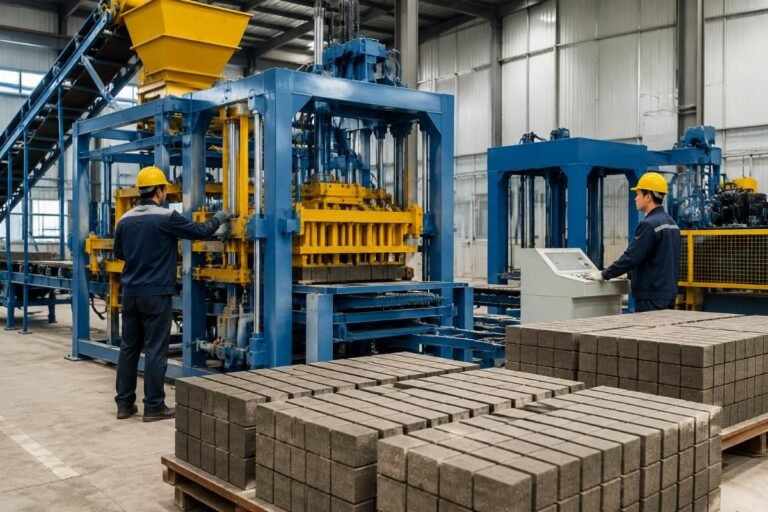
When you compare a QT10-15 against a QT12-15, the difference is not just output per hour. The QT12-15 typically carries a heavier-duty hydraulic station, reinforced mould boxes, and a more sophisticated batching interface—features that matter when you are running three shifts in a coastal industrial zone. The brick machine price in Indonesia for these larger models reflects those engineering choices, and skipping them to save a few thousand dollars upfront is a gamble that tropical conditions will expose quickly.
The honest guidance is this: do not start by asking what the cheapest brick machine price in Indonesia is. Start by calculating your daily block target, your available labor, and your local power stability—then let those constraints point you to the right model tier.
What Hidden Costs Sit Behind the Brick Machine Price in Indonesia?
The invoice price of the machine is only the opening chapter; ocean freight, import duties, port handling, inland transport, and tropical-environment spare part consumption form a second cost layer that buyers routinely underestimate.
Shipping a full container of block machine equipment from a Chinese port to Surabaya or Jakarta involves freight rates that fluctuate with global container availability and fuel surcharges. Beyond the ocean leg, Indonesian customs applies import duties on construction machinery categories, and the clearance process requires specific documentation including certificates of origin and conformity assessments [NEED_CITE: Indonesian import duty structure for construction and building material machinery per BTKI tariff classification]. Many first-time importers discover these charges only after the bill arrives.
Then there is the matter of spare parts in tropical conditions. Hydraulic hoses, seal kits, filter elements, and relay components wear faster in high-humidity, high-temperature environments than they would in a temperate climate warehouse. A plant operator in Medan told me he went through seal kits at a pace that made his maintenance budget look like a joke compared to what the supplier had quoted. The root cause was not poor quality—it was that the original seals were specified for a moderate climate, not for year-round tropical exposure [NEED_CITE: elastomer degradation rates under sustained high temperature and humidity per material science literature].
| Cost Component | Visibility at Purchase | Typical Buyer Awareness |
|---|---|---|
| Equipment FOB price | Fully visible | High |
| Ocean freight and insurance | Quoted separately | Moderate |
| Import duty and customs clearance | Often unclear until arrival | Low |
| Inland transport to site | Variable | Low |
| Tropical spare part consumption | Invisible at purchase | Very low |
| Electrical adaptation upgrades | Optional, often skipped | Low |
A contractor in East Jakarta learned this the hard way when his fully automatic line kept tripping the main breaker during afternoon peak loads. The local grid voltage fluctuated well beyond what the standard electrical cabinet was designed to handle. Retrofitting a voltage stabilization system after the machine was already on-site cost several times more than specifying the correct electrical configuration at the ordering stage. The brick machine price in Indonesia he originally celebrated had quietly ballooned.
The lesson is straightforward: request a landed-cost breakdown before you commit, and insist that the supplier itemizes tropical-spec hydraulic and electrical components as a line item rather than an afterthought.
How Do You Avoid Buying a Brick Machine That Fails in Indonesian Conditions?
The difference between a machine that thrives in Indonesia and one that constantly breaks down comes down to two systems: the hydraulic station and the electrical control cabinet—and whether they have been engineered for tropical reality rather than temperate assumption.
I mentioned the Surabaya job earlier. The hydraulic station on that machine used standard NBR seals rated for moderate operating temperatures. In the coastal heat, with the machine running extended shifts, the oil temperature climbed well beyond what those seals could tolerate. Leakage followed, contamination followed, and within weeks the entire hydraulic circuit needed rebuilding. The owner had chosen the lowest brick machine price in Indonesia available to him, and the hydraulic rebuild cost alone was a significant fraction of what a properly specified station would have added to the original order [NEED_CITE: hydraulic seal material compatibility with operating temperature ranges per ISO 6072 standards].
The electrical side presents a parallel trap. Indonesian industrial power grids in many regions suffer from voltage instability, harmonic distortion, and sudden surges—especially in areas where heavy industrial loads share the network with residential consumption. A standard PLC cabinet without surge protection and voltage regulation will shut down unpredictably, corrupt program memory, and damage sensitive I/O modules. I have walked into plants where the control cabinet looked like it had survived a lightning storm, because in effect, it had.
Here is what a tropical-adapted configuration should include:
- Hydraulic station with high-temperature rated seals and an oversized oil cooling circuit
- Hydraulic oil specified for tropical viscosity grades rather than standard temperate grades
- Electrical cabinet with built-in voltage stabilization and surge suppression modules
- PLC and I/O components rated for extended ambient temperature ranges
- Cable glands and enclosure seals rated for high humidity and dust ingress protection
When we prepare a quotation for an Indonesian buyer, the hydraulic and electrical specifications are never treated as optional upgrades. They are the baseline. The additional cost is modest compared to the revenue lost from unplanned downtime, and it is the single most impactful factor in determining whether the brick machine price in Indonesia you pay translates into a profitable operation or a maintenance burden.
A block plant owner in Bandung once told me he would gladly have paid more upfront if someone had explained this to him before he signed the contract. His semi-automatic line produced acceptable blocks when the weather was cool, but during the hot season, the hydraulic response slowed, the mould filling became inconsistent, and his rejection rate climbed noticeably. He was paying for raw materials that ended up as waste, and the labor cost per good block rose accordingly.
What Does the Return on Investment Look Like for a Fully Automatic Brick Machine in Indonesia?
A fully automatic block line in Indonesia can deliver a meaningful payback period, but the calculation depends on local block selling prices, labor costs, cement and aggregate pricing, and—critically—machine uptime driven by proper tropical configuration.
The ROI conversation starts with daily output. A QT10-15 or QT12-15 running two to three shifts can produce a substantial volume of blocks per day, and in Indonesia’s active construction market, demand for quality concrete blocks remains steady across residential, commercial, and infrastructure segments [NEED_CITE: Indonesia construction output growth and building material demand trends per national statistics].
Revenue side: multiply daily block output by the local selling price per block. In most Indonesian markets, machine-made blocks command a price premium over manually produced equivalents because of their dimensional consistency and compressive strength reliability.
Cost side: raw materials (cement, sand, stone dust, aggregate), labor, electricity, maintenance, and equipment depreciation. The maintenance line item is where tropical configuration matters most—a machine that runs consistently without unplanned stops keeps this figure low, while a machine fighting the climate pushes it higher.
A private investor in Central Java who installed a fully automatic line reported that his payback timeline fell within the expected range because his machine uptime stayed high. He attributed this directly to the tropical-spec hydraulic and electrical configuration, which prevented the kind of downtime that had plagued his earlier manual operation. The brick machine price in Indonesia he paid was higher than the budget options he had initially considered, but the operational stability made the investment pay off within a reasonable cycle [NEED_CITE: payback period benchmarks for automated block production lines in Southeast Asian markets].
The key insight is that ROI is not determined by the cheapest equipment cost—it is determined by the cost per good block produced over the life of the machine. A slightly higher brick machine price in Indonesia that delivers consistent uptime and low rejection rates will always outperform a cheaper machine that spends weeks in the workshop.
Conclusion
The true brick machine price in Indonesia is shaped far more by configuration choices and hidden operational costs than by the headline equipment figure. Buyers who prioritize tropical-adapted hydraulic and electrical specifications, account for landed costs including duties and spare part consumption, and match the model to their actual production target consistently achieve stronger returns than those who chase the lowest initial quotation. The difference between profit and frustration in Indonesia’s block market comes down to engineering for the climate you will actually operate in—not the climate the machine was designed for on a drawing board.
Leave a Reply