

QT10-15 Brick Machine Supplier for Vietnam: China Factory Direct
The cheapest brick machine quote is rarely the most cost-effective once it reaches your factory floor in Vietnam.
When sourcing a brick machine supplier for Vietnam, the three most overlooked yet critical selection criteria are voltage compatibility with local grids, adaptation to regional raw material properties, and verifiable after-sales response speed—these determine whether your equipment runs profitably or sits idle waiting for repairs.
I still remember a shipment we sent to a small investor near Hanoi years ago. The QT6-15 semi-automatic line arrived on schedule, but within weeks the main motor burned out—not once, but twice. The local grid voltage fluctuated wildly outside the machine’s default tolerance range. The client nearly returned the entire order. That incident reshaped how I approach every Vietnam project: before discussing price or model, I now insist on confirming the actual voltage profile at the installation site and testing local aggregate samples. [NEED_CITE: Vietnam industrial voltage standard specifications and grid fluctuation tolerance ranges]
Let me walk you through what actually matters when choosing a brick machine supplier for Vietnam, based on what I’ve seen on the ground.
What Should Vietnam Buyers Check Before Choosing a Brick Machine Supplier?
Voltage compatibility, raw material testing, and after-sales accessibility form the non-negotiable foundation of any successful brick machine purchase for Vietnam operations.
Many buyers focus almost exclusively on machine specifications and pricing, only to discover after delivery that their equipment cannot handle local conditions. Here is what experienced operators verify before signing contracts:
Voltage Adaptation
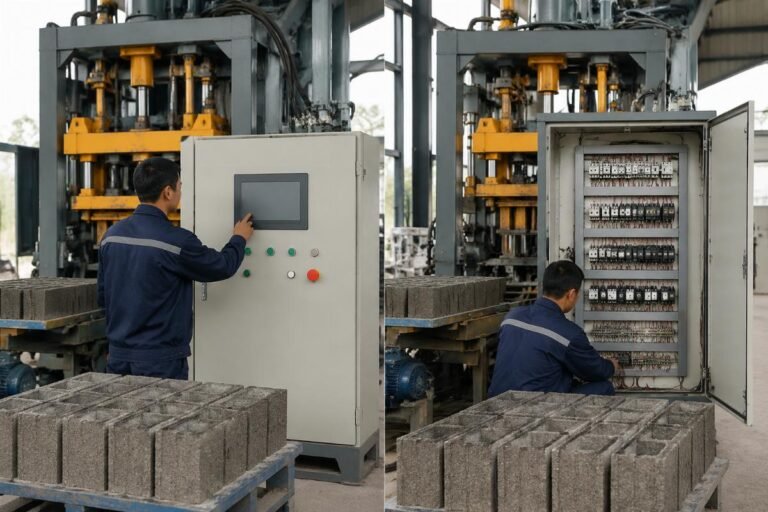
Vietnam’s standard industrial voltage is 380V/50Hz, but actual grid conditions vary dramatically between regions. Northern provinces near Hanoi experience different fluctuation patterns than southern areas around Ho Chi Minh City. [NEED_CITE: Vietnam Ministry of Industry and Trade electrical grid standards and regional voltage stability data] Machines configured for stable European grids will fail repeatedly in areas with frequent surges or drops. A proper brick machine supplier for Vietnam should offer customized electrical cabinets with built-in voltage regulation or at minimum provide clear specifications for external stabilizer requirements.
Raw Material Compatibility
Vietnamese manufacturers typically use locally sourced river sand, stone dust, and fly ash. These materials have different hardness, moisture content, and particle distribution compared to Chinese or European aggregates. A machine calibrated for hard granite dust will struggle with softer river sand mixtures, leading to inconsistent block density and accelerated mold wear. [NEED_CITE: Southeast Asian construction material properties and concrete block production requirements] Request that your brick machine supplier for Vietnam conduct trial pressing with your actual material samples before finalizing the order.
After-Sales Response Structure
Downtime costs far exceed the initial price difference between suppliers. When a hydraulic pump fails during peak production season, waiting weeks for a replacement part from overseas destroys your cash flow. Verify that your brick machine supplier for Vietnam maintains spare parts inventory accessible to the region and can dispatch technicians within a reasonable timeframe. [NEED_CITE: Concrete block production line downtime cost analysis for emerging markets]
Which Brick Machine Model Fits Different Vietnam Production Scales?
Matching machine capacity to your actual market demand and investment budget prevents both underproduction and wasted capital on unused capacity.
The QT series covers a wide spectrum, from entry-level mobile machines to fully automatic high-output lines. Here is how different models align with typical Vietnam production scenarios:
| Model | Automation Level | Daily Output Range | Operator Requirement | Floor Space | Best Suited For |
|---|---|---|---|---|---|
| QT4-25 | Mobile/Egg-laying | Low | Minimal | Compact | Rural startups, limited capital |
| QT4-15/QT6-15 | Semi-automatic | Moderate | Small team | Standard | Small-to-medium private investors |
| QT10-15 | Fully automatic | High | Reduced crew | Large | Established plants, expansion projects |
| QT12-15/QT15-15 | Fully automatic | Very high | Minimal | Extensive | Large-scale commercial operations |
Small-Scale Entry: QT4-25 Mobile Machine
For first-time investors in rural areas with limited capital, the QT4-25 egg-laying machine offers the lowest barrier to entry. It moves directly on the curing yard, eliminating the need for pallet systems and complex conveyors. However, output is limited and labor intensity remains high. This model works for testing market demand before committing to larger investments.
Mid-Range Expansion: QT6-15 Semi-Automatic Line
A medium-sized investor near Ho Chi Minh City recently upgraded from a manual setup to a QT6-15 semi-automatic line. The upgrade included a basic batching system, block conveyor, and stacker. Production capacity increased substantially while maintaining manageable operator requirements. The investment payback period remained reasonable because the machine matched actual local demand rather than chasing maximum theoretical output. [NEED_CITE: Concrete block machine ROI calculation methodology for Southeast Asian markets]
High-Volume Production: QT10-15 and Above
When daily output requirements exceed what semi-automatic lines can deliver, the QT10-15 fully automatic line becomes the logical choice. PLC-controlled operations, automatic pallet circulation, and integrated curing systems minimize labor while maximizing consistency. A government infrastructure contractor in central Vietnam deployed a QT10-15 line for a large-scale affordable housing project. The fully automatic system ensured uniform block quality across massive production volumes, meeting strict tender specifications.
Critical Consideration: Avoid Overcapacity
A common mistake is purchasing the largest machine available, assuming higher capacity always means better value. When actual market demand falls short of machine capability, the fixed costs—depreciation, maintenance, electricity—remain while revenue stagnates. A brick machine supplier for Vietnam should help you calculate realistic demand based on local construction activity and competitor capacity, not simply push the most expensive model.
How Does Factory-Direct Pricing Compare to Trading Company Quotes?
Factory-direct procurement typically eliminates substantial middleman markups, but requires verification of certifications and export track record to avoid counterfeit operations.
The price difference between factory-direct and trading company quotes can be dramatic, often ranging from substantial savings to even more depending on the product complexity. However, the lowest price carries risks if the supplier lacks genuine manufacturing capability or export experience.
Understanding the Price Structure
Trading companies add margins at multiple stages: sourcing from factories, warehousing, export documentation, and profit. While they offer convenience and sometimes consolidated shipping, these costs accumulate. Factory-direct pricing removes these layers, passing manufacturing costs more directly to buyers.
Verification Requirements
Before committing to a factory-direct brick machine supplier for Vietnam, verify:
- CE/SGS/ISO certifications: Request original documents, not photocopies. Confirm certification scope covers the specific models you’re ordering. [NEED_CITE: International brick machine safety certification standards and verification methods]
- Export track record: Ask for references from previous Vietnam customers. A legitimate factory should have documented experience shipping to and supporting equipment in your region.
- Manufacturing facility: Request video calls showing actual production floors, not staged showrooms. Verify the factory produces the complete machine, not just final assembly of purchased components.
- Customization capability: Genuine factories can modify electrical systems, hydraulic configurations, and mold designs based on your specific requirements. Trading companies often lack this flexibility.
Total Cost vs. Unit Price
The cheapest unit price becomes expensive if the machine requires constant repairs, cannot source replacement parts, or fails to meet local safety standards. Calculate total cost of ownership including installation, commissioning, training, spare parts availability, and expected service life. A brick machine supplier for Vietnam offering comprehensive support packages often delivers better long-term value than the lowest initial quote.
What After-Sales Support Matters Most for Vietnam Brick Plants?
On-site installation, operator training, and rapid spare parts supply determine whether your brick machine achieves designed productivity or becomes a costly idle asset.
Equipment delivery is only the beginning. The difference between successful operation and prolonged startup delays lies entirely in after-sales support quality.
Installation and Commissioning
Proper installation requires experienced technicians who understand both the machine and local site conditions. Foundation preparation, electrical connections, hydraulic system bleeding, and calibration all affect long-term performance. A professional brick machine supplier for Vietnam should include on-site installation in their service package, with engineers staying until the machine produces blocks meeting agreed quality standards.
Operator Training
Vietnamese operators may have limited experience with advanced PLC-controlled systems. Comprehensive training covers not just basic operation but also routine maintenance, troubleshooting common issues, and safety protocols. Well-trained operators prevent most equipment failures and extend service life substantially. [NEED_CITE: Concrete block machine operator training best practices for emerging markets]
Spare Parts Availability
Hydraulic seals, sensors, mold components, and wear parts require replacement during normal operation. Waiting weeks for parts shipped from overseas halts production and destroys profitability. Your brick machine supplier for Vietnam should maintain a regional spare parts inventory or guarantee expedited shipping for critical components.
Long-Term Technical Support
Equipment modifications, production optimization, and troubleshooting complex issues require ongoing access to technical expertise. Verify that your supplier offers remote support capabilities and can dispatch engineers for major issues. A brick machine supplier for Vietnam with dedicated regional support staff provides faster resolution than those relying solely on headquarters-based teams.
How to Verify a Chinese Brick Machine Factory’s Credibility?
Export history, certification authenticity, customer references, and customization capability separate legitimate manufacturers from trading companies or fraudulent operations.
With numerous Chinese suppliers claiming factory-direct status, due diligence prevents costly mistakes.
Export Country Coverage
A genuine manufacturer serving international markets should have documented export experience across multiple regions. Request specific examples of equipment installed in Vietnam or neighboring Southeast Asian countries. [NEED_CITE: Chinese construction equipment export verification methods and documentation requirements]
Certification Verification
Contact the certifying bodies directly to confirm certificate validity and scope. CE marking for machinery requires compliance with specific EU directives; verify that the certification covers your exact model numbers.
Customer Reference Checks
Request contact information for previous Vietnam customers. Speak directly with operators or owners about their experience with equipment quality, delivery accuracy, installation support, and after-sales responsiveness. Legitimate factories welcome these checks; questionable suppliers make excuses.
Customization Evidence
Ask how the factory would adapt their standard machine for your specific requirements—whether voltage differences, raw material characteristics, or site layout constraints. Detailed technical responses indicate genuine engineering capability; vague answers suggest limited manufacturing depth.
Factory Audit Options
If order volume justifies the investment, consider visiting the factory in person or hiring a third-party inspection service. Physical verification of production facilities, quality control processes, and inventory management provides the strongest credibility confirmation.
Conclusion
Selecting a brick machine supplier for Vietnam requires looking beyond initial price to evaluate voltage compatibility, raw material adaptation, and after-sales infrastructure—these factors determine long-term operational success.
Match machine capacity to actual market demand rather than theoretical maximums, verify factory credentials through certifications and customer references, and prioritize suppliers offering comprehensive installation, training, and spare parts support. The right brick machine supplier for Vietnam becomes a long-term partner in your production success, not just a one-time equipment vendor.
Leave a Reply