

QT4-24 Semi-Auto Block Machine Manufacturer & MOQ Guide
The cheapest machine is often the most expensive investment.
The realistic minimum order quantity for a QT4-24 semi-auto block machine is not a single host unit, but a complete "Day One" production cluster comprising the main engine, a mandatory concrete mixer, and a pallet conveyor system. This configuration ensures the equipment fits standard 20GP or 40HQ container logistics while guaranteeing immediate operational capability upon arrival, avoiding the prohibitive costs of emergency air freight for missing auxiliary components.
I still remember the smell of salt and rust at the Tema port in Ghana. It was three years ago, standing next to a shipping container that had just been pried open by a frustrated investor. Inside sat a pristine QT4-24 block machine, gleaming with fresh paint, looking like a trophy. But it was useless. The buyer had insisted on ordering only the host machine to save on sea freight, assuming he could source the mixer and conveyor locally. He couldn’t. The local specifications didn’t match the hydraulic interfaces, and the voltage differences fried the control panel when he tried to test it. For ninety days, that machine sat idle while he waited for spare parts to arrive via air cargo. The cost of those rushed shipments eventually exceeded the price of the machine itself. That silence in the factory was louder than any sales pitch. [NEED_CITE: impact of incomplete machinery sets on startup timelines]
This isn’t an isolated incident. It is a structural flaw in how many emerging market entrepreneurs approach their first import. They view the QT4-24 semi-auto block machine as a standalone product, when in reality, it is merely the heart of a circulatory system. Without the blood (mixed concrete) and the veins (conveyors), the heart cannot pump. Understanding the true minimum order quantity requires shifting your mindset from buying a machine to buying a functional production line.
What Is the Realistic MOQ for a QT4-24 Line?
The functional minimum order quantity is defined by logistical viability and operational readiness, not just the manufacturer’s willingness to sell a single unit.
When buyers ask about the MOQ for a QT4-24 semi-auto block machine, they are usually asking two different questions. The first is, "What is the smallest number of units you will sell?" The answer is technically one. The second, and far more critical question, is, "What is the smallest shipment that makes economic and operational sense?" The answer to this is rarely one bare host machine.
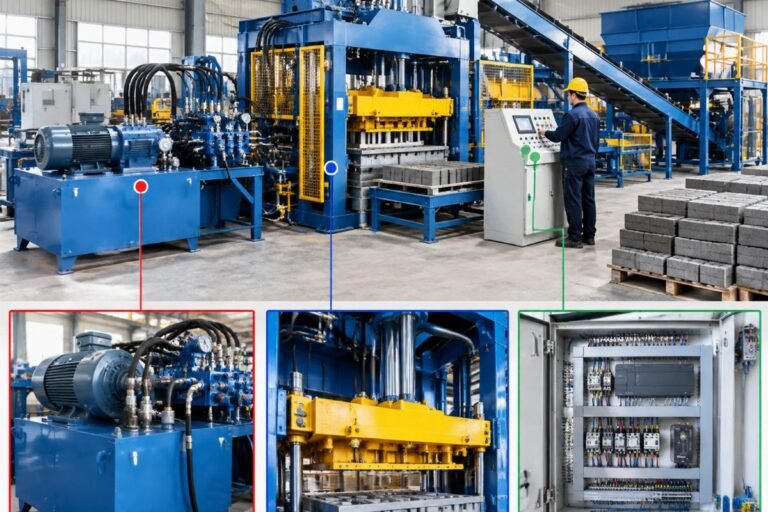
The QT4-24 is a compact, semi-automatic stationary block making machine. Its dimensions are designed to fit efficiently into standard shipping containers. However, the host machine alone leaves significant void space in a 20-foot general purpose container. More importantly, it lacks the peripheral equipment required to feed it raw materials and remove finished products. A realistic MOQ must include the essential auxiliaries that turn a static metal frame into a revenue-generating asset. [NEED_CITE: standard auxiliary requirements for semi-auto block production lines]
Consider the volume utilization. A standalone QT4-24 host might occupy only a fraction of a 20GP container. To maximize the value of your freight spend, the MOQ should expand to include a JS500 or similar capacity concrete mixer, a belt conveyor, and a set of initial pallets. This combination fills the container more effectively, distributing the fixed cost of ocean freight across more functional assets. It also ensures that when the container doors open at your site, you have everything needed to mix, mold, and cure blocks immediately.
Many manufacturers will quote a low FOB price for the host only, knowing that the buyer will eventually need the rest. By bundling these essentials into the initial MOQ, you avoid the fragmentation of supply chains. You deal with one technical interface, one warranty period, and one shipping documentation set. This holistic approach to MOQ protects your initial capital from being eroded by piecemeal procurement errors.
How Does Container Loading Affect Your Initial Investment?
Shipping efficiency is not about filling every cubic meter; it is about protecting critical components and optimizing weight distribution for safe unloading.
The choice between a 20GP and a 40HQ container significantly impacts the per-unit landed cost of your QT4-24 semi-auto block machine. While a 40HQ offers nearly double the volume, it is not always the most economical choice for a single line setup. The key lies in understanding the density and fragility of the components involved.
The main host of the QT4-24 is heavy and robust. It can withstand some stacking pressure if properly braced. However, the electrical control box, hydraulic valves, and the concrete mixer’s motor are sensitive. In a 40HQ container, there is more vertical space, which can tempt loaders to stack items higher. Without professional stowage plans, this increases the risk of damage during transit, especially on rough sea routes common in trade lanes to Africa and Latin America. [NEED_CITE: damage rates for machinery in high-cube vs standard containers]
A well-planned loading sequence for a QT4-24 semi-auto block machine typically places the heaviest items, like the mixer and the host base, at the bottom front. Lighter items, such as molds and pallets, are stacked above or behind. The residual space is then filled with spare parts, wear plates, and tools. This method ensures that the center of gravity remains low, reducing the risk of the container tipping during crane operations at destination ports.
| Component | Handling Requirement | Stowage Position |
|---|---|---|
| QT4-24 Host Frame | Heavy, Robust | Bottom, Center |
| Concrete Mixer | Bulky, Motor Sensitive | Bottom, Front |
| Control Panel | Fragile, Electronic | Top, Secured |
| Molds & Pallets | Stackable, Heavy | Rear, Upper |
| Spare Parts | Small, High Value | Filling Voids |
Buyers often overlook the unloading side of the equation. A 40HQ container requires a taller crane spreader and potentially more clearance at the yard. In some smaller ports or inland depots, handling a 40HQ can be more complex and costly than a 20GP. By optimizing the load within a 20GP for a single QT4-24 line, you simplify the logistics chain from factory floor to your production shed.
Which Auxiliary Equipment Is Non-Negotiable for First Shipment?
Omitting key auxiliaries to lower the upfront invoice price inevitably leads to higher total landed costs and delayed project commissioning.
Defining the non-negotiable auxiliaries for a QT4-24 semi-auto block machine requires a clear understanding of the production workflow. The machine does not create concrete; it shapes it. Therefore, the quality and consistency of the input material are paramount. A manual mixing process is too slow and inconsistent for even a semi-auto line, leading to poor block strength and high rejection rates.
First, a concrete mixer is essential. For a QT4-24, a pan mixer or a twin-shaft mixer with a capacity matching the machine’s hourly output is required. This ensures a continuous supply of homogeneous concrete. Second, a belt conveyor is needed to transport the mixed concrete from the mixer to the machine’s hopper. Without this, labor costs skyrocket, and the feeding process becomes a bottleneck, negating the efficiency gains of the semi-auto mechanism.
Third, do not underestimate the importance of pallets. The QT4-24 produces blocks that sit on pallets during curing. If you arrive without enough pallets, your production halts every time the curing area fills up. A standard initial shipment should include enough steel or bamboo-faced plywood pallets to cover at least one full day’s production cycle, allowing for proper curing time. [NEED_CITE: optimal pallet turnover ratios for semi-auto block plants]
A client in Southeast Asia once tried to save money by excluding the conveyor and using wheelbarrows. Within weeks, the labor fatigue led to inconsistent feeding, causing uneven block density. The cost of retraining staff and dealing with customer complaints far outweighed the savings on the conveyor. Including these auxiliaries in the initial MOQ for your QT4-24 semi-auto block machine is an insurance policy against operational inefficiency.
How to Optimize Space for Spare Parts and Molds?
Strategic packing of high-wear items transforms empty container voids into a valuable inventory buffer for the first year of operation.
Once the main equipment is loaded, there is almost always residual space in the container. Smart buyers use this space to stock up on high-wear spare parts and additional molds. Shipping these items separately later incurs disproportionate freight costs. By integrating them into the initial QT4-24 semi-auto block machine shipment, you reduce the long-term operating cost per block.
Focus on items that have a predictable lifespan. Mixer blades, vibration motor bearings, and hydraulic seals are prime candidates. These parts will eventually need replacement, and having them on-site prevents downtime. Additionally, consider adding a second set of molds. If your market demand shifts from hollow blocks to solid bricks or pavers, having an extra mold set allows you to diversify your product range without waiting for a new shipment.
Proper bracing is critical here. Loose spare parts can shift during transit and damage the main machine. Use wooden crates or secure boxing for small parts, and wedge them tightly against the larger equipment. This not only protects the goods but also maximizes the usable volume of the container.
This approach turns the shipping container into a mobile warehouse. It ensures that your QT4-24 semi-auto block machine is not just a piece of hardware, but a fully supported business unit ready to generate revenue from day one. The slight increase in the initial order value is offset by the elimination of future urgent shipping fees and the ability to maintain continuous production.
Conclusion
True economy in machinery procurement is measured by operational uptime, not just the initial invoice price.
The minimum order quantity for a QT4-24 semi-auto block machine is a strategic decision that balances logistics, operational readiness, and cost efficiency. By viewing the purchase as a complete production system rather than a single unit, investors can avoid the hidden pitfalls of incomplete shipments. Proper container loading and the inclusion of essential auxiliaries ensure that the machine begins generating value immediately upon arrival.

Leave a Reply