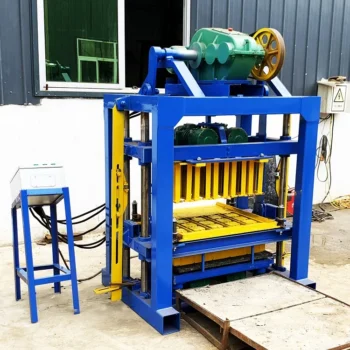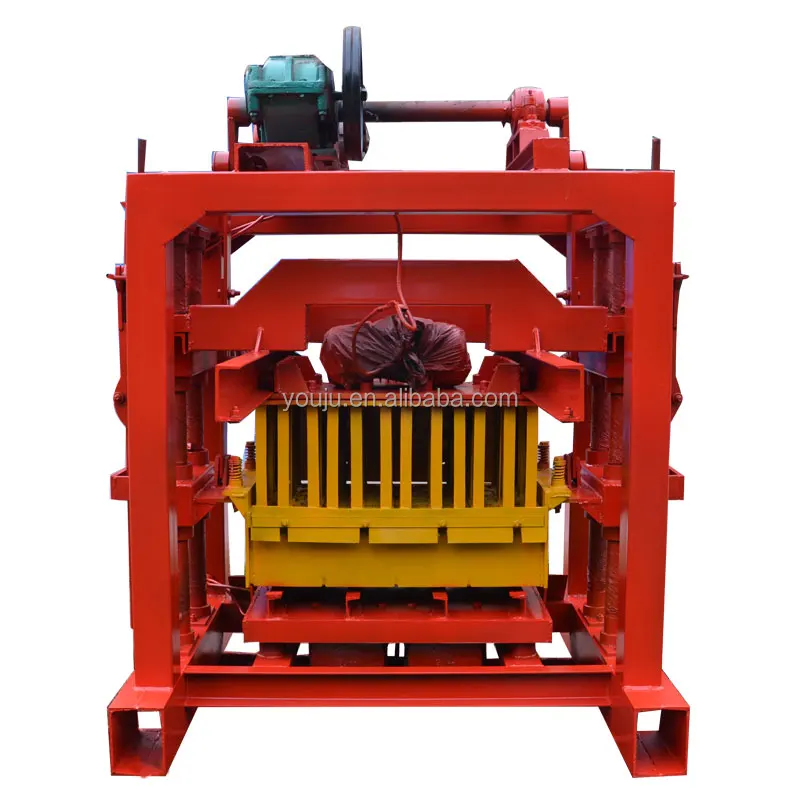


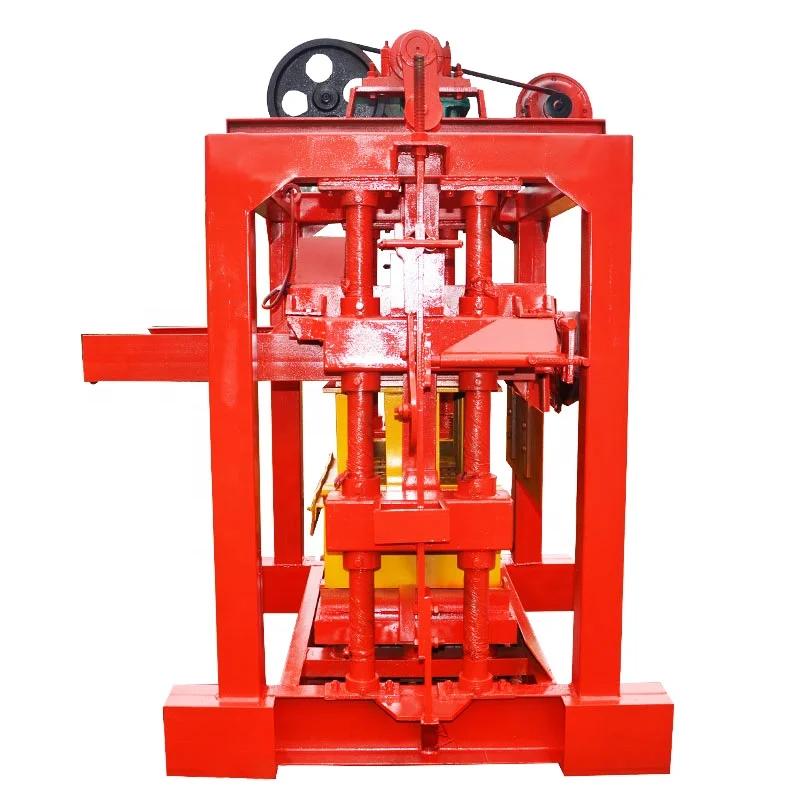

Description
Fast Dispatch for Small-Scale Block Projects — the QTJ4-40 is held in stock with standard hollow block mould, so your order can move from confirmation to container loading in days rather than weeks.
Technical Specifications
| Parameter | Value |
|---|---|
| Model | QTJ4-40 |
| Product Type | Stationary Concrete Block Making Machine |
| Molding Cycle | 40 seconds |
| Product Capacity | 5 pcs per mould (400×200×200mm hollow block basis) |
| Rated Power | 10.4 kW |
| Vibration Frequency | 2,800 r/min |
| Pallet Size | 850 × 450 × 20 mm |
| Overall Size | 1,350 × 1,460 × 1,800 mm |
| Total Mass | 1,200 kg |
| Control System | Mechanical and electric combination |
| Vibration System | Table vibration feeding, fluctuation vibration molding |
| Standard Configuration | Host machine 1 set, block mould 1 set, JQ350 mixer |
Application Suitability
| Application | Material or Output |
|---|---|
| Small-scale hollow block production | Crushed stone, cement, sand aggregate mix |
| On-site solid block manufacturing for contractors | Local quarry aggregate with cement binder |
| First-time block plant startups | Standard concrete mix with readily available raw materials |
| Paving block and kerbstone runs (with optional moulds) | Fine aggregate and cement blends |
Why "In Stock" Matters More Than You Think on a Block Machine Purchase
A QTJ4-40 stationary block machine in stock means your project timeline stays yours, not the factory’s production schedule.
I spent years on construction sites across the Middle East watching deadlines slip because equipment was still "being built." One contractor in Riyadh had a housing project with penalties written into the contract — his block machine arrived six weeks late because the supplier only started fabrication after receiving the deposit. The penalty clauses cost him more than the machine itself. When buyers ask about the QTJ4-40 stationary block machine in stock, what they really need to know is whether the unit is physically ready or just listed as available. [NEED_CITE: typical lead time differences between stocked and built-to-order industrial machinery]
Stocked machines also mean the standard mould, the JQ350 mixer, and the host unit have already passed factory testing together. There is no waiting for a production slot, no uncertainty about whether your specific voltage requirement delays the build. The machine ships as a tested set.
What Arrives When the Machine Ships From Stock
When a QTJ4-40 stationary block machine in stock is confirmed for dispatch, the complete configuration leaves the warehouse together. The host machine, one standard block mould set, and the JQ350 mixer form the base package. Everything has been assembled and run during factory testing, so the mechanical and electrical systems are verified before crating. This matters because machines built to order sometimes ship with components sourced from different production batches, introducing minor fit issues during on-site assembly.
The dismantling process for container loading follows a documented sequence. The upper frame sections separate from the vibration table, and the mould is packed independently to prevent transit damage. A machine of this mass and footprint fits into standard container configurations, and the loading plan is provided before dispatch so the buyer’s freight forwarder can arrange the correct booking without guesswork.
Dispatch Timing and What Controls the Calendar
Once an order for a stocked QTJ4-40 stationary block machine in stock is confirmed, the critical path shifts to paperwork and logistics rather than fabrication. Voltage confirmation, control panel language setting, and export documentation preparation are the steps that either accelerate or delay departure. [NEED_CITE: export documentation requirements for industrial machinery by destination region]
I always push buyers to confirm their site voltage and frequency before the order is finalized — not after. A 380V/50Hz machine arriving at a site wired for 440V/60Hz is not a small problem. I once saw a block machine sit idle for three weeks in Jeddah while an electrician sourced a step-down transformer that should have been discussed before the machine left the factory. Stock availability eliminates the build wait, but the electrical confirmation still needs to happen early.
Reading the Numbers That Actually Affect Your Site
The 40-second molding cycle defines what your crew can realistically plan around. At five hollow blocks per mould on the 400×200×200mm format, each cycle produces a predictable output that lets you calculate curing rack space and daily pallet rotation. This is not a theoretical maximum — it is the cycle the machine was tested on, with the standard vibration frequency of 2,800 r/min and table vibration feeding system working together to consolidate the mix within that window.
The pallet size of 850 × 450 × 20 mm determines how many pallets you need in circulation. On a stationary machine with manual pallet handling, your crew moves each loaded pallet to the curing area by hand or with a simple cart. Knowing the pallet dimensions before the machine arrives means you can arrange curing racks and storage space to match, rather than discovering the pallets are too wide for your existing shelving.
The 10.4 kW rated power requirement is modest enough for most small-site electrical supplies, but it still needs a dedicated circuit. The mechanical and electric combination control system keeps operation straightforward — no PLC programming to learn, just direct control over the vibration and molding sequence. For a first-time block plant operator, this simplicity reduces the training burden significantly.
The Hidden Cost of Skipping Pre-Shipment Checks
Buyers who rush a stocked machine order without confirming site conditions often pay for it at the other end. Voltage mismatch is the most common issue I have encountered — the machine works fine on the factory floor but cannot run at the destination. Beyond electrical problems, pallet material matters: wooden pallets, bamboo pallets, and PVC pallets all behave differently during curing, and choosing the wrong type for your local climate can cause blocks to stick or crack during the early curing hours. [NEED_CITE: pallet material selection factors for concrete block curing environments]
Then there is the question of which mould format ships with the machine. A standard hollow block mould may not match what your local market actually buys. If most of your customers want solid blocks or interlocking pavers, discovering that the stocked machine came only with a hollow block mould means an additional order and another shipping cycle. Confirming the mould format before dispatch costs nothing and saves weeks.
Why This Purchase Path Works for Deadline-Driven Buyers
Single-focus machinery sourcing means the host machine, mould, pallet specification, and mixer are specified as a matched set — not assembled from separate suppliers who may not coordinate on tolerances. With the QTJ4-40, the JQ350 mixer is included in the standard configuration, so the raw material preparation stage is ready from day one without a separate procurement process.
Configuration is confirmed against the buyer’s destination voltage and frequency before the machine leaves the warehouse. This is not a catalogue default shipment — the electrical panel is checked against the confirmed site supply. Factory test records are generated before crating, and packing photographs document the machine condition at the point of dispatch so both sides have a visual record for freight claims if needed.
Documentation arrives with the machine: operation manuals, hydraulic and electrical schematics, and customs paperwork are prepared as part of the standard dispatch package. For importers clearing goods through ports with strict documentation requirements, having the CE declaration and commercial paperwork ready eliminates the most common cause of customs delays. [NEED_CITE: common causes of customs hold for imported industrial equipment]
Documentation & Verification
- Factory test record run on standard hollow block format before dispatch
- Electrical schematic confirming site voltage and frequency match
- Packing photographs documenting machine condition at crating
- Operation and maintenance manual in confirmed language
- Customs documentation package prepared for destination port clearance
Installation, Commissioning & Support
- Foundation pad must support 1,200 kg total mass with level tolerance for vibration table stability
- Dedicated electrical circuit rated for 10.4 kW draw with correct voltage and frequency confirmed before connection
- Machine ships dismantled into frame sections, vibration table, and mould set for container transport
- First production run should verify molding cycle consistency and block density with local aggregate mix
- Mechanical and electric combination control requires no software configuration, reducing commissioning time
- JQ350 mixer setup includes belt tension check and drum rotation verification before first batch
What to Include With Your Inquiry
To move quickly from inquiry to dispatch confirmation, provide your destination port, required voltage and frequency, and the block format your market demands. If you need moulds beyond the standard hollow block, specify the format and dimensions so availability can be checked against current stock. Share your site curing area layout if pallet size compatibility is a concern.
Frequently Asked Questions
Q: Is the QTJ4-40 currently in stock or built to order, and what is the dispatch lead time?
A: The QTJ4-40 is held as a stocked model with the standard hollow block mould and JQ350 mixer. Dispatch lead time depends on documentation confirmation and container booking availability rather than fabrication. Once voltage and control language are confirmed, the machine can move to crating and loading. Exact timing is quoted at inquiry based on current warehouse status and your destination port schedule.
Q: How is the machine dismantled and loaded into a container?
A: The host machine separates into upper frame and vibration table sections, with the mould packed independently. At 1,200 kg total mass and 1,350 × 1,460 × 1,800 mm overall dimensions, the dismantled set fits standard container configurations. A loading plan is provided before dispatch so your freight forwarder can book the correct container type and arrange loading equipment at the destination.
Q: What standard moulds ship with the machine, and can additional moulds be added later?
A: The stocked configuration includes one standard hollow block mould set matched to the 850 × 450 mm pallet size. Additional mould formats such as solid block, paving block, or interlocking brick can be ordered separately and shipped together if available at the time of dispatch, or sent in a subsequent shipment. Confirming required formats early ensures they are included in the initial container load.
Q: What arrival estimate can be quoted for my destination port?
A: Arrival timing depends on your destination port, chosen shipping line, and current sailing schedules. Once the container is booked, a transit estimate is provided based on the carrier’s published schedule. Stocked machines reduce the total timeline by eliminating the production phase, so the critical path becomes documentation preparation, container loading, and ocean transit to your port.
Q: What customs documentation is provided to support import clearance?
A: The dispatch package includes commercial invoice, packing list, bill of lading, certificate of origin, and CE declaration where applicable. These documents are prepared to match destination country requirements and are shared in draft form before finalization so your customs broker can review them. Correct documentation prevents the most common cause of port delays for machinery imports.