

Curbstone Machine Buyer Checklist: QT Series Manufacturer for Sale
Higher vibration force does not guarantee better curbstones. In fact, mismatched frequency with your local aggregate size is the primary cause of segregation and structural weak spots.
Buying a curbstone machine requires matching equipment vibration parameters and mold durability to your specific raw materials, not just selecting a model number based on output capacity. This approach prevents costly downtime by prioritizing compatibility over initial price. [NEED_CITE: impact of vibration frequency on concrete compaction quality]
I recall a urgent call from a client in Jakarta. Their new QT6 machine had been running for half a month, yet the demolding pass rate was below sixty percent. The edges were chipped, and the surface was rough. Rushing to the workshop, I found the issue was not the machine itself. The local crushed stone had a larger particle size and higher moisture content than the standard mix used in northern China. The vibration frequency, set according to domestic standards, simply could not compact the material properly. After recalibrating the excitation force and replacing the mold liners with a more wear-resistant grade, the production line finally ran smoothly. This incident established a rule for my subsequent work: before quoting a price, I must understand the customer’s aggregate, target output, and finished product specifications. This curbstone machine buyer checklist is distilled from those hard-learned lessons.
Understanding why machines fail to meet targets is the first step in using this curbstone machine buyer checklist effectively.
Why Does Your Curbstone Machine Fail to Meet Output Targets?
The primary cause of low efficiency is a mismatch between machine specifications and local raw materials. Many buyers focus on the theoretical hourly output listed in brochures, ignoring how their specific sand and stone composition interacts with the machine’s compaction system.
Concrete is not a uniform commodity. The grading of aggregates varies significantly across regions. In tropical climates, high moisture content in sand can lead to poor demolding if the water-cement ratio is not adjusted alongside the vibration time. A machine designed for dry, fine sand will struggle with wet, coarse gravel. [NEED_CITE: relationship between aggregate moisture and concrete demolding quality]
Consider the difference in daily output variance. Manual feeding systems often show significant fluctuations, while automated systems maintain consistency. However, even an automatic feeder cannot compensate for a fundamental mismatch in compaction parameters. If the vibration amplitude is too high for the aggregate size, the heavier stones sink, and the lighter cement paste rises, causing segregation. This results in curbs that look solid but crumble under stress.
| Parameter | Mismatched Setup | Optimized Setup |
|---|---|---|
| Vibration Frequency | Fixed high frequency regardless of material | Adjustable based on aggregate grading |
| Moisture Handling | Standard water ratio | Adjusted for local humidity and sand moisture |
| Compaction Result | Segregation and weak spots | Uniform density and strength |
| Maintenance Impact | High wear due to uneven load | Extended service life |
A buyer in West Africa once reported that their machine produced curbs with visible honeycombing. Upon inspection, we found they were using a mix with large, irregular river stones. The standard vibration setting was shaking the stones apart rather than compacting them. By reducing the frequency and increasing the amplitude slightly, we achieved a dense, smooth finish. This adjustment is a critical part of any curbstone machine buyer checklist.
How to Evaluate Mold Quality and Durability?
Mold steel quality and liner design determine the majority of long-term maintenance costs, not just the initial purchase price. Sharp edges and chipping are common complaints, often traced back to inferior mold steel or poor liner fit.
Many suppliers offer molds that look identical on the outside but differ vastly in internal hardness and wear resistance. A mold made from standard steel might last for a few thousand cycles before the edges begin to chip, whereas a mold made from high-grade alloy steel with proper heat treatment can withstand tens of thousands of cycles. [NEED_CITE: standards for mold steel hardness and wear resistance in precast concrete]
The design of the liner is equally important. A poorly fitted liner allows concrete slurry to leak into the gap between the liner and the mold frame. This buildup causes dimensional inaccuracies and makes demolding difficult, leading to broken curbs. In one case, a manufacturer in Southeast Asia was replacing liners every few months because the original design did not account for the abrasive nature of their local sand. Switching to a mold with a tighter tolerance and harder liner material extended the replacement interval significantly.
When evaluating a supplier, ask about the steel grade and the heat treatment process. Do not just accept "high-quality steel" as an answer. Request specifics on the hardness rating and whether the mold has been tested for cycle life. This scrutiny is essential for any serious curbstone machine buyer checklist.
| Feature | Basic Mold | Premium Mold |
|---|---|---|
| Steel Grade | Standard carbon steel | High-grade alloy steel |
| Heat Treatment | Minimal or none | Controlled hardening process |
| Liner Fit | Loose tolerance | Precision fit to prevent leakage |
| Expected Lifespan | Short, frequent replacement | Long, reduced maintenance |
What Vibration Parameters Suit Your Aggregate Type?
Adjusting frequency and amplitude based on stone size and moisture content is crucial for optimal compaction. There is no single "best" setting; the right parameters depend entirely on your raw materials.
High vibration force is often marketed as a superior feature, but it can be detrimental if not matched to the aggregate. For fine sand, a higher frequency helps to settle the particles. For larger stones, a lower frequency with higher amplitude is more effective in moving the heavy particles into place without causing segregation. [NEED_CITE: effect of vibration frequency on different aggregate sizes]
In tropical regions, where sand moisture can fluctuate daily, the ability to adjust vibration time is vital. A wetter mix requires less vibration time to achieve compaction, while a drier mix needs more. Machines with fixed vibration timers often struggle in these environments. A PLC-controlled system allows for precise adjustment of vibration time and intensity, ensuring consistent quality despite material variations.
During a site visit in Latin America, we observed a plant using a machine with fixed vibration settings. The operator had to manually stop the cycle early when the sand was wet, leading to inconsistent density. Upgrading to a system with adjustable vibration parameters allowed them to maintain consistent quality regardless of weather conditions. This flexibility is a key item on the curbstone machine buyer checklist.
Manual vs. Automatic Feeding: Which Fits Your Scale?
Comparing ROI and consistency helps choose the right level of automation for your production volume. While automatic feeding offers higher consistency, it may not be cost-effective for small-scale operations.
Manual feeding relies on the skill and stamina of the operator. Output can vary significantly throughout the day, and labor costs can add up. Automatic feeding systems, such as belt conveyors or hopper feeders, ensure a consistent supply of mix to the mold, reducing variability and labor requirements. However, they come with a higher initial investment and maintenance needs.
For a startup investor, the choice depends on the target market and available labor. If labor is cheap and abundant, a semi-automatic machine might offer a faster payback period. For larger operations aiming for high volume and consistent quality, full automation is usually the better long-term investment. [NEED_CITE: labor cost analysis for manual vs automatic block production]
A client in the Middle East started with a manual feed system to keep initial costs low. As demand grew, the inconsistency in output became a bottleneck. They eventually upgraded to an automatic feeder, which stabilized their daily output and reduced their reliance on skilled labor. This transition highlights the importance of planning for scalability in your curbstone machine buyer checklist.
| Feature | Manual Feeding | Automatic Feeding |
|---|---|---|
| Initial Cost | Low | High |
| Output Consistency | Variable | High |
| Labor Requirement | High | Low |
| Scalability | Limited | High |
Essential Pre-Purchase Verification Steps
Conducting site-specific material tests and requesting demo runs with your own aggregates is the most reliable way to ensure equipment suitability. Do not rely solely on factory demonstrations using ideal materials.
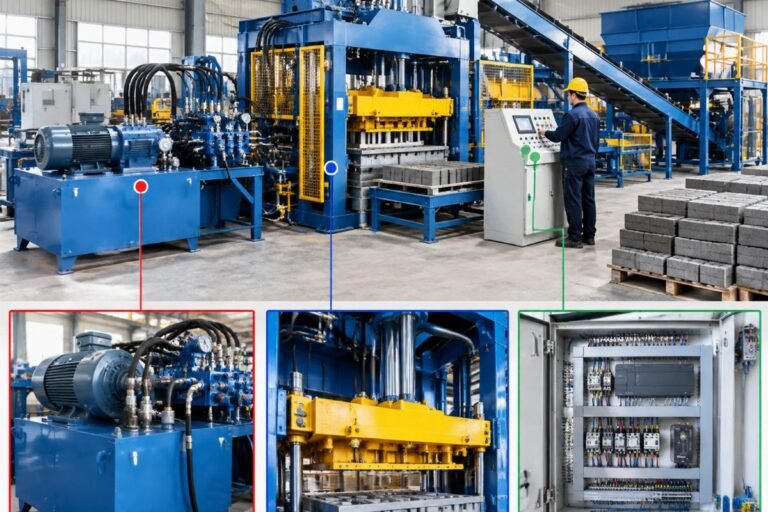
Before finalizing a purchase, send samples of your local sand, stone, and cement to the manufacturer. Ask them to run a test batch using your materials. This reveals how the machine handles your specific mix and allows for adjustments to be made before shipping. Additionally, verify the hydraulic system’s stability under load. A unstable hydraulic system can lead to inconsistent pressure and poor compaction.
Shiyue’s turnkey solution includes operator training and remote diagnostic support, which ensures that the machine is set up correctly and parameters are tuned for local conditions. This support is invaluable for avoiding the pitfalls of mismatched settings. [NEED_CITE: importance of operator training in concrete machinery operation]
A buyer in Europe once skipped the material test phase, assuming their standard mix would work. Upon arrival, the machine struggled with their specific aggregate blend, leading to weeks of downtime while adjustments were made. Had they conducted a pre-purchase test, this delay could have been avoided. This step is non-negotiable in a comprehensive curbstone machine buyer checklist.
Conclusion
Success in curbstone production depends on compatibility, not just capacity. By focusing on raw material matching, mold quality, and appropriate automation, you can avoid common pitfalls and ensure a profitable operation. Use this curbstone machine buyer checklist to guide your selection process and secure a machine that meets your specific needs.
Leave a Reply