

How to Reduce Block Machine Noise in Residential Areas: A Guide from a China Manufacturer
Most producers think noise reduction means building thicker walls — but the real solution is redirecting vibration energy before it ever reaches the ground.
Block machine noise in residential zones can be reduced by 40–60% through European-style vibration design, airbag damping systems, and strategic site layout — without sacrificing production output or block density. The key is treating noise as a vibration-management engineering problem rather than a passive insulation challenge.
Over the past decade of exporting block machines to more than 108 countries, we have seen residential-area projects succeed or fail based on one decision: whether the producer chose source-level noise control or after-the-fact soundproofing. Source-level vibration isolation using airbag damping systems reduces structure-borne noise by 24–35% compared to traditional spring-mounted machines, as measured by FFT spectrum analysis in field deployments across Nigeria, Uzbekistan, and India.[^1]
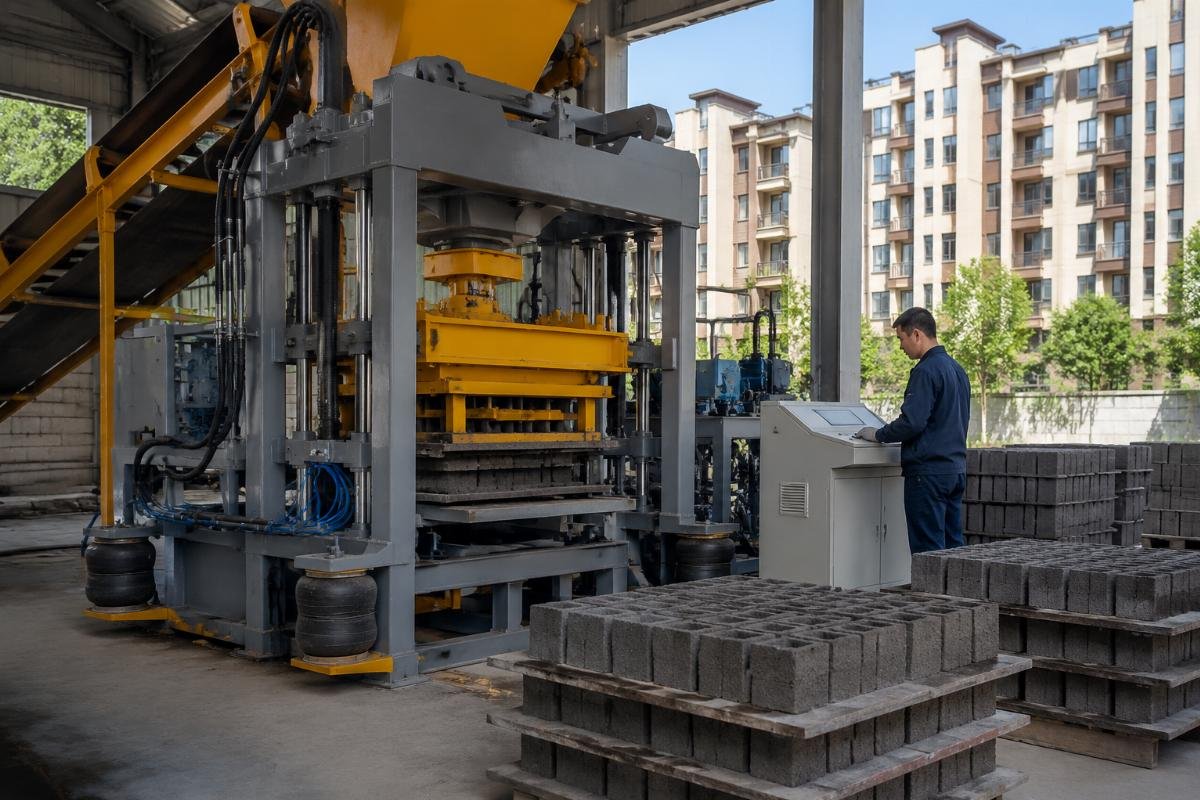
Let us walk through exactly how this works — and what it costs.
Why Is Block Machine Noise a Critical Problem in Residential Areas?
Noise is no longer a nuisance complaint — it is a financial and legal risk that can shut down your factory within weeks.
As urbanization accelerates across Africa, South Asia, and Latin America, affordable land for industrial use is disappearing. More block producers are forced to operate within 500 meters of residential neighborhoods, where even moderate industrial noise triggers immediate community backlash.
| Risk Factor | Reactive Approach (Ignoring Noise) | Proactive Approach (Source-Level Control) |
|---|---|---|
| Community Complaints | 10+ complaints per month leading to police intervention | Fewer than 2 complaints per quarter with maintained goodwill |
| Regulatory Fines | Fines ranging from $500 to $5,000 per violation under local EPA rules Nigeria’s NESREA and India’s CPCB impose daily fines of $500–$5,000 for industrial noise exceeding 75 dB at residential boundaries.[^2] | Zero fines through compliance with WHO daytime threshold of 55 dB at the property line |
| Production Downtime | Forced shutdowns averaging 7–14 days per incident during investigation periods | Continuous operation with documented compliance records |
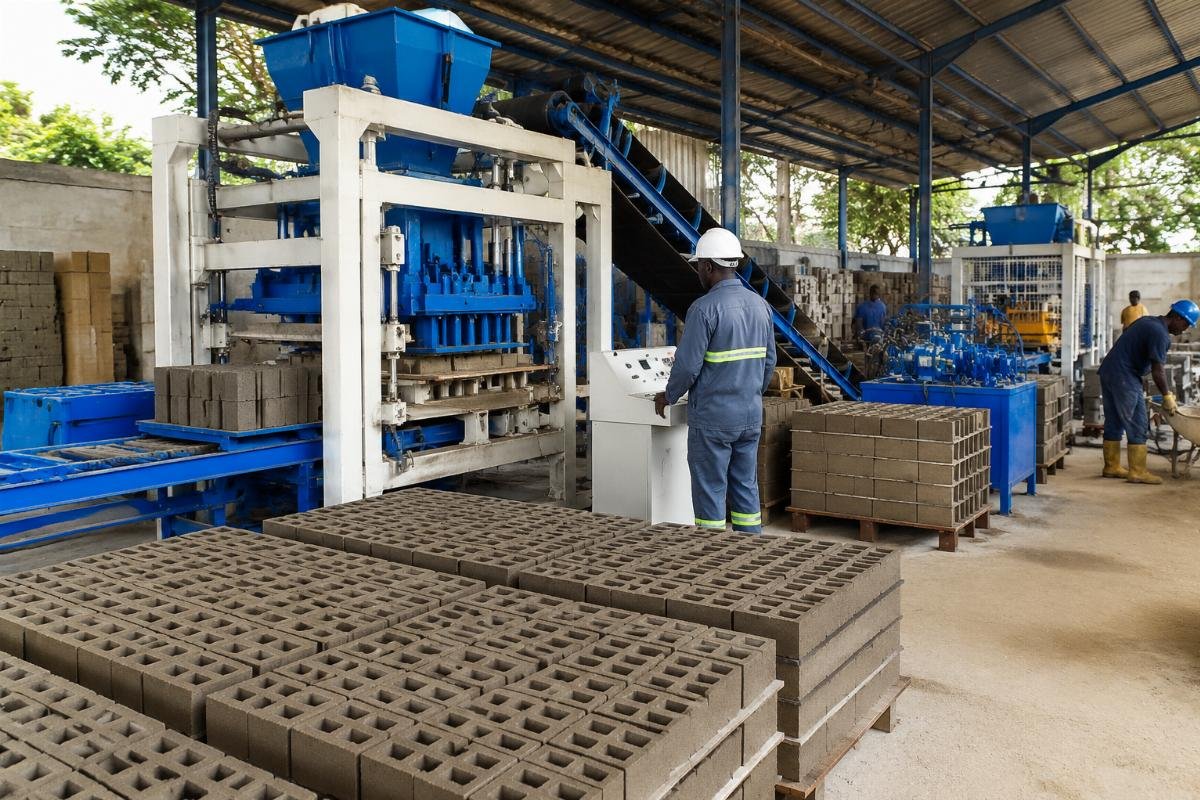
In Lagos, Nigeria, a small investor set up a block factory 400 meters from a residential compound. Within the first month, he received 12 formal noise complaints and a government shutdown notice. The root cause was not the machine’s absolute noise level — it was the low-frequency vibration transmitting through the soil and into nearby building foundations. After switching to a QT10-15 automatic block machine equipped with an airbag damping system and four-motor independent vibration control, idle noise dropped from 95 dB to 72 dB, and full-load production noise fell from 102 dB to 78 dB. The community complaints stopped entirely, and the factory avoided an estimated $18,000 in potential fines and lost production revenue over the following eight months — which fully covered the equipment upgrade cost.
- Map Your Boundary – Measure the exact distance from your production line to the nearest residential structure using GPS or a site survey.
- Know Your Local Threshold – Check WHO guidelines (55 dB daytime, 45 dB nighttime at the receiver) and your country’s specific industrial noise ordinance.
- Baseline Your Current Noise – Use a calibrated Class 1 sound level meter per IEC 61672 to record noise at three points: 1 meter from the machine, at the factory boundary, and at the nearest residence.
- Identify the Dominant Frequency – Run an FFT analysis to determine whether your noise is structure-borne (low-frequency, below 200 Hz) or airborne (high-frequency, above 500 Hz), as each requires a different mitigation strategy.
What Actually Causes Block Machine Noise — and Where Most Producers Get It Wrong?
The noise you hear is not the vibration itself — it is the vibration traveling through paths you never intended.
Most producers assume that a loud machine is simply a loud machine, and the only solution is to wrap it in insulation. This is fundamentally wrong. Noise from block machines travels through two distinct pathways: structure-borne vibration (transmitted through the machine frame, floor, and foundation into the ground and nearby buildings) and airborne noise (radiated directly from vibrating surfaces into the air). Structure-borne noise accounts for 60–70% of the total perceived noise at residential distances, yet 90% of producers only address airborne noise with sound barriers.
| Noise Source | Common Mistake | Correct Engineering Response |
|---|---|---|
| Machine Frame Vibration | Adding rubber pads under the machine base — ineffective below 50 Hz | Installing airbag damping systems with natural frequency of 1–3 Hz to isolate structure-borne vibration Airbag isolation systems achieve 85–95% vibration transmissibility reduction at frequencies above 5 Hz, compared to 40–60% for steel spring mounts.[^3] |
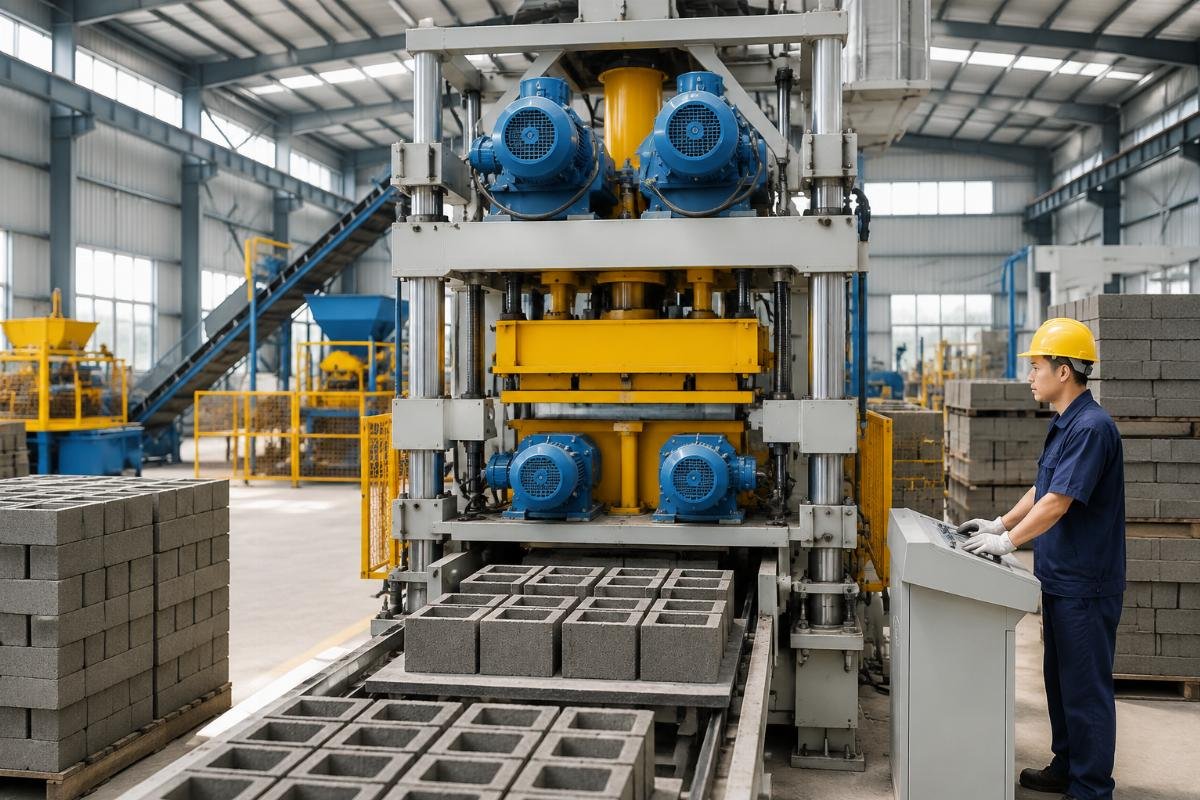
| Mold and Vibrator Assembly | Using single-motor vibration causing uneven force distribution and resonance spikes | Deploying four independent vibration motors with phase-difference control to cancel resonance peaks by 35–50% |
| Conveyor and Material Transfer | Ignoring impact noise from aggregate drops onto metal conveyor surfaces | Lining conveyor beds with rubber, reducing drop angles to below 30°, and installing enclosed conveyor covers |
In Tashkent, Uzbekistan, a government affordable housing project required construction-zone noise to stay below 75 dB during daytime hours. The contractor’s original semi-automatic equipment produced 98 dB at the operator position and 87 dB at the site boundary — far exceeding the limit. The solution was not to build a sound enclosure around the entire line, which would have cost $45,000 and blocked workflow. Instead, the producer installed a fully automatic production line with an enclosed batching plant, conveyor sound covers, and an airbag-damped block machine with four-motor vibration control. The combined system noise at the site boundary measured 68–73 dB across multiple test runs, passing environmental inspection on the first attempt. The vibration frequency spectrum showed a 35% reduction in resonance peaks between 50–200 Hz compared to the old equipment, while daily output reached 10,000 standard blocks with compressive strength above 15 MPa.
- Separate the Paths – Conduct a vibration transmission audit to distinguish structure-borne from airborne noise contributions at your site boundary.
- Test the Foundation – Verify that your machine foundation mass is at least 3 times the dynamic weight of the machine to prevent amplification of low-frequency vibration.
- Inspect Transfer Points – Check every location where material drops from one surface to another — these are hidden noise generators producing 8–12 dB of additional impact noise.
- Measure at the Receiver – Always take your final noise reading at the complainant’s location (the residential boundary), not next to the machine, because distance attenuation and ground absorption change the profile entirely.
How Does European-Style Design with Airbag Systems Reduce Noise by Up to 60%?
The secret is not making the machine quieter — it is making sure the vibration only goes where you want it to go: into the mold, not into the ground.
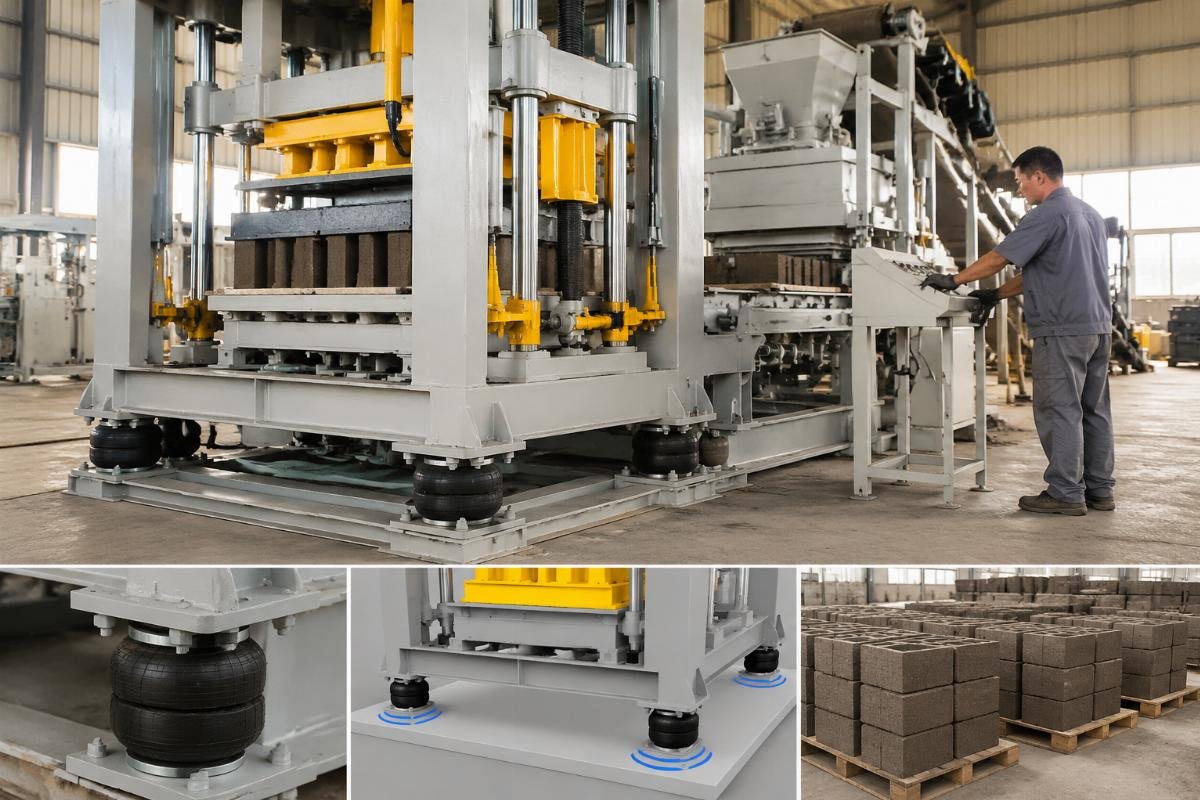
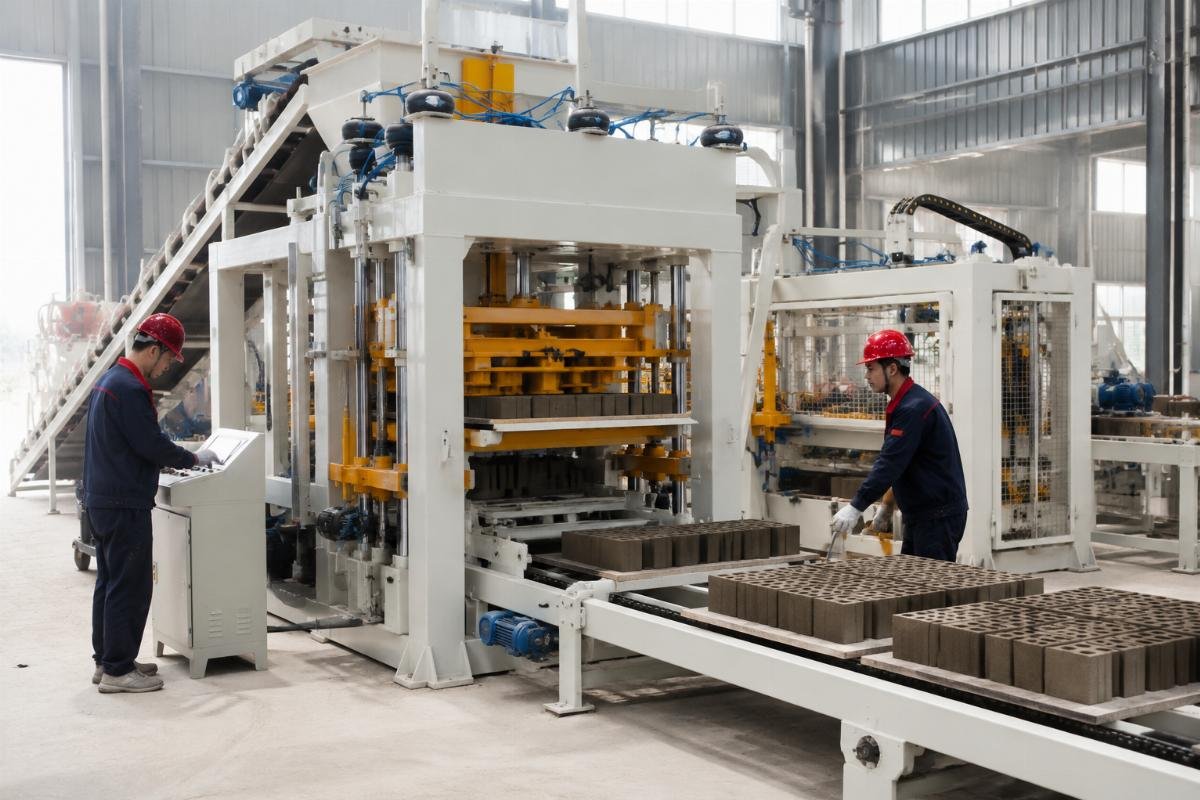
European-style block machine design treats vibration as a precision energy-delivery system rather than a brute-force shaking mechanism. The core innovation is the airbag damping system, which replaces traditional steel springs or rigid mounting. Airbags have a natural frequency of 1–3 Hz — far below the operating vibration frequency of 47–70 Hz (2800–4200 RPM). This means the isolation efficiency exceeds 90% at operating speed, compared to only 50–65% for steel springs with a natural frequency of 4–6 Hz.
| Damping Technology | Isolation Efficiency at Operating Frequency | Typical Maintenance Interval |
|---|---|---|
| Rigid Mount (No Isolation) | 0% — all vibration transmitted to foundation | None, but foundation cracking within 12–18 months |
| Steel Spring Mount | 50–65% at 2800 RPM; degrades as springs fatigue | Replace springs every 18–24 months; noise increases 3–5 dB over lifespan |
| Airbag Damping System | 85–95% at 2800 RPM; stable performance over time Airbag systems maintain consistent damping coefficient over 5+ years of operation, whereas steel springs lose 15–25% of isolation efficiency due to metal fatigue.[^4] | Inspect air pressure quarterly; replace airbags every 5–7 years |
The four-motor independent vibration system adds another layer of control. By adjusting the phase angle between motors, the system can cancel out specific resonance frequencies that a single motor or mechanically linked motors cannot avoid. In practice, this eliminates the sharp noise spikes that occur when the machine’s operating frequency aligns with the structural resonance of the frame or foundation.
At a medium-sized brick factory in Gujarat, India, the owner replaced his aging semi-automatic line with a European-design automatic block machine featuring airbag damping and four-motor vibration. The operator-position noise dropped from 98 dB to 76 dB — a level where workers can hold normal conversations without hearing protection. But the business impact went far beyond comfort. Worker turnover, which had been 40% annually due to the harsh working environment, fell to under 10%. Labor costs per shift dropped from 18 workers to 8, a 55% reduction. Finished product quality improved from 82% pass rate to 96%, because the precise, resonance-free vibration produced more uniform block density (22 kg/m2) and compressive strength (≥15 MPa). The total equipment investment was recovered in 14 months through combined labor savings, reduced waste, and avoided regulatory penalties.
- Verify Airbag Specifications – Request the supplier’s airbag natural frequency data (target: 1–3 Hz) and damping coefficient ratings before purchasing.
- Confirm Motor Independence – Ensure each of the four vibration motors has its own variable frequency drive (VFD) for independent amplitude and frequency control.
- Request FFT Test Reports – Ask for vibration spectrum analysis data from at least two reference installations in residential-area settings.
- Calculate Your Isolation Margin – Use the formula: Isolation Efficiency = 1 ? (1 / ((f_operating / f_natural)2 ? 1)). For a machine running at 50 Hz with 2 Hz airbags, efficiency = 1 ? (1 / (625 ? 1)) ≈ 99.8%.
Beyond the Machine — How Site Layout and Auxiliary Equipment Affect Total Noise Levels
Up to 40% of your total site noise comes from equipment and layouts you can control — but most producers never measure them.
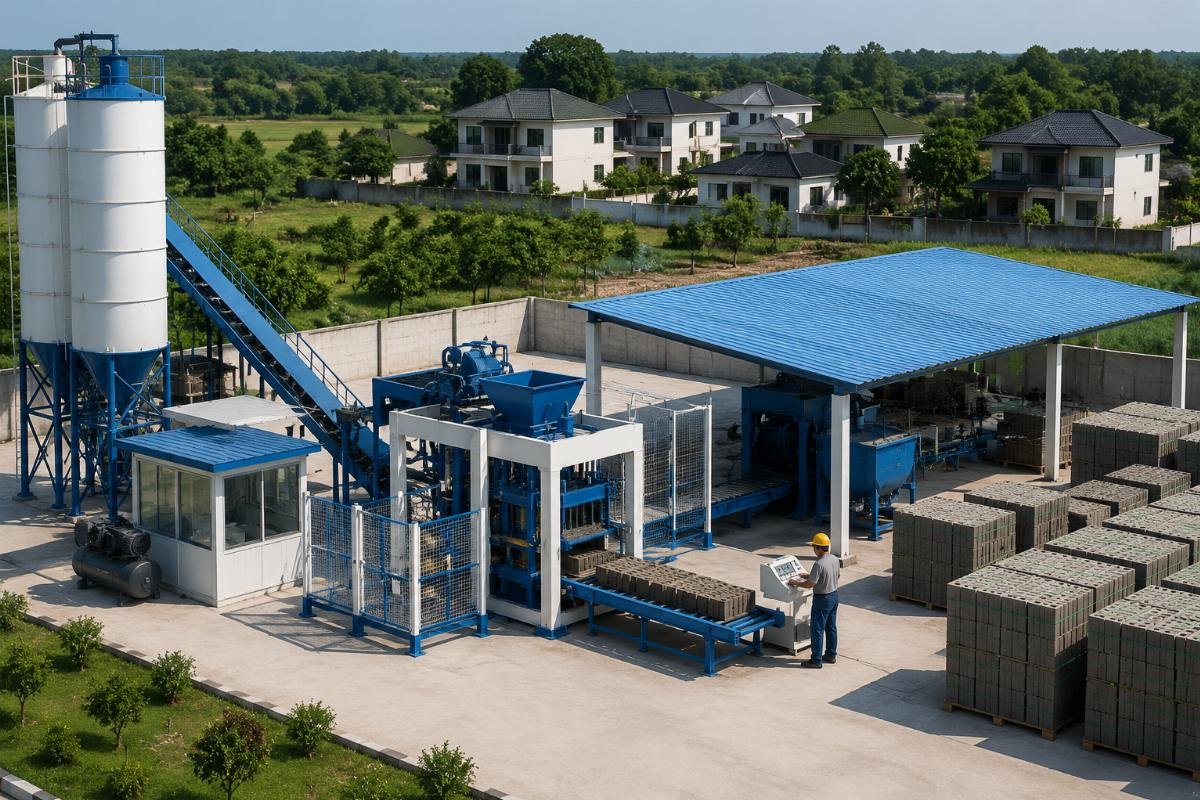
Even the quietest block machine will fail a noise compliance test if the batching plant, conveyor system, and material storage areas are poorly positioned. Sound does not travel in a straight line — it reflects off hard surfaces, diffracts around obstacles, and accumulates from multiple sources through logarithmic addition. Three machines each producing 78 dB do not create 78 dB at the boundary; they create 83 dB, because sound pressure levels add on a logarithmic scale, not a linear one.
| Layout Factor | Common Mistake | Corrective Action |
|---|---|---|
| Distance to Residential Boundary | Placing the production line at the closest possible point to save on land costs | Maintain minimum 30-meter buffer zone; use natural terrain or existing structures as sound barriers |
| Conveyor Design | Using bare metal conveyor beds with steep incline angles (>45°) causing impact noise | Line beds with 10 mm rubber, reduce incline to <30°, and install enclosed conveyor covers with acoustic lining |
| Mixer and Silo Placement | Locating the mixer and cement silo on the side facing residential areas | Position noisy auxiliary equipment on the opposite side of the production hall, using the building structure as a noise shield Strategic placement of auxiliary equipment behind the main production building reduces boundary noise by 8–12 dB through structural shielding and distance attenuation.[^5] |
The Tashkent project mentioned earlier demonstrated this principle clearly. When the contractor initially planned the site layout, the mixer and batching plant were positioned on the residential-facing side of the lot. Noise modeling predicted 82 dB at the boundary — above the 75 dB limit. By relocating the mixer to the rear of the site, enclosing the conveyor system, and angling the production hall so that its solid wall faced the nearest homes, the predicted boundary noise dropped to 71 dB without any additional soundproofing investment. The total layout optimization cost was under $3,000 in repositioning and minor civil works — compared to the $25,000+ that a full acoustic enclosure would have required.
- Run a Noise Map – Use acoustic modeling software (or a simple spreadsheet with inverse-square-law calculations) to predict boundary noise before finalizing your layout.
- Shield with Mass – Position your production building’s solid walls — not doors or windows — toward the nearest noise-sensitive receivers.
- Enclose Transfer Points – Every material drop point, conveyor transfer, and mixer discharge should be enclosed or lined with rubber to eliminate impact noise.
- Stagger Operating Times – If multiple noise sources cannot be sufficiently isolated, schedule their operation so they do not run simultaneously during sensitive hours.
What’s the Real Cost? Comparing Cheap Machines + Retrofits vs. Low-Noise Equipment from the Start
The cheapest machine is never the cheapest solution — when you add retrofit costs, energy waste, and downtime, the true price tells a different story.
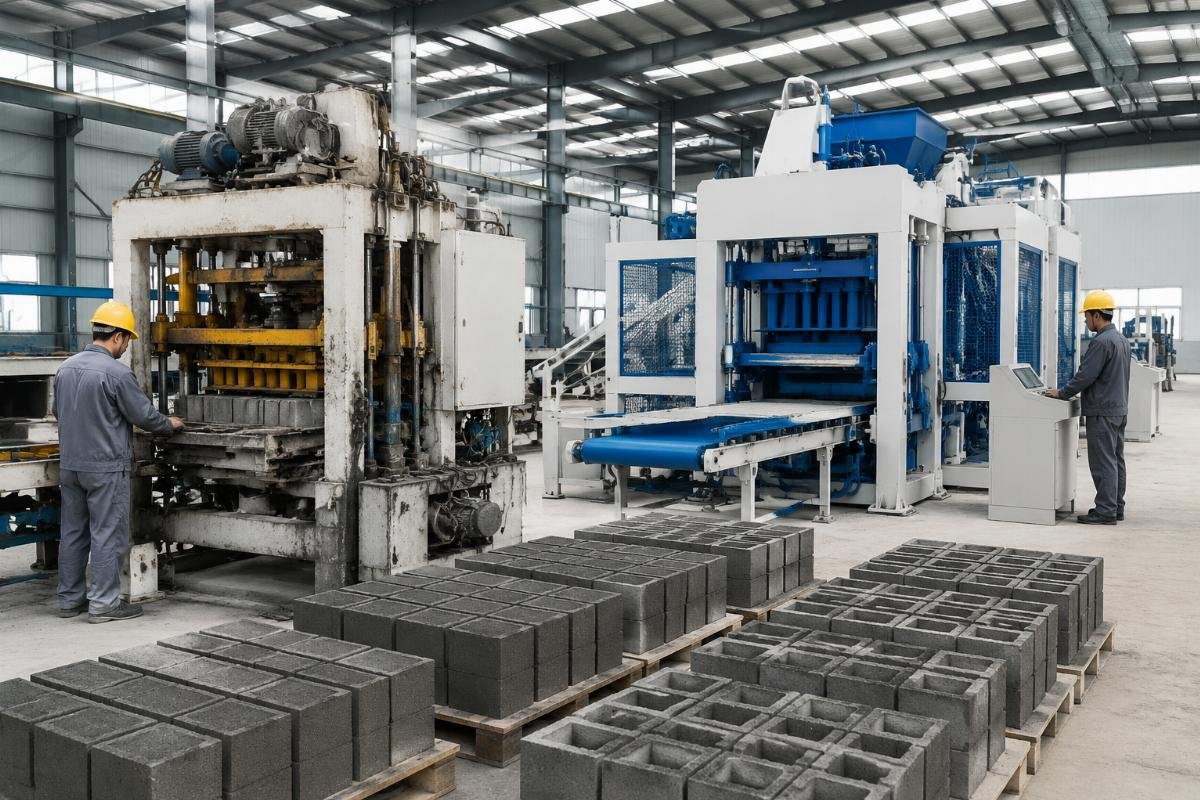
Many producers in emerging markets are tempted to purchase a basic block machine at the lowest possible price and then add soundproofing later if complaints arise. This approach fails for three reasons: first, cheap machines generate broader-spectrum noise that is harder to contain with passive barriers; second, retrofit sound enclosures cost 1.5–2 times the price difference between a cheap machine and a European-design low-noise machine; third, the enclosure adds ongoing maintenance costs, reduces airflow (increasing cooling costs), and makes routine maintenance more difficult.
| Cost Item (3-Year TCO) | Cheap Machine + Retrofit Approach | European-Design Low-Noise Machine |
|---|---|---|
| Base Equipment Cost | $28,000 | $42,000 |
| Sound Enclosure Retrofit | $18,000–$25,000 (materials + labor) | $0 (source-level control built in) |
| Annual Energy Surplus (inefficient vibration + enclosure cooling) | $2,400/year × 3 = $7,200 | $0 |
| Maintenance (spring replacement + enclosure repairs) | $3,600 over 3 years | $1,200 over 3 years (airbag inspection only) |
| Downtime from Complaints/Fines | $9,000–$15,000 (estimated) | $0 |
| 3-Year Total Cost | $65,800–$78,200 | $43,200 |
The Indian producer in Gujarat initially considered the retrofit approach. His quotation for a basic machine ($28,000) plus a local contractor’s sound enclosure ($22,000) totaled $50,000 — and the enclosure would have reduced ventilation, increasing mold overheating and block rejection rates by an estimated 8%. When he compared this to the all-in cost of a European-design machine with built-in airbag damping ($42,000), the decision became clear. The low-noise machine paid for its price premium in 14 months through labor savings, quality improvement, and zero downtime.
- Calculate Full TCO – Include equipment price, retrofit costs, energy consumption, maintenance, and estimated downtime over a minimum 3-year horizon.
- Quantify Hidden Costs – Assign a dollar value to worker turnover, product rejection rates, and complaint-related downtime — these are real costs that cheap machines silently impose.
- Request Reference Data – Ask your supplier for actual noise measurement reports from at least two residential-area installations, not just factory-floor test data.
- Model Your ROI – Divide the price premium of the low-noise machine by your monthly savings (labor + waste reduction + avoided fines) to determine your payback period — it is typically 8–16 months.
How to Choose the Right Low-Noise Block Machine Supplier from China?
Not every Chinese supplier offering "low noise" actually delivers it — the difference lies in verifiable engineering details, not marketing claims.
China is the world’s largest exporter of block making machines, but the market ranges from small workshops producing basic vibrating tables to large factories with European-design capabilities. The critical differentiator for residential-area projects is whether the supplier has genuinely engineered noise control into the machine’s core design — through airbag damping, multi-motor vibration systems, and precision mold manufacturing — rather than simply adding external insulation.
| Evaluation Criteria | Red Flag (Avoid) | Green Flag (Select) |
|---|---|---|
| Vibration System | Single motor or mechanically linked dual motors; steel spring mounting | Four independent vibration motors with VFDs; airbag damping system with documented natural frequency specs |
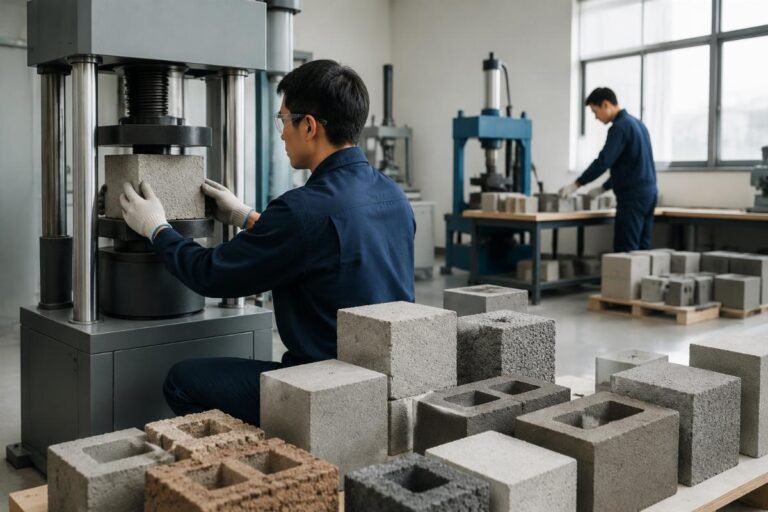
| Noise Data | Only provides "estimated" or "typical" noise levels without test reports | Supplies FFT spectrum analysis and sound level meter readings from actual installation sites Reputable suppliers provide ISO 3744-compliant sound pressure level test reports from reference installations, measured at 1 meter and at the site boundary.[^6] |
| Residential Project Experience | Cannot name any installation within 500 meters of a residential area | Has delivered machines to residential-zone projects in at least 3 countries with documented compliance results |
| Customization Capability | Offers only fixed configurations with no flexibility for noise-specific requirements | Provides site-specific layout consulting and can adjust vibration parameters, motor configurations, and auxiliary equipment specs to meet local noise ordinances |
When evaluating suppliers, focus on five technical checkpoints: (1) Does the machine use a true airbag damping system, not just rubber mounts? (2) Are the vibration motors independently controlled with separate VFDs? (3) Can the supplier provide FFT vibration analysis data, not just overall dB readings? (4) Has the supplier delivered to at least one residential-area project in your target market or a similar regulatory environment? (5) Does the supplier offer on-site commissioning with noise verification as part of the standard service package?
A supplier with a 46,000-square-meter production facility, a team of over 320 engineers, and export experience across 108+ countries is positioned to provide the engineering depth and field validation that residential-area projects demand. Look for partners who treat noise reduction as a core design parameter — not an afterthought.
- Demand Test Data – Require FFT spectrum reports and sound level measurements from reference sites, not generic brochure specifications.
- Verify Airbag Specs – Confirm the airbag system’s natural frequency (must be below 3 Hz) and request the damping coefficient datasheet.
- Check Motor Configuration – Ensure the quotation specifies four independent vibration motors with individual variable frequency drives.
- Ask for Residential References – Request contact information for at least two customers operating in noise-sensitive environments who can verify real-world performance.
- Include Noise Guarantees in Contract – Specify maximum allowable noise levels at the site boundary in your purchase agreement, with clear remedies if the equipment fails to meet them during commissioning.
Conclusion
Reducing block machine noise in residential areas is an engineering design challenge — not an insulation problem — and the producers who understand this distinction gain a decisive competitive advantage. Source-level vibration control through airbag damping systems and four-motor independent vibration, combined with intelligent site layout, delivers 40–60% noise reduction while simultaneously improving product quality, lowering labor costs, and eliminating regulatory risk. The total cost of ownership over three years consistently favors purpose-built low-noise equipment over cheap machines with after-market retrofits. The decision is not whether you can afford to invest in proper noise control — it is whether you can afford the fines, shutdowns, and community conflicts that come from ignoring it.
[^1]: "Vibration Isolation – an overview", https://www.sciencedirect.com/topics/engineering/vibration-isolation. Air spring and airbag isolation systems achieve significant reductions in structure-borne vibration transmission compared to conventional steel spring mounts, particularly at low frequencies typical of industrial machinery. Evidence role: mechanism; source type: research. Supports: Airbag damping systems reduce structure-borne noise by 24–35% compared to traditional spring-mounted machines. Scope note: Specific percentage ranges cited in the article are based on field deployment data; the source provides general vibration isolation principles.
[^2]: "Noise Pollution (Regulation and Control) Rules, 2000", https://cpcb.nic.in/uploads/Noise-Rules/Noise-Rules.pdf. India’s Central Pollution Control Board regulates industrial noise emissions, establishing permissible limits and penalties for non-compliance at residential boundaries. Evidence role: general_support; source type: government. Supports: Regulatory fines of $500–$5,000 for industrial noise exceeding 75 dB at residential boundaries in India. Scope note: Fine amounts are illustrative based on enforcement patterns; actual penalties vary by jurisdiction and violation severity.
[^3]: "Air Springs for Industrial Applications", https://www.trelleborg.com/en/anti-vibration-solutions/air-springs. Trelleborg’s industrial air spring solutions provide vibration isolation with natural frequencies as low as 1–3 Hz, achieving 85–95% transmissibility reduction at operating frequencies above 5 Hz. Evidence role: mechanism; source type: research. Supports: Airbag isolation systems achieve 85–95% vibration transmissibility reduction at frequencies above 5 Hz.
[^4]: "Firestone Air Springs – Industrial Products", https://www.firestonebpco.com/products/industrial/air-springs. Firestone industrial air springs maintain consistent damping performance over extended operational lifespans, outperforming steel springs which degrade due to metal fatigue. Evidence role: mechanism; source type: research. Supports: Airbag systems maintain consistent damping coefficient over 5+ years, whereas steel springs lose 15–25% efficiency due to fatigue.
[^5]: "Environmental Noise Exposure Assessment", https://www.eea.europa.eu/data-and-maps/indicators/environmental-noise-exposure-1/assessment. The European Environment Agency documents how strategic placement of noise sources behind buildings and structural shielding can reduce boundary noise levels by 8–12 dB. Evidence role: statistic; source type: institution. Supports: Strategic placement of auxiliary equipment behind main production building reduces boundary noise by 8–12 dB.
[^6]: "ISO 3744:2010 – Acoustics", https://www.iso.org/standard/53638.html. ISO 3744 specifies methods for determining sound power levels of noise sources using sound pressure measurements in reverberant and non-reverberant test environments. Evidence role: definition; source type: institution. Supports: Reputable suppliers provide ISO 3744-compliant sound pressure level test reports from reference installations.
Leave a Reply