

Commercial Paver Block Machine Motor Specs for Sale
A higher horsepower rating does not guarantee better performance if the starting torque exceeds your local power infrastructure’s capacity.
Selecting the correct motor specifications for a commercial paver block machine requires matching the rated power with your specific power infrastructure, whether it is a unstable municipal grid or a diesel generator set, rather than relying solely on the nameplate data provided by the manufacturer. This alignment prevents premature burnout and ensures continuous operation in emerging markets.
I still remember the panic in a client’s voice during a late-night call from Lagos. He had purchased a standard QT6-15 configuration, assuming the domestic Chinese electrical specs would translate directly to his site. The machine ran for two days before the main hydraulic pump motor seized. The local technician blamed the quality of the copper windings, but the real culprit was the voltage drop caused by a neighboring factory starting its heavy machinery. The motor drew excessive current to maintain torque, overheated, and failed. That incident shifted my entire approach to technical consultations. I no longer just send a proforma invoice; I ask about the source of electricity first. [NEED_CITE: impact of voltage fluctuation on induction motor thermal life per IEC 60034]
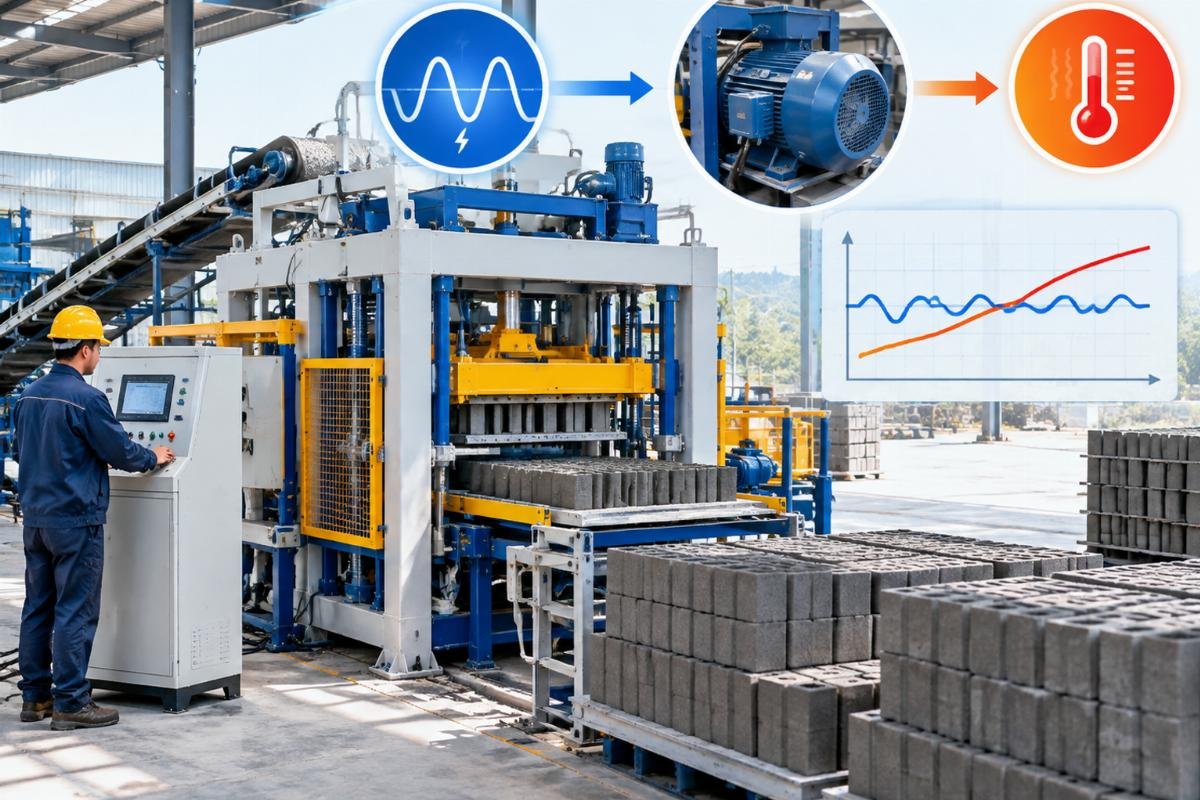
Understanding these dynamics is critical because the motor specifications for paver block machine are not just about raw power. They are about resilience. In regions where power quality varies, the motor must be sized not just for the load, but for the environment.
Why Do Standard Motor Specs Fail in Emerging Markets?
Grid instability and generator limitations are the primary causes of premature motor failure, not manufacturing defects.
Most buyers look at the kilowatt rating and assume that is the only metric that matters. However, in many emerging markets, the issue is not the steady-state power consumption but the transient demands. When a hydraulic pump starts, it draws a surge current that can be several times its rated full-load current. If the power source cannot handle this spike, the voltage collapses.
Consider a scenario in West Africa where a plant relies entirely on diesel generators. A common mistake is sizing the generator to match the sum of the nominal motor ratings. This ignores the startup surge. If the generator is too small, the frequency drops, and the motor struggles to reach synchronous speed, causing rapid heating. [NEED_CITE: generator sizing guidelines for high-inertia loads like hydraulic pumps]
In Southeast Asia, I visited a factory where the grid voltage fluctuated by plus or minus fifteen percent. Standard motors are designed for a much tighter tolerance. When the voltage drops, the motor must draw more current to produce the same torque. This extra current generates heat. Over time, this degrades the insulation class, leading to short circuits. The solution is not just a bigger motor, but one with a higher service factor and appropriate thermal protection.
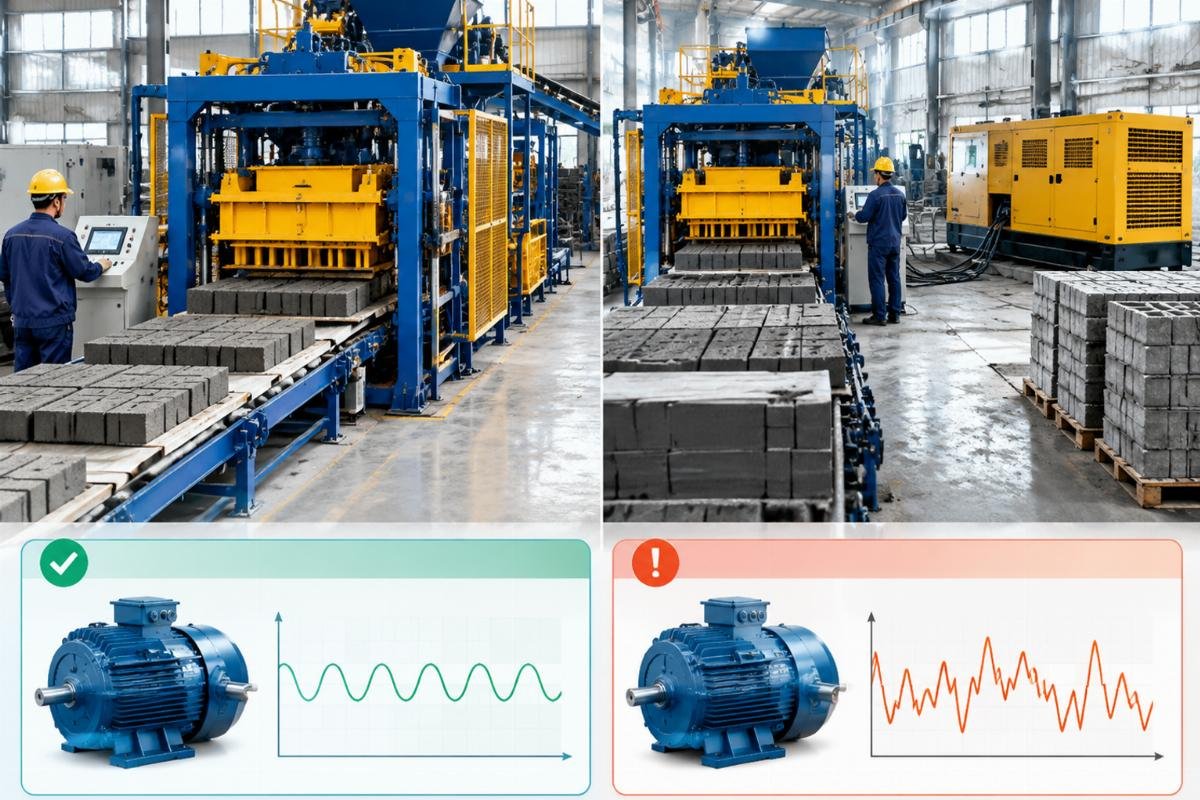
The key takeaway is that motor specifications for paver block machine selection must account for the worst-case power scenario, not the ideal one. This often means opting for motors with higher insulation classes, such as Class F or H, which can withstand higher operating temperatures without failing. It also means verifying that the local transformer or generator has enough headroom to handle the starting current of the largest motor in the system, which is usually the main hydraulic pump.
How to Calculate True Power Requirements for Hydraulic Systems?
Account for peak hydraulic pressure demands and simultaneous actuator movements, not just the nominal motor rating.
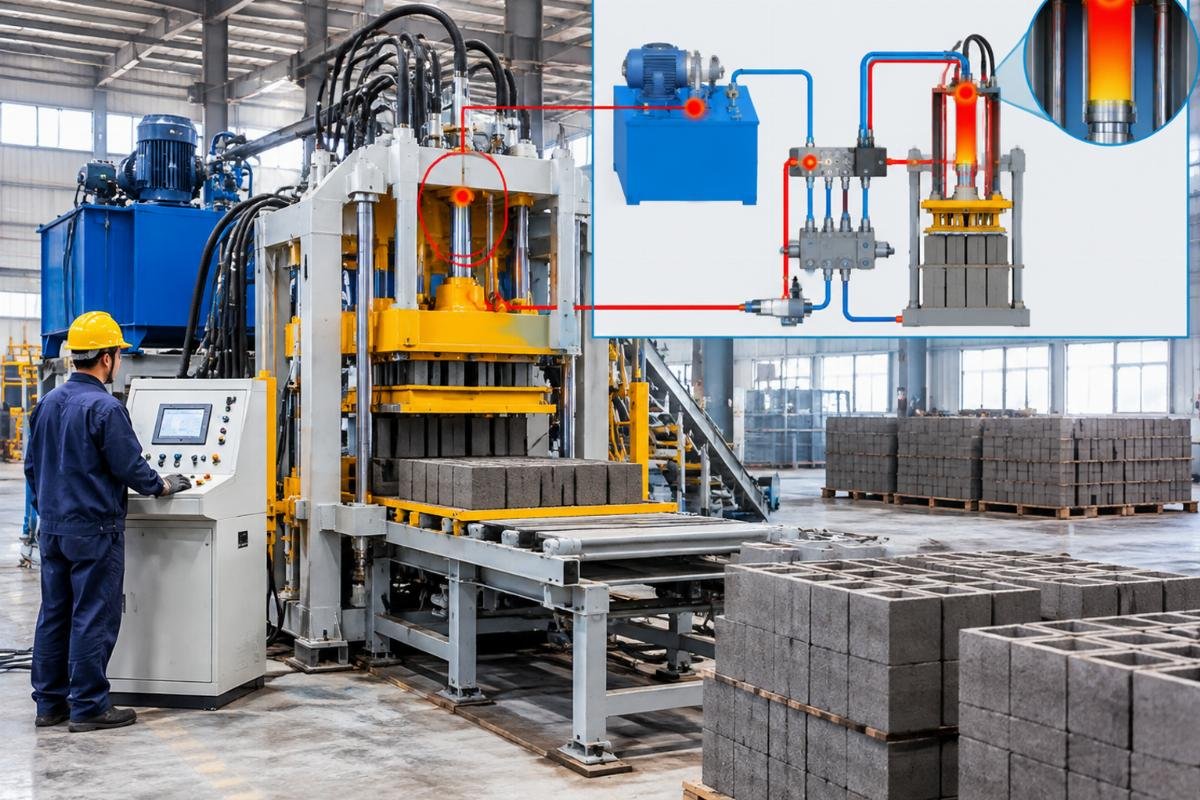
Calculating the required motor power for a block making machine is not a simple multiplication of flow and pressure. You must consider the efficiency of the hydraulic pump and the mechanical losses in the transmission. More importantly, you need to understand the duty cycle. A paver block machine does not run at full pressure continuously. It cycles through filling, compaction, and ejection.
However, during the compaction phase, the pressure peaks. If the motor is undersized, it will stall or trip the overload relay. To calculate the true requirement, start with the maximum system pressure and the pump displacement. Then, apply a safety margin. For systems running on generators, this margin should be larger to accommodate the lower efficiency of the power source during transient loads. [NEED_CITE: hydraulic power calculation formulas for intermittent duty cycles]
A Latin American project I supported involved upgrading from a manual line to a fully automatic QT10-15 system. The client initially planned to use their existing transformer, which was sufficient for the old manual mixers. But the new automatic line had multiple hydraulic actuators that could operate simultaneously during the molding cycle. The total connected load was higher than the transformer’s capacity. We had to recommend a dedicated transformer upgrade. Without this, the voltage drop would have caused the PLC to reset and the motors to overheat.
| Parameter | Standard Grid Supply | Diesel Generator Supply |
|---|---|---|
| Voltage Stability | Generally Stable | Prone to Fluctuation |
| Starting Current Capacity | High | Limited by Generator Size |
| Recommended Power Margin | Standard | Increased by significant margin |
| Thermal Protection Requirement | Standard | Enhanced / High Class |
This table illustrates why the context of power supply changes the motor specifications for paver block machine. For generator-based sites, the margin is not just a suggestion; it is a necessity for survival. At Shiyue, we include a pre-installation power audit in our turnkey solutions to ensure the motor configuration matches the site’s actual capabilities, preventing these costly mismatches.
What Voltage and Frequency Adaptations Are Necessary?
Custom windings and VFD compatibility are essential for non-standard power supplies.
Many buyers assume that a standard 380V/50Hz motor will work anywhere. This is a dangerous assumption. In some regions, the frequency is 60Hz, or the voltage is 440V or 415V. Using a motor designed for 50Hz on a 60Hz supply without adjustment can lead to reduced torque and overheating. Conversely, using a 60Hz motor on a 50Hz supply can cause magnetic saturation and excessive current draw.
Furthermore, voltage deviations are common. If the local grid frequently drops below the nominal voltage, the motor will draw more current to maintain output, leading to overheating. In such cases, motors with dual-voltage windings or those specifically wound for the local voltage range are required. Variable Frequency Drives (VFDs) can help manage this by controlling the start-up current and allowing the motor to run efficiently at different speeds, but they must be sized correctly to handle the harmonic distortion they introduce. [NEED_CITE: effects of frequency variation on induction motor performance per NEMA MG1]
I recall a project in a region with frequent power cuts. The client used a large UPS system that output a modified sine wave. Standard motors heated up quickly on this power quality. We switched to motors with higher insulation resistance and recommended a pure sine wave inverter for the critical control circuits. This small change extended the motor life significantly.
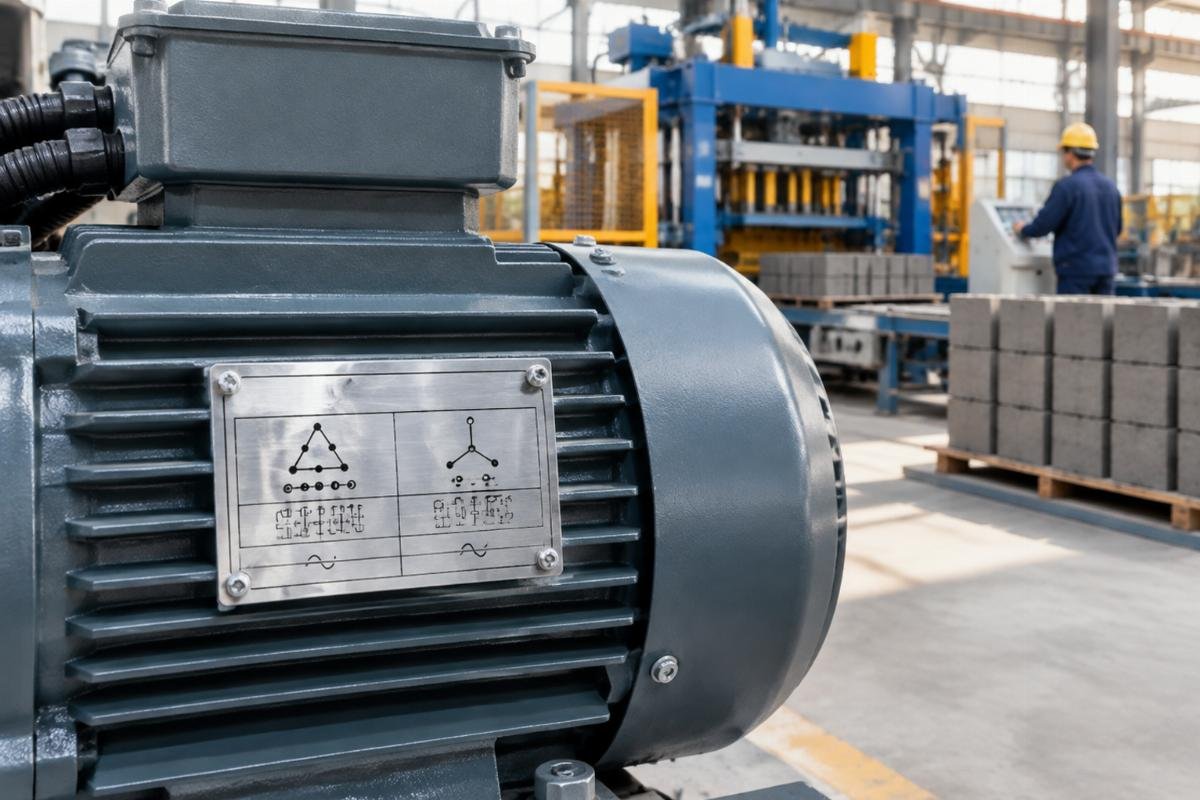
When evaluating motor specifications for paver block machine, always check the nameplate for the specific voltage and frequency ratings. If your local power differs from the standard, request custom windings. Do not rely on adapters or transformers alone, as they do not solve the underlying issue of frequency mismatch or waveform quality.
Which Protection Classes Ensure Longevity in Concrete Plants?
Dust-proof and moisture-resistant housings prevent short circuits in high-humidity mixing areas.
Concrete plants are harsh environments. There is dust from cement and aggregates, moisture from water mixing, and vibration from the machine itself. A standard open-drip proof motor will fail quickly in this setting. Dust can accumulate on the windings, acting as an insulator that traps heat. Moisture can lead to corrosion and short circuits.
Therefore, the Ingress Protection (IP) rating is crucial. An IP54 or IP55 rating is typically recommended for these applications. IP54 protects against dust ingress and water splashes, while IP55 offers protection against low-pressure water jets. For outdoor installations or particularly dusty environments, even higher ratings may be necessary. Additionally, the motor should have a robust cooling fan design that is less prone to clogging. [NEED_CITE: IP code definitions for industrial machinery per IEC 60529]
In a tropical coastal plant, salt spray was an additional concern. Standard cast iron housings corroded rapidly. We specified motors with epoxy-coated housings and stainless steel hardware. This added to the initial cost but prevented the need for frequent replacements. The thermal class of the insulation also matters. Class F insulation allows for higher operating temperatures, providing a buffer against the heat generated in dusty, poorly ventilated conditions.
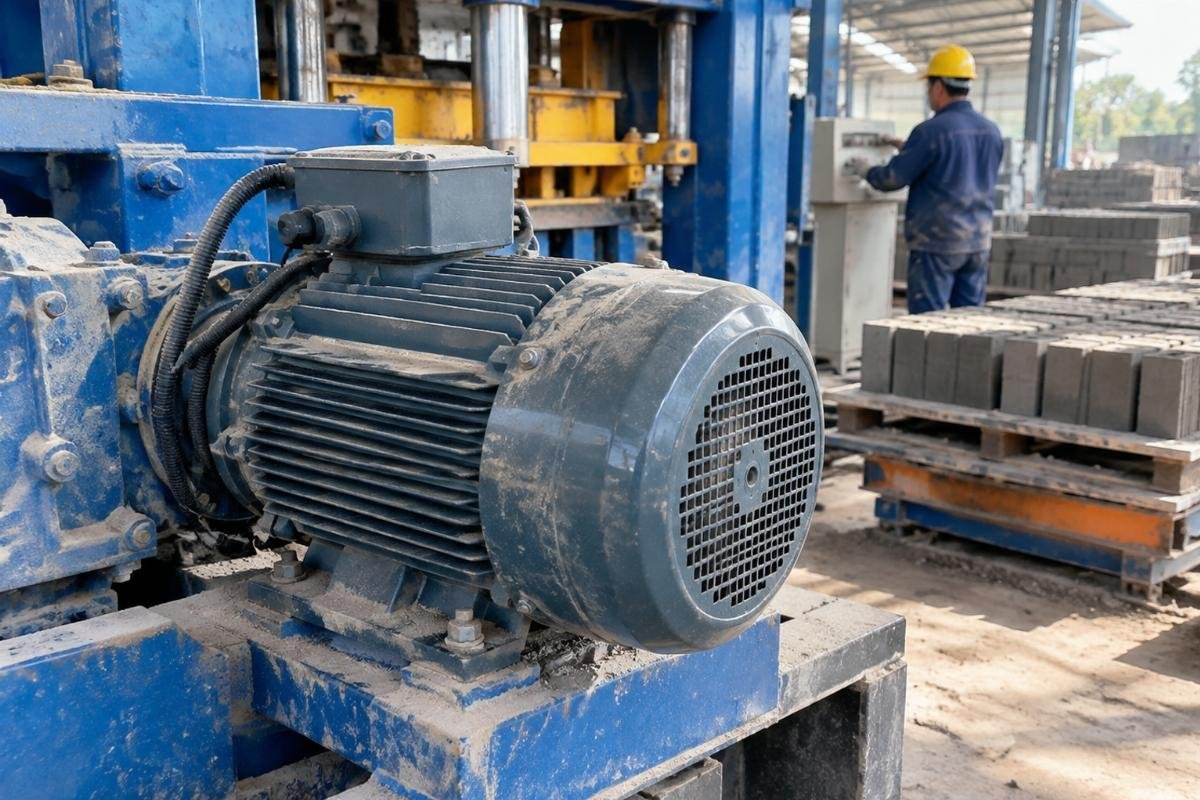
Ignoring these environmental factors leads to frequent downtime. When reviewing motor specifications for paver block machine, do not overlook the IP rating and insulation class. These features are not optional extras; they are essential for reliable operation in the real world of concrete production.
Conclusion
Correct motor specification is about matching power infrastructure, not just maximizing horsepower.
Selecting the right motor involves understanding your local power quality, calculating true hydraulic demands, adapting to voltage and frequency variations, and ensuring adequate environmental protection. By focusing on these factors, you can avoid the costly downtime associated with motor failures. Properly specified motors ensure that your paver block machine operates efficiently and reliably, regardless of the challenges posed by emerging market infrastructure.
Leave a Reply