

QT4-25 Compact Block Machine OEM Customization Options
Most buyers assume OEM customization is just changing the voltage sticker. This assumption causes immediate motor burnout or production halts upon arrival.
Successful QT4-25 block machine OEM customization requires aligning electrical specs, mold geometry, and human-machine interface (HMI) logic with local site conditions, not just changing standard parameters. Distributors and plant investors in Africa and Latin America must verify phase sequence protection, validate local brick dimensions against informal standards, and request operator-friendly PLC languages before shipment to avoid costly delays.
I remember standing in a dusty workshop in Linyi, watching a quality inspector flag a control panel for a West African client. The order specified 415V, which seemed straightforward. But the inspector pointed out the missing phase sequence relay. Without it, if the local grid wires were swapped during installation—a common occurrence in remote areas—the main vibration motor would run in reverse, destroying the eccentric shaft within hours. That specific detail, often overlooked in standard brochures, became a mandatory check in our process. It highlighted that true adaptation goes beyond simple parameter tweaks. [NEED_CITE: IEC standards for three-phase motor protection requirements]
This experience underscores why a generic approach fails. When you source a QT4-25 block machine OEM customization package, you are not just buying a machine; you are buying a system that must survive the specific realities of your local infrastructure and labor force.
Why Standard QT4-25 Fails in Local Markets?
The disconnect between factory standards and site reality is the primary cause of early-stage operational failure. Manufacturers often build to a "global standard," assuming that a 380V/50Hz specification covers most bases. However, emerging markets frequently operate outside these neat boundaries.
In many regions, grid instability is not an exception; it is the norm. Voltage fluctuations can exceed typical tolerance levels, causing sensitive PLC components to reset or fail prematurely. Furthermore, the assumption that "standard" molds fit local construction practices is flawed. In Nigeria, for instance, the term "6-inch block" might refer to a nominal size that differs significantly from the actual dimensional requirements of local masons who rely on specific mortar joint thicknesses.
A client in Latin America once reported that their blocks were too large for the designated wall cavities. Upon investigation, we found they had ordered based on a verbal description rather than precise CAD measurements. The local building code allowed for a variance that the standard international mold did not account for. This mismatch led to weeks of rework and wasted concrete. [NEED_CITE: Local construction building codes variance analysis]
The root issue is expectation management. Buyers expect plug-and-play functionality, but the QT4-25 block machine OEM customization process demands a collaborative verification phase. Without this, the machine arrives as a foreign object rather than an integrated production tool.
Critical Electrical OEM Adjustments
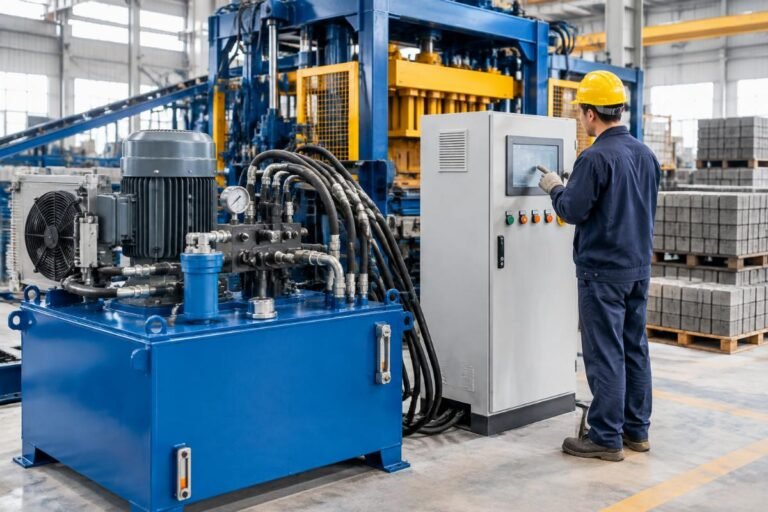
Electrical compatibility is the most visible yet misunderstood aspect of customization. It is not merely about matching the voltage number. It involves understanding the quality of power delivery and the physical connection standards.
First, voltage range adaptability is crucial. While a machine may be rated for 415V, the local grid might swing between 380V and 440V. Standard motors may overheat at the lower end or suffer insulation stress at the higher end. Incorporating industrial-grade voltage stabilizers or specifying motors with wider tolerance ratings mitigates this risk. [NEED_CITE: Motor thermal performance under voltage fluctuation]
Second, phase sequence protection is non-negotiable. As noted in the opening anecdote, incorrect phase wiring reverses motor direction. For hydraulic pumps, this can cause immediate catastrophic failure. For vibration motors, it reduces compaction efficiency and damages bearings. A simple phase sequence relay ensures the machine only starts when the phases are correctly aligned.
Third, plug and socket standards vary wildly. A European-style plug will not fit a British-standard wall outlet, which is common in parts of Africa. Rather than relying on adapters, which can loosen and arc under high load, the OEM process should include installing locally compliant industrial plugs directly at the factory.
| Electrical Component | Standard Configuration | Customized OEM Requirement | Risk if Ignored |
|---|---|---|---|
| Voltage Input | Fixed 380V/415V | Wide-range tolerance ±10% | Motor overheating or PLC reset |
| Phase Protection | Basic circuit breaker | Phase sequence relay | Motor reverse rotation and damage |
| Connection Type | Generic terminal box | Local standard industrial plugs | Arcing, loose connections, safety hazards |
| Control Voltage | 220V AC | Isolated transformer with surge protection | Control board failure during spikes |
These adjustments seem minor on paper but represent the difference between a machine that runs for years and one that becomes a spare parts donor within months. When configuring your QT4-25 block machine OEM customization, insist on detailed electrical schematics that reflect these protections.
Mold Customization: From CAD to Local Brick Size
Mold design is where engineering meets local tradition. The term "standard mold" is a misnomer in global trade. Brick dimensions are dictated by local masonry practices, historical precedents, and even the size of local transport vehicles.
The customization process must begin with verified CAD drawings. Never rely on verbal descriptions like "8-inch hollow." Instead, request the exact outer dimensions, wall thickness, and hole configuration required by your local building codes. Provide these drawings to the manufacturer for review. They can advise on steel hardness and structural integrity based on the aggregate type you plan to use. [NEED_CITE: ISO guidelines for concrete mold durability]
Material selection is another critical factor. If your local sand contains high levels of abrasive silica or sharp river gravel, standard mold steel may wear out quickly. Upgrading to higher-hardness alloy steel or applying specialized wear-resistant coatings can extend mold life significantly. This is particularly important for the QT4-25 block machine OEM customization, as the vibration intensity places high stress on mold walls.
A case in point involved a buyer in Southeast Asia who used crushed granite as aggregate. The standard molds showed visible wear after just three months. By switching to a hardened steel variant during the OEM phase, the subsequent molds lasted over a year with minimal dimensional drift.
Verifying these details before manufacturing prevents the costly error of receiving molds that produce blocks unfit for purpose. It ensures that every block ejected from your QT4-25 block machine OEM customization line meets local market expectations.
Operator-Centric PLC Interface Design
The human-machine interface (HMI) is often treated as an afterthought, yet it dictates daily operational efficiency. A sophisticated PLC system is useless if the operator cannot interpret its messages.
Many manufacturers default to English interfaces, assuming it is the universal language of industry. In reality, this creates a barrier for semi-literate operators or those whose primary language is not English. Error codes like "Hydraulic Pressure Low" may be meaningless without context.
Customizing the PLC interface involves more than translation. It requires simplification. Using icon-based navigation allows operators to understand functions regardless of literacy levels. A red stop icon, a green start icon, and a warning triangle are universally understood. For text, using local dialects or Pidgin English can drastically reduce debugging time.
In one instance, a Nigerian plant experienced a four-day shutdown because operators could not decipher an English error message regarding a sensor fault. Once the interface was updated with simplified Pidgin prompts and visual icons, similar issues were resolved in minutes. [NEED_CITE: Human factors in industrial HMI design]
When discussing QT4-25 block machine OEM customization, specify the language and interface style required. Request a demo of the customized UI before final approval. This ensures that your team can operate the machine confidently, reducing downtime and training costs.
Pre-Shipment Validation Checklist
Before the container is loaded, a rigorous validation process ensures that all customization requests have been implemented correctly. This step is often skipped in the rush to ship, leading to on-site surprises.
- Electrical Simulation: Test the machine with a variable power supply to simulate voltage fluctuations. Verify that the phase sequence relay trips correctly when phases are swapped.
- Mold Trial Run: Produce a sample batch of blocks using the custom molds. Measure these blocks against the provided CAD drawings. Check for dimensional accuracy and surface finish.
- HMI Review: Navigate through the PLC interface. Confirm that all labels, icons, and error messages match the agreed-upon language and simplicity standards.
- Spare Parts Kit: Ensure the included spare parts match the customized components. For example, if you ordered hardened steel molds, verify that the replacement wear plates are of the same specification.
This checklist serves as the final gatekeeper. It transforms the QT4-25 block machine OEM customization from a theoretical agreement into a verified, ready-to-operate asset. By insisting on this validation, you protect your investment and ensure a smooth commissioning process.
Conclusion
Customization is not a luxury; it is a necessity for operational success in diverse markets.
Aligning electrical protections, mold geometry, and interface logic with local conditions prevents costly failures. The QT4-25 block machine OEM customization process demands attention to detail, from phase sequence relays to Pidgin English prompts. By validating these elements before shipment, investors ensure their equipment integrates seamlessly into their local production environment.
Leave a Reply