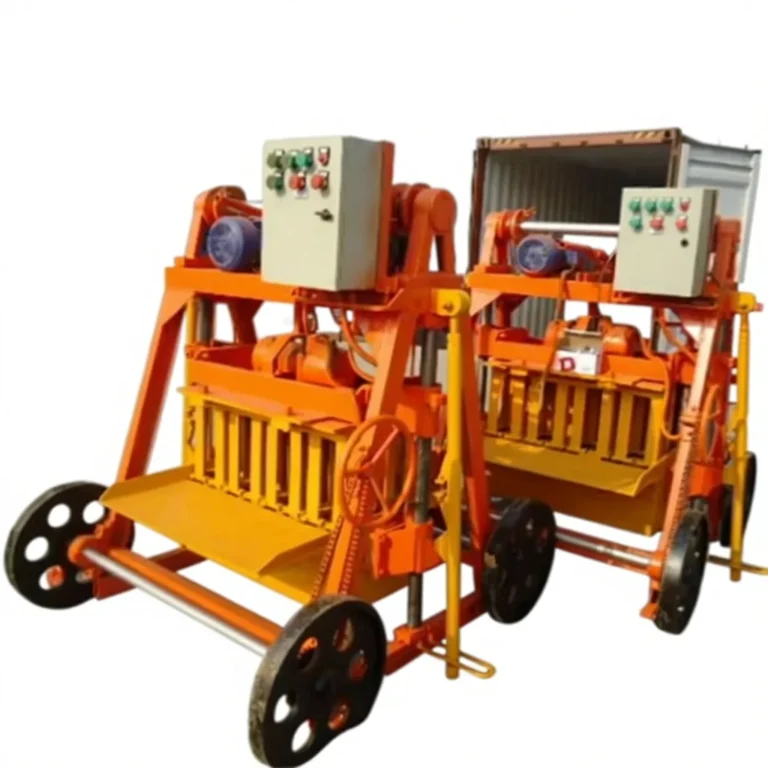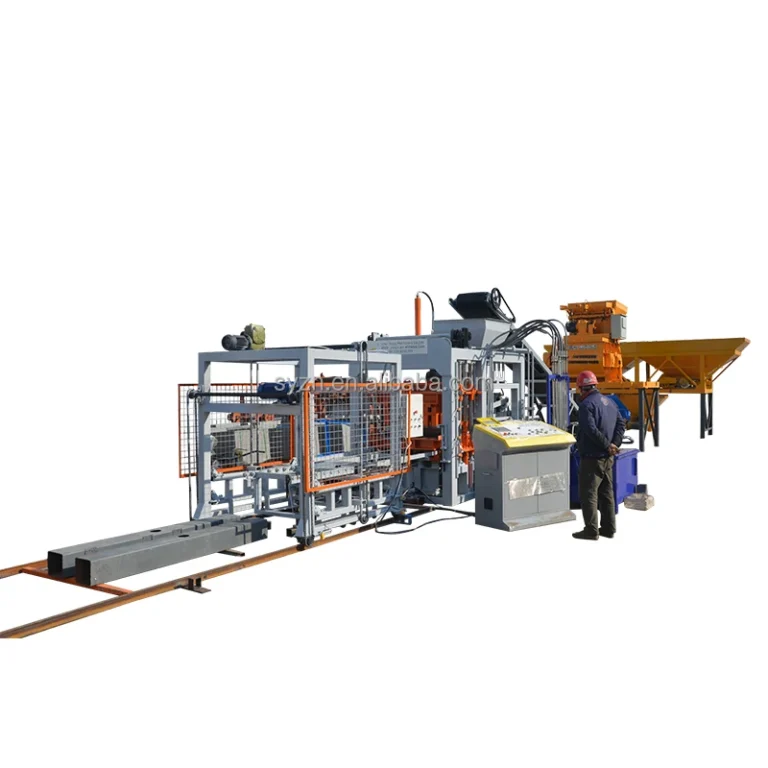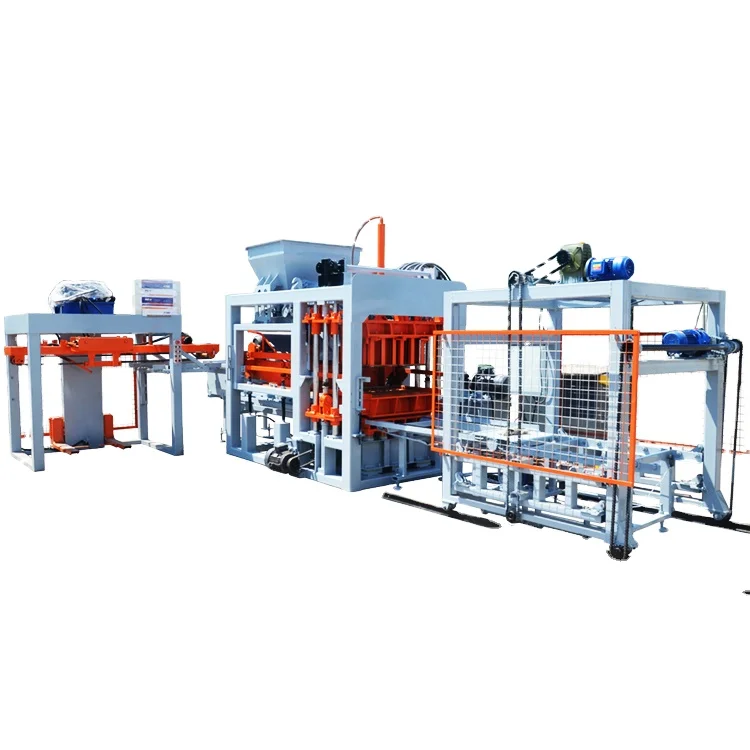


Description
Matched system dispatch — every QT6-15 unit ships with hydraulic station, PLC, pallet feeder and brick conveyor tested together before leaving Linyi, so the line arrives ready to run rather than assembled from mismatched parts.
Technical Specifications
| Parameter | Value |
|---|---|
| Model | QT6-15 |
| Product Type | Fully Automatic Hydraulic Vibration Block Making Machine |
| Overall Dimensions (L×W×H) | 7400×1900×2660 mm |
| Molding Cycle | 15-25s (basis not stated in source — confirm block format / material / thickness) |
| Vibration Frequency | 4600 r/min |
| Exciting Power (Vibration Force) | 40-50 kN |
| Total Power | 31.25 kW |
| Mixer Model | JQ350 |
| Pallet Size | 850×550×25 mm |
| Total Weight | 7 T |
| Control System | PLC control system |
| Hydraulic Station | Included |
| Included Equipment | Block making machine, hydraulic station, PLC control system, pallet feeder, brick conveyor, block sweeper |
| Free Accessories | Manual hydraulic trolley, spare parts and tools |
| Automation Level | Fully automatic |
| Output Capacity | 1200-1680 pcs/h based on 400×200×200 mm hollow block |
| Output Capacity | 1800-2400 pcs/h based on 400×150×200 mm hollow block |
| Output Capacity | 3240 pcs/h based on 240×115×53 mm solid brick |
| Daily Output (8 hr) | 9600-13440 pcs based on 400×200×200 mm hollow block |
| Daily Output (8 hr) | 14400-19200 pcs based on 400×150×200 mm hollow block |
| Daily Output (8 hr) | 16200-19440 pcs based on 240×115×53 mm solid brick |
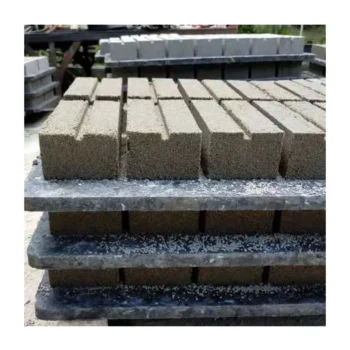
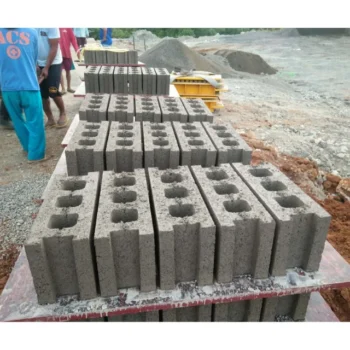
| Applied Products | Paver, solid block, hollow block, curbstone |
| Raw Materials | Crushed stones, sand, cement, dust, fly ash |
Application Suitability
| Application | Material or Output |
|---|---|
| Hollow block production for building walls | Crushed stone, sand, cement, fly ash — 400×200×200 mm and 400×150×200 mm formats |
| Solid brick production for load-bearing structures | Cement, sand, and dust mixes — 240×115×53 mm standard brick |
| Paver production for walkways and yards | Crushed stone and cement blends in interlocking or rectangular formats |
| Curbstone production for road edging | High-aggregate concrete mixes in kerb profiles |
| On-site block production for housing projects | Locally sourced aggregates with cement binder |
Why "Stock Availability" Matters More Than the Brochure Says
When a project deadline is slipping, a QT6-15 block machine in stock fast delivery means the difference between finishing the foundation phase on schedule and paying a contractor crew to stand idle. Stocked machines dispatch within days, not months, and that timeline certainty is what lets you book the container before your site is even ready.
I have watched buyers commit to a machine quoted at a lead time that stretched from four weeks to twelve, while their block yard sat half-built and the cement order already invoiced. The problem is rarely the press itself — it is the mismatch between promised arrival and the construction calendar that was never communicated upfront [NEED_CITE: common causes of project delays in block plant commissioning]. With a stocked unit, the container loading plan and dispatch window are confirmed before the purchase order is signed, removing the most unpredictable variable from the procurement chain.
Dispatch Timeline and Container Loading for the QT6-15
A stocked QT6-15 block machine in stock fast delivery is not just about the press sitting in a yard. The hydraulic station, PLC cabinet, pallet feeder, brick conveyor, and block sweeper are pre-assembled and tested as a set, so the container load is planned around a known bill of materials. This eliminates the scenario where auxiliary equipment is still on a supplier back-order while the main press is already crated.
The machine ships nude-packed in a 20GP container alongside approximately 500 production pallets. The pallets and the manual hydraulic trolley fill the remaining cubic space, keeping the shipment to a single container and avoiding split-shipment coordination at the destination port.
Arrival Estimate and Port-Side Coordination
The arrival estimate depends on the shipping lane from Qingdao or Lianyungang to your discharge port, and this can be quoted before you commit. I always recommend buyers confirm their port’s free-storage window and customs broker availability at the inquiry stage, because a fast dispatch only matters if clearance on arrival is equally smooth [NEED_CITE: typical ocean freight transit times from Shandong ports to West Africa and Southeast Asia]. The container loading photographs and packing list are shared before the vessel closes, so your logistics team has full visibility of what is on board.
What the Vibration Force and Pallet Size Mean for Your Output
The 40-50 kN vibration force at 4600 r/min is matched to compact hollow blocks and solid bricks from standard crushed-stone mixes. Higher vibration frequency shortens the molding cycle, but only if the hydraulic pressure holds the mould steady during vibration — both systems must be balanced, which is why the QT6-15 ships as a matched set with its dedicated hydraulic station.
The 850×550×25 mm pallet size determines how many blocks cure per rack position and which forklift can handle them. If your existing curing yard uses a different pallet dimension, you will need to adjust rack spacing before the machine arrives, not after. Confirming pallet compatibility during the order stage prevents a situation where the first week of production is spent re-racking rather than selling blocks.
The Hidden Cost of Ordering Without a Loading Plan
Buyers who confirm price but skip the container loading plan often discover at the port that the pallets were stacked loose and arrived damaged, or that the hydraulic hoses were coiled in a way that kinked them during transit. These are not machine defects — they are packing oversights that surface only after customs clearance [NEED_CITE: freight damage claims related to industrial machinery packing]. A confirmed loading plan with photographs taken at the factory gate transfers accountability to the shipper and gives the buyer a reference document for any insurance claim.
Why Buyers Source This Stocked Model Through Our Dispatch Process
Block machinery is our single focus, which means the QT6-15 is specified alongside its moulds, pallets, and handling equipment as one system — not assembled from separate supplier quotations. Stock availability is stated per model and per mould format, so you know exactly which block shapes can ship with the machine rather than discovering a six-week mould lead after the press has already sailed.
Dispatch lead time and container loading are confirmed before the order is placed, not revised afterward. Factory test records on your specified block format are documented and shared, giving you a production baseline before the machine reaches your site. Voltage, frequency, and PLC display language are locked in at the order stage so that commissioning is not delayed by a language pack that was never requested [NEED_CITE: electrical standards and voltage configurations for industrial machinery exports].
Documentation & Verification
- Capacity calculation sheet stating output per block format with the assumed dimensions
- Factory test record run on your specified mix and target hollow block size
- Voltage, frequency, and PLC display language confirmation before production begins
- Container loading photographs and packing list shared before vessel departure
- CE declaration provided where applicable to your import market requirements
- Operation and maintenance manual with mould change procedures for each included format
Installation, Commissioning & Support
- Foundation slab must accommodate the 7400×1900 mm footprint with level tolerance for vibration stability
- Electrical supply must match the confirmed voltage and frequency, with a dedicated 31.25 kW circuit
- Machine ships nude-packed and requires on-site reconnection of hydraulic hoses and PLC cabling
- First-run commissioning includes cycle time verification on your local aggregate and mix design
- Operator training covers PLC interface navigation, mould changeover, and daily hydraulic checks
- Wear parts list and mould maintenance schedule provided with the free spare parts kit
What to Include in Your Inquiry
Send us your target block format with dimensions, the daily output you need in an eight-hour shift, and the aggregate materials available locally — including any fly ash or stone dust you plan to use. Confirm your site voltage, frequency, and preferred PLC display language. If you already have curing racks and a forklift in place, share the pallet dimensions and rack spacing so we can verify the 850×550×25 mm pallet fits your existing setup before the QT6-15 block machine in stock fast delivery is booked to your port.
Frequently Asked Questions
Q: What is the dispatch lead time for a stocked QT6-15, and how is container loading arranged?
A: Stocked QT6-15 units are prepared for dispatch within days of order confirmation. The machine ships nude-packed in a single 20GP container with approximately 500 production pallets, the hydraulic station, PLC cabinet, and all auxiliary equipment. Loading photographs and a packing list are shared before the container is sealed, so your freight forwarder has full documentation for booking.
Q: Which block formats are included as standard moulds, and are custom moulds available?
A: Standard moulds cover hollow block, solid brick, paver, and curbstone formats. The output figures quoted for the QT6-15 are format-specific, so each mould change produces a known cycle time and daily output. Custom moulds can be produced to your drawings, though lead time for non-standard formats should be confirmed before the main machine ships.
Q: What voltage and frequency options ship from stock, and can the PLC language be set before dispatch?
A: Voltage and frequency are configured to your site supply at the order stage — this must be confirmed before the machine leaves the factory. The PLC display language is equally set before dispatch, removing any commissioning delay caused by an interface the operators cannot read. These details are documented in the pre-shipment confirmation sheet.
Q: How many pallets ship with the machine, and is the pallet material selectable?
A: Approximately 500 production pallets ship in the same container as the QT6-15. Pallet material — bamboo, steel, or PVC — should be confirmed at the order stage based on your curing environment and local climate. The 850×550×25 mm pallet dimension is fixed for this model, so verify it matches your existing curing racks and forklift capacity.
Q: What is the arrival estimate once the container is booked?
A: The arrival estimate depends on the shipping lane from the dispatch port to your destination, and it can be quoted before you commit to the order. We recommend confirming your port’s free-storage period and customs broker availability at the inquiry stage, so the container can be collected promptly after discharge and the QT6-15 block machine in stock fast delivery reaches your site on schedule.

![QT4-20 Block Machine for Concrete Blocks – In Stock82 → 8+5+1+9+2 = 27, 27 % 6 = 3 结构3: [应用或物料] [品类词] – [站点修饰词] Concrete Block Machine QT4-20 – Ready to Ship](https://sdsyblockmachine.com/wp-content/uploads/2026/04/He8800ffe33484ed284537362a9105812u.webp)