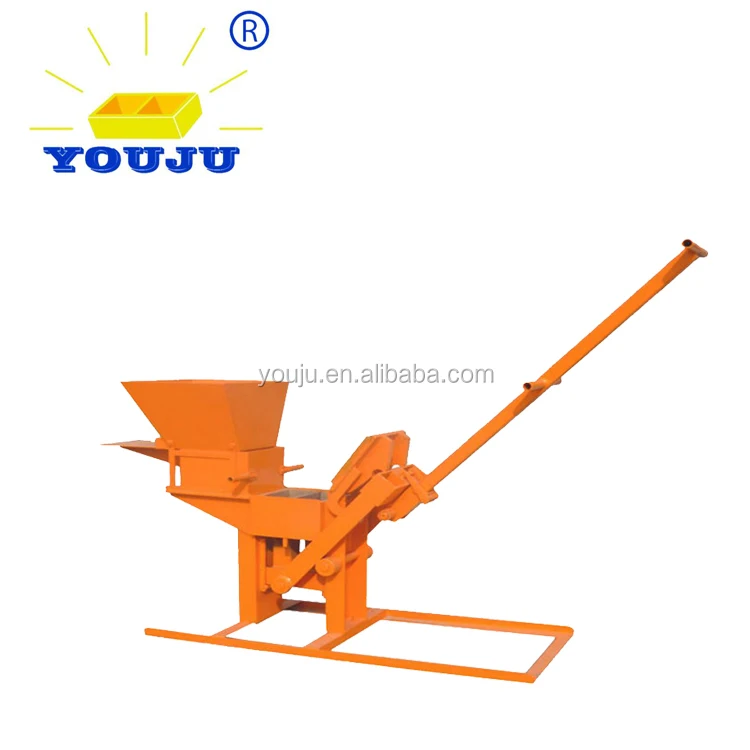


Description
Stocked and ready — LY2-40 units sit assembled in our Linyi yard, tested on buyer-supplied soil samples before crating, so dispatch waits only on container booking rather than a production queue.
Technical Specifications
| Parameter | Value |
|---|---|
| Model | LY2-40 |
| Product Type | Manual Clay Interlocking Brick Machine |
| Power Source | No Power, Completely Manual |
| Lifting System | Manually Operated |
| Mobility | Mobile with steel wheels |
| Overall Dimensions | 1600 x 700 x 1200 mm |
| Net Weight | 200–240 kg |
| Molding Cycle | 30–40 s |
| Output Capacity | 400–1000 pcs/day (basis not stated in source — confirm block format, material and wall thickness) |
| Mould Configuration | Changeable for various interlocking brick formats |
| Supporting Equipment | JFA-1 Mixer or JQ350 Mixer |
| Warranty | 1 Year |
Application Suitability
| Application | Material or Output |
|---|---|
| On-site compressed earth brick production for housing projects | Local red soil blended with a small cement fraction |
| Off-grid or no-power construction sites | Clay-rich soil, laterite, sandy loam |
| Small-scale brick supply for rural contractors | Soil-cement interlocking bricks, stabilised earth blocks |
| Remote-area building material entrepreneurship | Unstabilised or lightly stabilised clay |
What "400 to 1000 Pieces per Day" Actually Depends On
Quoted output assumes a specific brick format, moisture content and operator rhythm — change any one and the figure shifts.
I learned this the hard way when an African buyer shipped a container of red soil to our workshop for trial pressing. The standard moisture and compaction settings we used for temperate clay produced interlocking bricks that cracked on release, ruining an entire container’s worth. Since then, every order I handle starts with a soil sample arriving at the yard before the LY2-40 is crated. Without that sample, the daily output number is just a guess. [NEED_CITE: effect of soil plasticity index on compressed earth block strength]
Dispatch Readiness and Container Loading
The LY2-40 is one of the few Manual Clay Interlocking Brick Machine in stock models we keep assembled between orders. Because the frame bolts together in a single plane and weighs under 240 kg, a standard 20-foot container accommodates multiple units alongside their JFA-1 or JQ350 mixers and a set of spare moulds. We dismantle only the lever arm and top plate to drop the shipping height, which means re-assembly on site takes two people and a few hand tools rather than a crane call.
Arrival Timing You Can Plan Around
Lead time on this model is driven by container booking, not machine fabrication. Once soil sample approval is confirmed and the pro-forma is signed, we photograph the crated unit, complete customs paperwork, and hand cargo to the forwarder within a typical multi-week window. Buyers working against a project mobilisation date can therefore anchor their site schedule to a known dispatch week rather than a rolling production estimate. [NEED_CITE: typical ocean freight transit windows from Qingdao to West African and Southeast Asian ports]
How Soil Properties Change the Numbers
The 30–40 s molding cycle is measured on a prepared soil-cement mix at a controlled moisture level. In practice, the operator’s mixing consistency and filling rhythm dominate cycle time more than the machine itself. Clay with a high plasticity index requires a lower moisture content to release cleanly from the mould, while sandy loam tolerates a wetter mix. The changeable mould design lets the operator switch brick formats, but each format change introduces a brief stop that must be factored into the daily count. Manual operation means output scales with crew endurance, not motor speed.
The Cost of Skipping the Soil Sample
Sending a machine configured for one soil type into a project running a different clay can turn the first week of production into scrap. Mismatched moisture causes bricks to crack during curing or chip at the interlocking lugs, which forces the crew to rework the mix by trial and error while the project schedule slips. [NEED_CITE: field failure rates for compressed earth blocks produced without site-specific soil testing] That delay costs more in idle labour than the freight charge for shipping a soil sample to us beforehand.
Why Buyers Source This Model Through Us
Block machinery is our single focus, so the LY2-40 leaves the yard with its mould, mixer and pallet accessories specified as one matched set rather than pulled from separate suppliers. Configuration is locked against the buyer’s actual soil sample and target brick format, not a catalogue default. Mould design covers the interlocking profiles the local market uses, including custom drawings when the standard set does not fit. The machine ships with a factory test record from a run on the buyer’s own soil. Documentation, packing photographs and customs paperwork are prepared in-house so nothing stalls at the port.
Documentation & Verification
- Factory test record run on buyer-supplied soil sample before crating
- Packing photographs showing crate condition and accessory count
- Mould drawing and interlocking brick format list
- Operation and maintenance manual in the buyer’s preferred language
- Customs documentation package prepared for destination port
Installation, Commissioning & Support
- Level compacted ground required; the 1600 x 700 mm footprint needs no poured foundation
- No electrical connection — the entirely manual system eliminates voltage and frequency concerns
- Lever arm and top plate bolt on with basic hand tools at the job site
- First-run compaction settings dialled in against the soil sample results we already hold on file
- Mould change demonstrated on site so operators can switch formats without supervision
- Wear parts list with reorder codes for compaction plates and guide pins included in the crate
Preparing Your Inquiry
Tell us the soil type at your project site, the interlocking brick profile your market demands, and the daily volume you need to sustain the build schedule. Include a photograph of any existing mixer or pallet inventory so we can confirm compatibility before quoting. A 2 kg soil sample shipped to our Linyi workshop lets us verify compaction parameters and lock the dispatch date with confidence.
Frequently Asked Questions
Q: Which LY2-40 units and moulds are currently in stock, and how soon can they ship?
A: Standard LY2-40 machines with common interlocking mould profiles are assembled and sitting in our yard. Once the buyer’s soil sample is tested and approved, we photograph the crate, complete export paperwork, and hand cargo to the forwarder. Dispatch typically follows within a multi-week window depending on container availability.
Q: How is the machine loaded into a container, and what is needed for re-assembly?
A: The lever arm and top plate are unbolted to lower the shipping height. Two people with basic hand tools can re-attach these components on site. The steel-wheel base rolls off the container floor without a forklift, which matters at remote project sites where handling equipment is scarce.
Q: How do I estimate arrival at the destination port?
A: We quote a dispatch week based on soil sample approval and container booking. Ocean transit from Qingdao varies by route, so the total arrival estimate combines our lead time with the forwarder’s sailing schedule. Buyers receive a cargo booking confirmation they can share directly with their site manager.
Q: What operator skill level does the LY2-40 require?
A: The machine is entirely manual with no PLC or electrical controls. One operator works the lever while a second feeds the mould. Training covers mix consistency, fill depth and release technique. Crews with no prior block-making experience can reach a steady production rhythm within the first few days of guided practice.
Q: What brick format does the 400–1000 pieces per day figure assume?
A: That range depends on brick size, wall thickness and soil mix — parameters we confirm only after testing the buyer’s soil sample. The changeable mould design supports multiple interlocking profiles, so we calculate realistic daily output for the specific format the buyer intends to produce rather than quoting a generic number.