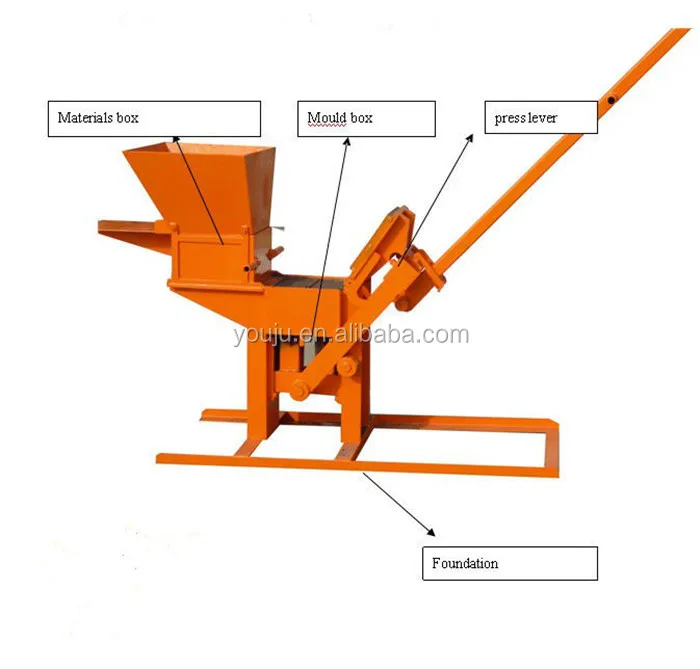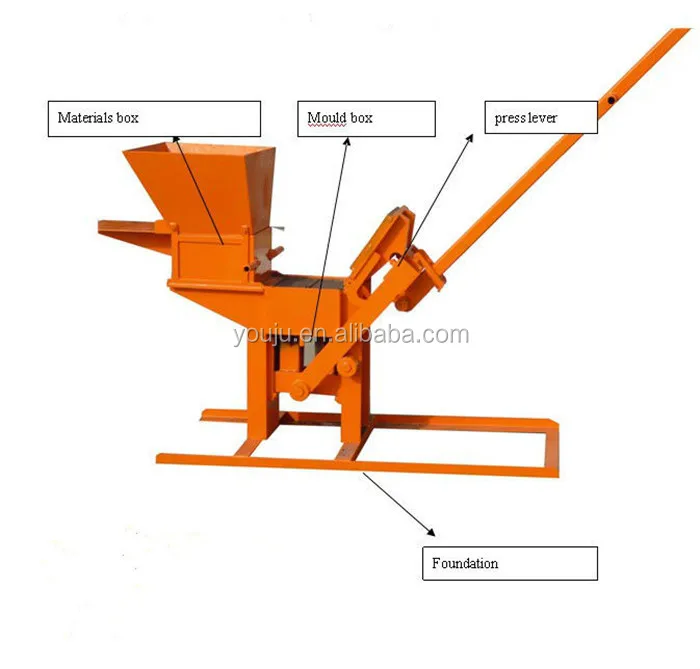


Description
Zero-downtime dispatch — LY2-40 manual clay brick making machines ship from stock so your site starts producing interlocking bricks within days of arrival, not months after order.
Technical Specifications
| Parameter | Value |
|---|---|
| Model | LY2-40 |
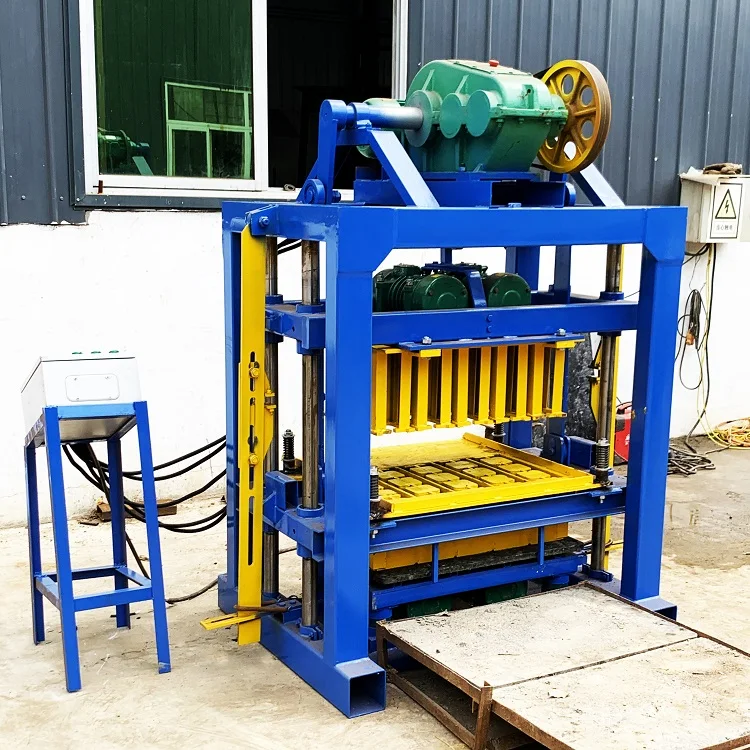
| Product Type | Manual Clay Brick Making Machine |
| Automation Level | Completely manual, no power required |
| Lifting System | Manual lever operation |
| Mobility | Steel wheels for on-site repositioning |
| Mould System | Changeable moulds for various interlocking formats |
| Overall Dimensions (L×W×H) | 1600 × 700 × 1200 mm |
| Total Mass | 200–240 kg |
| Total Power | None — fully hand-operated |
| Molding Cycle | 30–40 seconds per brick |
| Output Capacity | 400–1000 pcs/day (basis not stated in source — confirm block format, material, wall thickness) |
| Basic Equipment Included | JFA-1 Mixer or JQ350 Mixer |
| Material Mixing Options | Automated mix with external line mixer or manual mixing |
| Warranty | 1 year |
Application Suitability
| Application | Material or Output |
|---|---|
| On-site interlocking brick production for housing projects | Cement-stabilized clay and local soil |
| Off-grid brick manufacturing in areas without grid power | Red soil, laterite, and sandy loam blends |
| Small-scale contractor brick yards | Soil-cement mix with manual or JFA-1/JQ350 mixer |
| Remote development sites requiring immediate brick output | Crusher dust blended with clay where available |
What "400 to 1000 Bricks Per Day" Actually Means on Site
The daily output figure depends entirely on which interlocking format you press and how your crew feeds the hopper.
Catalogue sheets quote a range without naming the block. A thin paver cycles faster than a tall interlocking wall block, yet both numbers sit under the same headline. I have watched contractors in West Africa plan a building schedule around the upper number, only to find their actual daily count closer to the lower end once mould changeover and crew fatigue were factored in [NEED_CITE: block format assumptions in manual machine capacity claims]. With the LY2-40 manual clay brick making machine in stock, you can request the capacity calculation for your exact interlocking format before the container is loaded.
Stock Availability That Matches Your Project Deadline
When a contractor has a foundation crew waiting, a six-week production lead is not an inconvenience — it is a stalled payroll. The LY2-40 manual clay brick making machine in stock is warehoused as a complete unit with standard interlocking mould, steel wheels fitted, and lifting mechanism tested. Dispatch paperwork, including packing photographs and container loading plan, is prepared once the mould format is confirmed, so the machine can move from warehouse to port within the quoted lead window.
Mould Format Confirmed Before the Machine Leaves the Floor
A manual press only delivers value if the mould produces the brick your local market actually buys. Standard stock moulds cover common interlocking profiles, but wall thickness, interlock depth, and face dimensions vary by region. Confirming the mould drawing against your sample brick before shipment prevents the situation where the machine arrives and the first production run yields a format your masons have never laid.
Reading the Specs That Determine Real Output
The 30–40 second molding cycle is measured from hopper fill to lever release on a standard interlocking block. Heavier soil-cement mixes with higher clay content require more force on the lever and slightly longer settling time. The 1600 × 700 × 1200 mm frame is compact enough to wheel across a cleared site, yet the 200–240 kg mass provides the downward resistance needed during compaction — a lighter frame would shift on uneven ground. The JFA-1 or JQ350 mixer included in the basic equipment ensures the soil-cement blend reaches the hopper at a consistent moisture level, which is the single largest variable in manual brick density [NEED_CITE: soil moisture content effect on manual brick compressive strength].
The Hidden Cost of Skipping the Container Loading Plan
I have seen a manual brick press arrive with the mould bolted to the frame inside a shared container, and forklift tines at the destination port scrape the interlocking profile because the loading height was not checked against the forklift’s fork spread. A machine this size ships efficiently in a partial container load, but only if the dismantling and packing layout is agreed before dispatch. Without that step, you spend the first day on site unbolting transit brackets and straightening a bent mould edge instead of pressing bricks [NEED_CITE: container loading best practices for manual block machines].
Why Buyers Source This Machine Here
Block machinery is the single product focus, so the LY2-40 press, its mould, and the JFA-1 or JQ350 mixer are specified as a matched set rather than sourced from separate suppliers. Configuration is confirmed against your local soil sample and target interlocking format, not a catalogue default. Mould design covers the profiles your market sells, with stock items available for immediate inclusion in the shipment. Arrival timing is quoted at the order stage so your project schedule stays intact. Factory test records on your chosen interlocking profile are included with every dispatch.
Documentation & Verification
- Capacity calculation stating the interlocking brick format assumed
- Mould drawing with interlock depth and face dimensions for your profile
- Voltage confirmation sheet noting zero-power requirement for site records
- Factory test record on your soil-cement blend before dispatch
- Packing photographs and container loading plan prior to shipment
Installation, Commissioning & Support
- No foundation required — steel wheels allow positioning on compacted ground at your site
- Zero electrical connection needed, eliminating the need for a dedicated power circuit
- Machine arrives assembled with mould fitted; only mixer requires on-site setup
- First-run parameter guidance covering lever stroke rate and hopper fill timing for your mix
- Spare mould list provided so replacements can be ordered before the first set wears
- One-year warranty covers lifting mechanism and frame structural integrity
What We Need to Prepare Your Shipment
Send us the interlocking brick sample or drawing your local masons use, the soil type available at your site, and the daily brick count your project schedule requires. We will return a container loading plan and arrival estimate matched to your construction timeline.
Frequently Asked Questions
Q: Which LY2-40 units and moulds are in stock right now?
A: The LY2-40 manual clay brick making machine is held as a complete unit with standard interlocking mould fitted. Additional mould profiles from the stock range can be added to the same shipment. Confirm your required brick format so we can verify stock status before you commit to an order.
Q: How long is the dispatch lead time and how does loading work?
A: Because the machine ships from stock, dispatch lead time is measured in days once the mould format is confirmed. The unit is dismantled to fit the container loading plan, and packing photographs are shared before the container is sealed. Arrival estimate is quoted at the order stage.
Q: What block format does the 400–1000 pcs/day capacity assume?
A: That range depends on the specific interlocking brick profile, the soil-cement mix, and crew rotation. We provide a capacity calculation for your exact format and mix during the quotation stage so you can plan your project schedule on a confirmed number rather than a catalogue range.
Q: Can the JFA-1 or JQ350 mixer ship in the same container?
A: Yes. Both the JFA-1 and JQ350 mixer are sized to load alongside the LY2-40 in a single container. The loading plan accounts for the mixer footprint so both items arrive together and your site can begin mixing and pressing on the same day.