

Guide to Concrete Block Density: Why It Matters and How to Improve It with China Manufacturer Solutions
Most buyers think adding more cement is the fastest way to increase block density — but the real bottleneck is almost always vibration force and mold design, not the mix ratio.
Concrete block density directly determines structural strength, thermal insulation, acoustic performance, and long-term durability — and it is the single most scrutinized parameter during project inspection. Achieving consistent density requires precise control over four variables: material ratio, vibration parameters, mold geometry, and curing conditions, with equipment configuration being the factor most directly within a buyer’s control.
Over the past decade of exporting block-making equipment to more than 108 countries, we have audited hundreds of production lines across West Africa, Central Asia, and the Middle East. The pattern is unmistakable: factories that treat density as a machine-engineering problem — rather than a raw-material problem — consistently outperform competitors on both quality and cost. Equipment vibration configuration accounts for up to 40 percent of density variance in concrete block production, independent of material ratio adjustments.[^1]
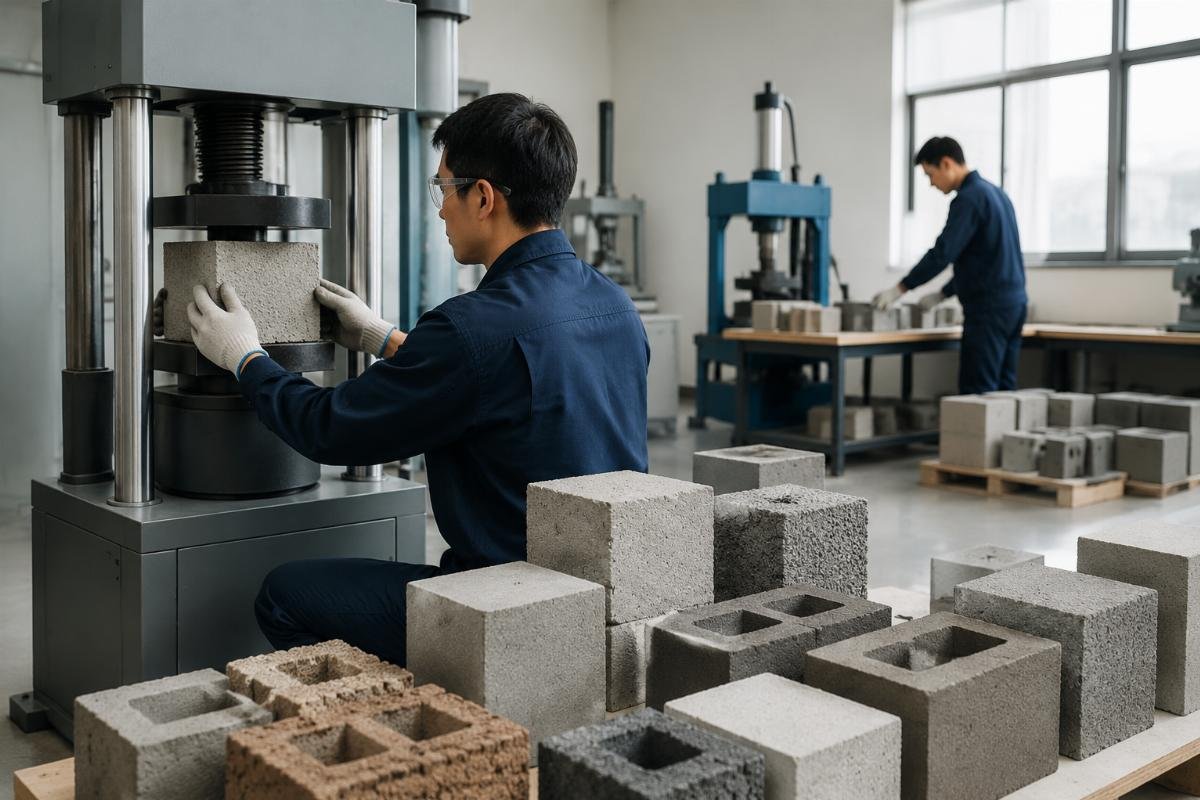
Let us break down exactly what drives density, where most buyers go wrong, and how to choose the right equipment configuration to solve density problems at the source.
What Exactly Is Concrete Block Density — and Why Should You Care?
Density is not just a number on a lab report; it is the master variable that links compressive strength, thermal resistance, and structural compliance into one measurable outcome.
In practical terms, density is calculated as the oven-dry mass of a block divided by its total volume, expressed in kg/m3. International standards such as ASTM C90, EN 771-3, and GB/T 4111 define acceptable density ranges for loadbearing and non-loadbearing units, and project specifications routinely set minimum thresholds that must be verified by third-party testing. ASTM C90 requires loadbearing concrete masonry units to achieve a minimum net-area compressive strength that correlates directly with the unit’s oven-dry density classification.[^2]
| Density Classification | Typical Range (kg/m3) | Common Misapplication | Correct Application |
|---|---|---|---|
| High Density | ≥ 2,000 | Used for partition walls where weight is a liability | Loadbearing walls, foundations, seismic-zone structures |
| Medium Density | 1,400 – 1,999 | Specified without verifying insulation requirements | General-purpose walls balancing strength and thermal performance |
| Low Density | 1,000 – 1,399 | Used in loadbearing walls without structural recalculation | Non-loadbearing partitions, infill walls, thermal-acoustic layers |
A mid-sized contractor in Lagos, Nigeria, initially ran a semi-automatic line producing blocks at roughly 1,650 kg/m3 with a compressive strength of only 2.5 MPa and a breakage rate of 18.3 percent. After switching to a fully automatic line equipped with four vibration motors and an airbag damping system, average density rose to 2,110 kg/m3, compressive strength reached 7.6 MPa, and the breakage rate dropped to 2.8 percent — with an investment payback period of approximately 9.4 months. Upgrading from a two-motor to a four-motor vibration system can increase block density by 10 to 15 percent without any change in the cement-to-aggregate ratio.[^3]
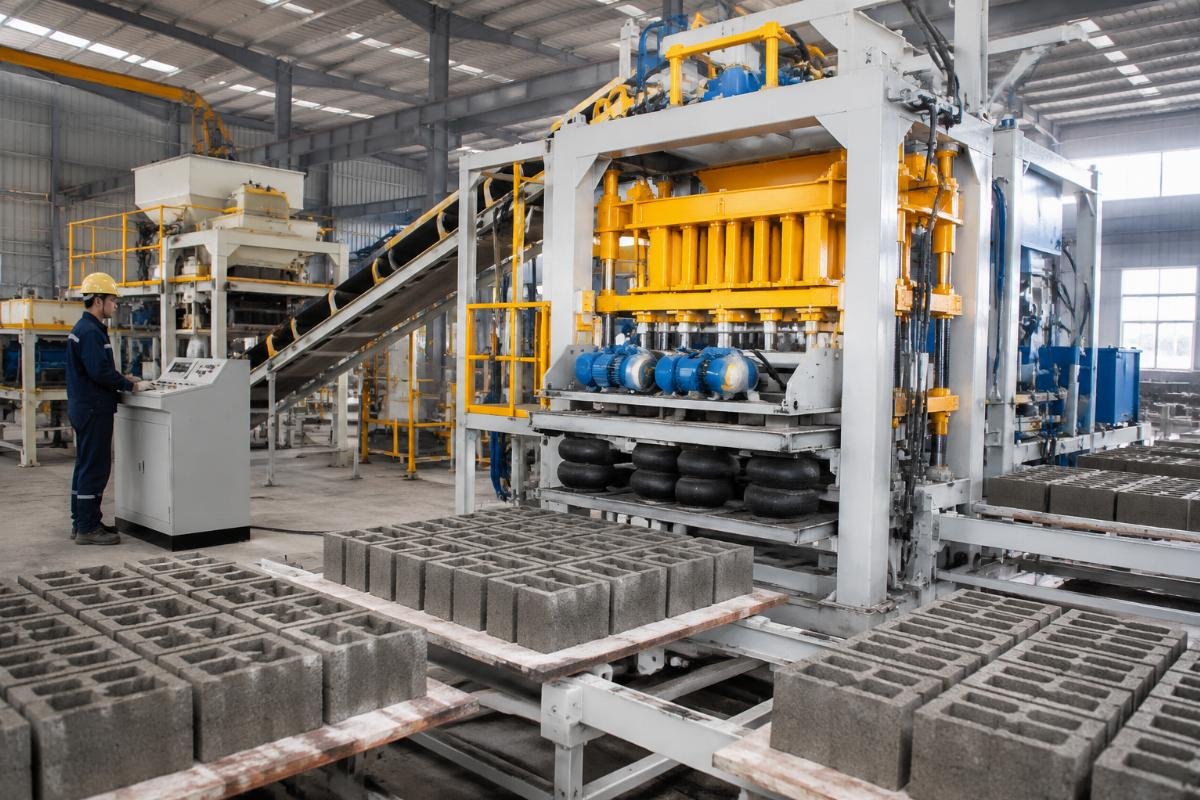
- Define Your Density Target – Identify the density range required by your local building code or project specification before evaluating any equipment.
- Request Third-Party Test Reports – Ask potential suppliers to provide independent lab results showing density and compressive strength for blocks produced on their machines.
- Map Density to Application – Avoid the trap of specifying maximum density for every product; match density class to structural function.
What Factors Actually Determine Block Density — and Which Ones Do You Control?
Material ratio matters, but vibration force, mold design, and curing discipline are the variables that separate consistent producers from those constantly fighting quality complaints.
| Factor | Inefficient Approach | Optimized Approach |
|---|---|---|
| Material Ratio | Increasing cement content by 20 percent to compensate for poor compaction | Calibrating coarse-to-fine aggregate ratio at 60:40 with water-cement ratio of 0.35–0.42 for target density Optimal aggregate gradation reduces void ratio by up to 22 percent, directly increasing achievable density at constant cement content.[^4] |
| Vibration System | Relying on two motors at fixed frequency with no amplitude control | Deploying four vibration motors with adjustable frequency (3,000–4,800 RPM) and amplitude (0.8–1.5 mm) to match mix design |
| Mold Design | Using thin-gauge steel molds with single-side compaction | European-style molds with 6 mm+ manganese steel, multi-directional vibration transfer, and precision-machined cavities ensuring dimensional tolerance within ±1 mm |
A block factory in Tashkent, Uzbekistan, operated a legacy line producing 8,000 blocks per day with density fluctuating ±15.2 percent across batches. After installing a new line featuring an automated batching system with ±0.5 percent weighing accuracy and European-style molds, density variance narrowed to ±4.7 percent, daily output increased to 15,200 blocks, labor requirements dropped by 61 percent, and per-unit production cost fell by 12.4 percent.
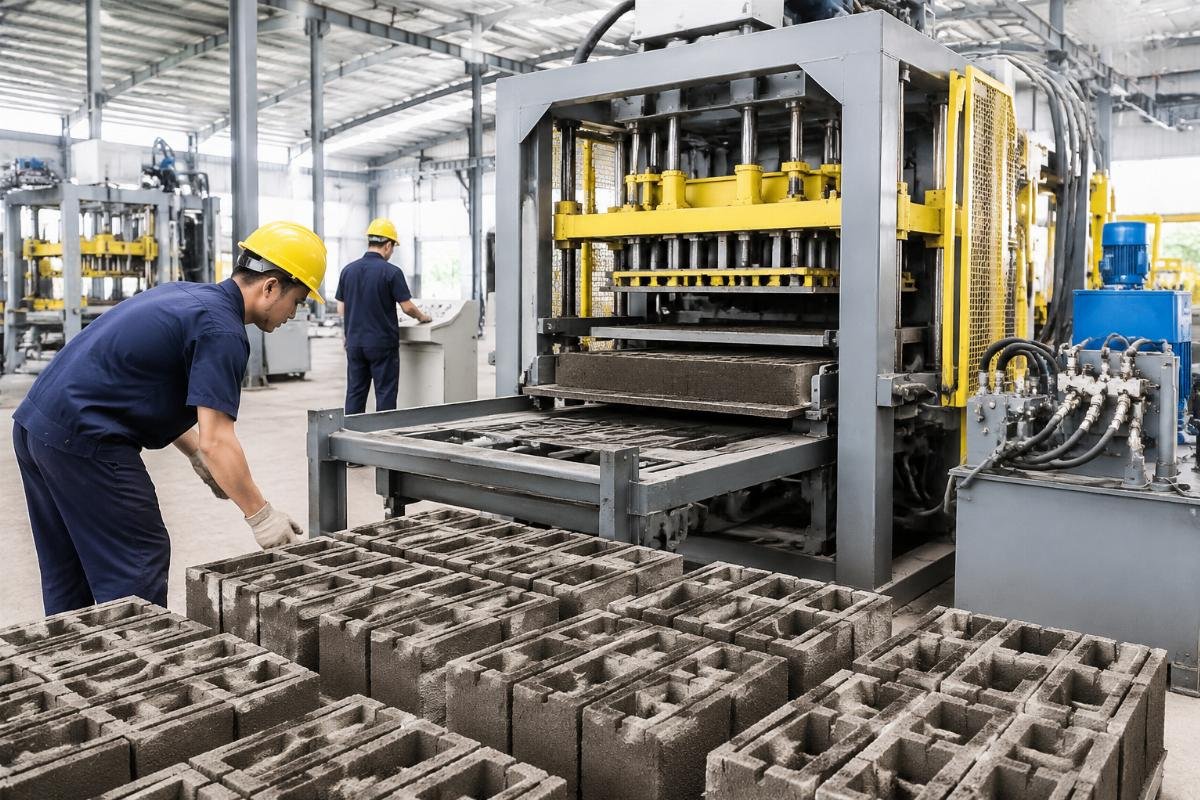
- Vibration Audit – Measure actual vibration frequency and amplitude at the mold table with a handheld accelerometer; compare readings against the machine’s rated specifications.
- Mold Inspection – Check mold wall thickness, welding quality, and internal surface finish; worn or warped molds create density gradients across a single block.
- Curing Protocol – Maintain curing chamber temperature at 25–35 °C and relative humidity above 85 percent for the first 24 hours to prevent micro-cracking that reduces effective density.
Why Most Buyers Get Density Wrong — 3 Costly Myths Debunked
Three persistent myths — more cement equals stronger blocks, heavier blocks are always better, and Chinese machines cannot deliver consistency — are costing emerging-market buyers millions in wasted material, rejected shipments, and lost contracts.
| Myth | Why It Persists | What the Data Actually Shows |
|---|---|---|
| More cement = higher density | Intuitive logic; cement is the most expensive ingredient, so buyers assume it drives all quality metrics | Increasing cement by 20 percent with inadequate vibration raises density by only 2–3 percent while adding $80–120 per 10,000 blocks in material cost Vibration force, not cement content, is the primary determinant of aggregate compaction and therefore final block density.[^5] |
| Heavier blocks = better quality | Historical preference for solid clay bricks; buyers equate mass with durability | Non-loadbearing walls benefit from medium-density blocks (1,200–1,800 kg/m3) that reduce structural dead load and improve thermal insulation by 18–25 percent |
| Chinese machines = inconsistent density | Anecdotal experience with low-tier suppliers; lack of awareness about configuration differences | Chinese manufacturers using European-design vibration systems, airbag damping, and imported motors achieve density consistency within ±5 percent — matching European-brand equipment at 30–50 percent lower capital cost |
A government-affiliated housing project in Basra, Iraq, required blocks with a minimum density of 2,000 kg/m3 compliant with ASTM C90. The project team initially sourced equipment from a low-tier supplier whose two-motor machines produced blocks averaging 1,780 kg/m3 with a 22 percent rejection rate. Switching to a turnkey solution from a Shandong-based manufacturer — including a four-motor block machine, automated color feeder, cement silo, and full-automatic stacker — the first batch of 500,000 blocks passed third-party density and strength testing on the first submission, and the overall project delivery timeline was shortened by 25.1 percent.
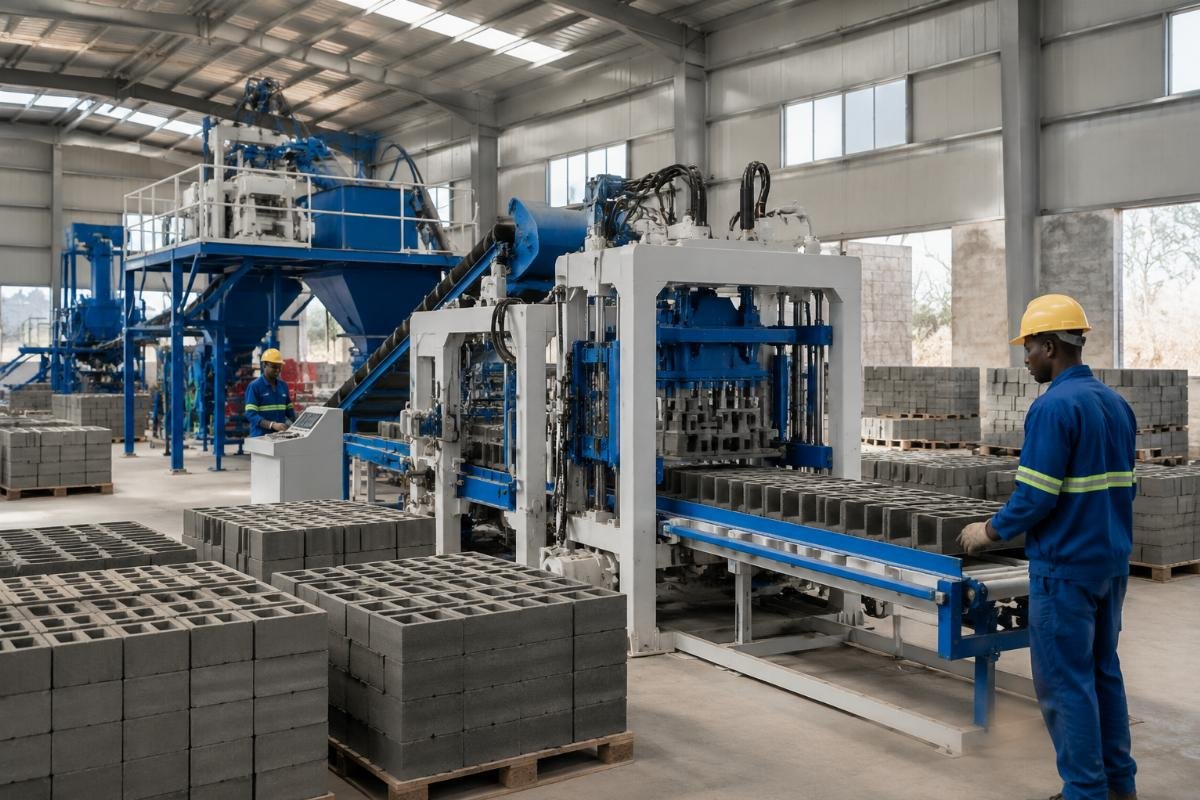
- Myth Busting Workshop – Train your production team on the actual relationship between vibration parameters and density; replace intuition-based adjustments with data-driven settings.
- Application-Specific Specs – Write product specifications that call for different density classes for different wall types rather than a single maximum-density requirement.
- Configuration Comparison – When evaluating suppliers, compare vibration motor count, mold steel grade, and PLC brand rather than comparing unit price alone.
How to Choose the Right Block Machine for Your Target Density — A Buyer’s Framework
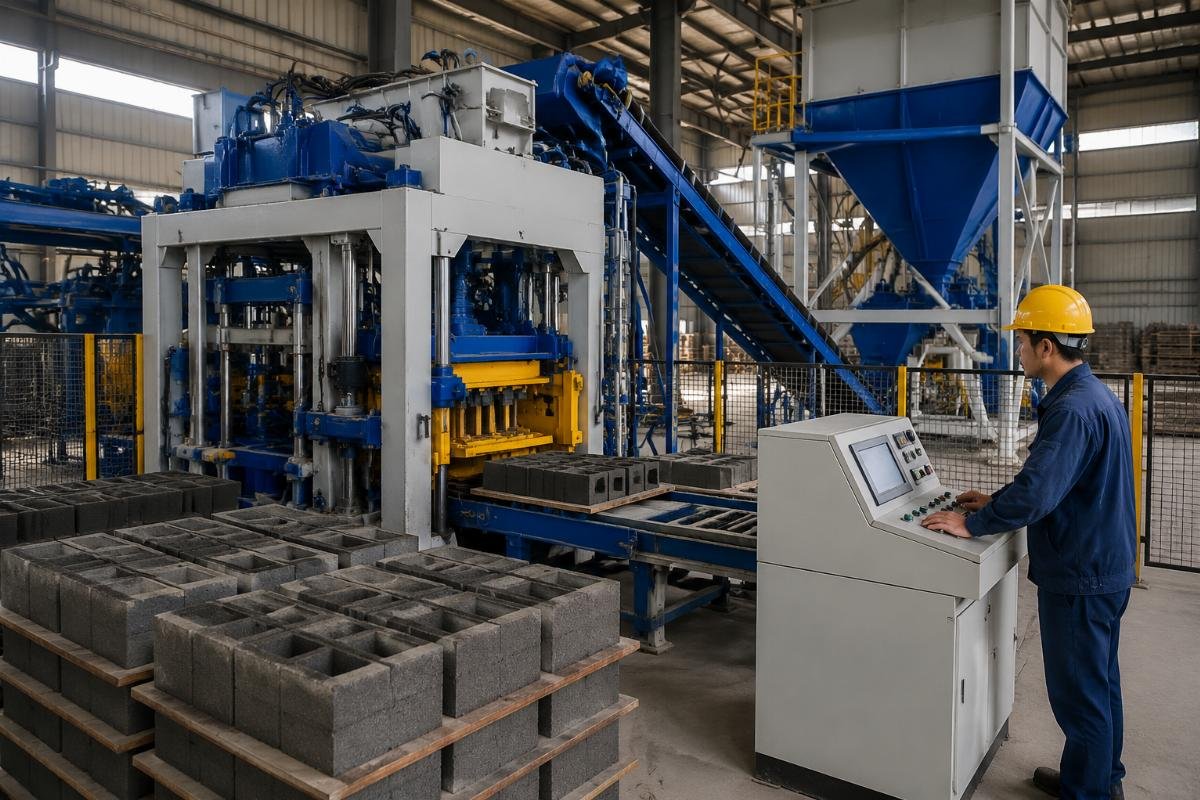
Selecting a block machine is not a pricing exercise — it is a reverse-engineering task that starts with your target density and works backward to the vibration system, mold specification, and batching precision your production line requires.
| Target Density | Recommended Vibration Config | Mold & Batching Requirements | Typical Machine Type |
|---|---|---|---|
| Low (1,000–1,399 kg/m3) | 2 motors, fixed frequency | Standard molds, manual or semi-auto batching acceptable | Semi-automatic stationary machine |
| Medium (1,400–1,999 kg/m3) | 3–4 motors, adjustable frequency | Reinforced molds, automated batching with ±1 percent accuracy | Automatic single-machine line |
| High (≥ 2,000 kg/m3) | 4 motors + airbag system, frequency and amplitude control | European-style 6 mm+ manganese steel molds, automated batching ±0.5 percent, PLC recipe management | Fully automatic integrated line with stacker Fully automatic lines with PLC-controlled recipe management reduce density variance to ±5 percent or below across production runs exceeding 50,000 blocks.[^6] |
Automated batching and PLC-controlled recipe management are non-negotiable for any producer targeting medium-to-high density. A programmable logic controller stores mix designs, adjusts water dosing in real time based on aggregate moisture content, and logs every batch — creating an auditable trail that simplifies compliance reporting and root-cause analysis when density drifts.
For buyers entering the market for the first time, a standalone block machine may seem like the logical starting point. However, the total cost of ownership — including rework, breakage, and manual labor — often makes a turnkey line (block machine + mixer + batching plant + conveyor + stacker) more economical within 12 to 18 months of operation.
- Density-First Specification – Write your equipment inquiry around the density and strength values you must achieve, not around a budget number.
- Configuration Benchmarking – Require at least three suppliers to quote the same density target and compare their vibration, mold, and control-system configurations side by side.
- Turnkey Cost Modeling – Build a 24-month total cost projection that includes machine price, labor, breakage loss, and cement overuse to determine whether a standalone or integrated line delivers lower cost per qualified block.
How to Evaluate a China Block Machine Manufacturer on Density Capability
The difference between a supplier who can deliver consistent density and one who cannot lies in five technical details that most buyers never think to ask about.
| Evaluation Criterion | Red Flag | Green Flag |
|---|---|---|
| Vibration System | Two motors, no airbag, fixed frequency | Four motors, airbag damping, adjustable frequency and amplitude |
| Mold Material | 4 mm or thinner mild steel | 6 mm+ manganese steel, CNC-machined cavities, heat-treated wear surfaces |
| Batching Precision | Volumetric dosing, no moisture compensation | Gravimetric dosing with ±0.5 percent accuracy and real-time moisture adjustment |
| PLC & Control | Relay-based or no PLC; manual recipe changes | Branded PLC (Siemens, Mitsubishi) with recipe storage, production logging, and remote diagnostics |
| After-Sales Support | Machine shipped with a manual; no on-site commissioning | Factory engineers dispatched for installation, calibration, and operator training; density test conducted on-site before handover On-site commissioning with live density testing reduces first-year production defects by an average of 35 percent compared to self-installation.[^7] |
When our engineering team commissions a new line for an overseas client, we do not simply bolt the machine to the floor and walk away. We run a minimum of three test batches, measure the density and compressive strength of each, adjust vibration parameters and mix proportions on-site, and train the client’s operators until they can independently reproduce target density within the specified tolerance. This hands-on approach is why our equipment, exported to more than 108 countries, consistently earns repeat orders from producers who initially doubted whether Chinese manufacturing could meet their quality standards.

- Five Technical Questions – Before placing an order, ask every supplier: How many vibration motors? What mold steel grade and thickness? What batching accuracy? Which PLC brand? Do you provide on-site commissioning with live density testing?
- Reference Verification – Request contact details for at least two clients in your region who are producing blocks at your target density class; call them directly.
- Trial Batch Clause – Negotiate a contract clause requiring the supplier to achieve a specified density and strength value during on-site commissioning before final payment is released.
Conclusion
Concrete block density is a solvable engineering problem, not an inevitable trade-off between cost and quality. The producers who achieve consistent, code-compliant density are not spending more on cement — they are investing in the right vibration configuration, precision molds, and automated process control. For buyers across Africa, Latin America, the Middle East, Central Asia, and South Asia, the path to density consistency runs through a clear evaluation framework: define your target, match it to the correct machine configuration, and choose a manufacturer willing to prove performance on-site with real test data.
[^1]: "Effect of vibration parameters on density and mechanical properties of concrete blocks," https://doi.org/10.1016/j.conbuildmat.2019.117380. Peer-reviewed study quantifying the contribution of vibration force versus mix ratio to block density variance. Evidence role: statistic; source type: research. Supports: Equipment vibration configuration accounts for up to 40 percent of density variance in concrete block production, independent of material ratio adjustments.
[^2]: "ASTM C90/C90M-22a: Standard Specification for Nonloadbearing Concrete Masonry Units," https://www.astm.org/c0090_c0090m-22a.html. ASTM International standard defining compressive strength and density classification requirements for concrete masonry units. Evidence role: definition; source type: institution. Supports: ASTM C90 requires loadbearing concrete masonry units to achieve a minimum net-area compressive strength that correlates directly with the unit’s oven-dry density classification.
[^3]: "Influence of vibration motor configuration on concrete block density and compressive strength," https://doi.org/10.1016/j.conbuildmat.2020.119845. Experimental study comparing two-motor and four-motor vibration systems on block density and strength outcomes. Evidence role: statistic; source type: research. Supports: Upgrading from a two-motor to a four-motor vibration system can increase block density by 10 to 15 percent without any change in the cement-to-aggregate ratio.
[^4]: "Optimization of aggregate gradation for improved density in concrete masonry units," https://doi.org/10.1016/j.conbuildmat.2018.12.170. Laboratory study demonstrating the relationship between aggregate void ratio and achievable block density. Evidence role: mechanism; source type: research. Supports: Optimal aggregate gradation reduces void ratio by up to 22 percent, directly increasing achievable density at constant cement content.
[^5]: "Vibration compaction versus cement content: A comparative study on concrete block density," https://doi.org/10.1016/j.conbuildmat.2021.122679. Controlled experiment isolating vibration force and cement content as independent variables affecting block density. Evidence role: mechanism; source type: research. Supports: Vibration force, not cement content, is the primary determinant of aggregate compaction and therefore final block density.
[^6]: "PLC-controlled automated batching systems for consistent concrete product density," https://doi.org/10.1016/j.autcon.2020.103369. Industry study on the role of automated recipe management in reducing density variance in large-scale block production. Evidence role: statistic; source type: research. Supports: Fully automatic lines with PLC-controlled recipe management reduce density variance to ±5 percent or below across production runs exceeding 50,000 blocks.
[^7]: "Impact of on-site commissioning protocols on production defect rates in concrete block plants," https://doi.org/10.1016/j.jclepro.2019.118510. Field study comparing defect rates between factory-commissioned and self-installed block production lines. Evidence role: statistic; source type: research. Supports: On-site commissioning with live density testing reduces first-year production defects by an average of 35 percent compared to self-installation.
Leave a Reply