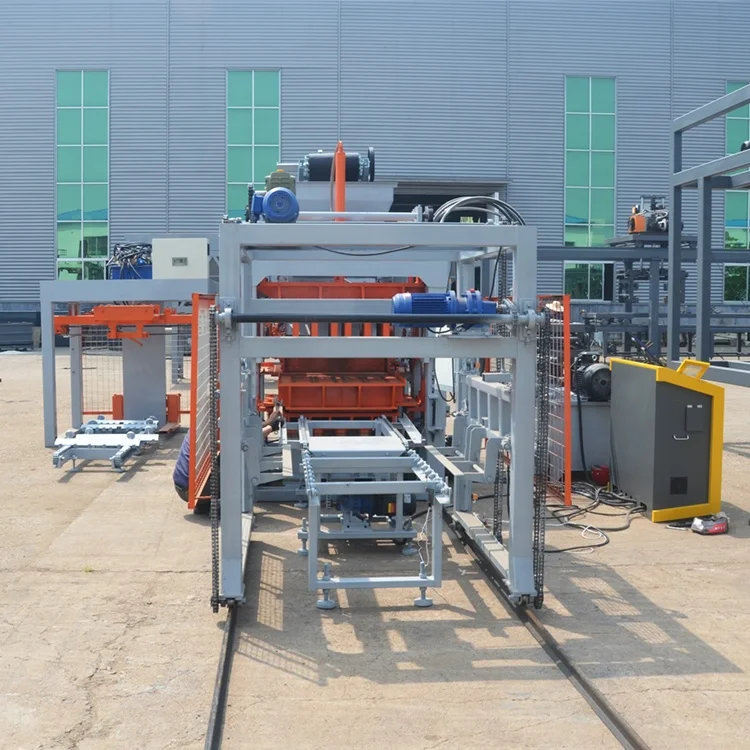


Description
Stocked availability — We verify warehouse readiness and confirm container loading plans before quoting dispatch dates for the QT18-25.
Technical Specifications
| Parameter | Value |
|---|---|
| Model | QT18-25 |
| Product Type | Fully Automatic Block Production Line |
| Production Capacity | 800 to 12000 pcs/8hours (basis to be confirmed) |
| Forming Method | Hydraulic pressure |
| Control System | PLC |
| Overall Dimensions (L×W×H) | 935023202950mm |
| Net Weight | 20ton |
| Pallet Size | 1350x1350x120mm |
| Molding Cycle | 15-25s |
| Vibration System | Platform vibration (2800-4500 R/min) |
| Voltage | Client Local Voltage |
| Assembly State | New |
Application Suitability
| Application | Material or Output |
|---|---|
| Housing project sites | Hollow blocks from cement and local aggregates |
| Commercial paving works | Paving and interlock blocks from crushed stone |
| Infrastructure development | Curbstone blocks for road and boundary construction |
| Municipal landscaping | Solid blocks for retaining walls and structural fills |
Why Arrival Timing Dictates Machinery Selection
Securing a Fully automatic block production line in stock prevents costly idle periods when project deadlines approach.
When contractors commit to a handover date, waiting for custom fabrication turns a machinery purchase into a schedule risk. I have seen sites where the foundation was poured and the curing yard was prepped, only for the main press to sit in port clearance for weeks because the shipment was delayed. Prioritizing immediate availability ensures the equipment arrives while the site crew is still mobilized. Equipment sitting in a warehouse waiting for the press burns through overhead without generating a single unit [NEED_CITE: financial impact of delayed capital equipment delivery on construction schedules].
Dispatch Readiness and Container Loading
Procuring a Fully automatic block production line in stock shifts the focus from manufacturing lead times to immediate logistics execution. The QT18-25 is prepared for rapid dismantling, ensuring that the 9350mm main frame and supporting stations fit precisely into standard shipping containers. We map out the loading sequence beforehand so that heavy structural components sit on the floor while hydraulic manifolds and the PLC cabinet are secured in custom crates above. This prevents transit damage and allows the forklift to unload in the exact reverse order for site assembly.
Upfront Arrival Estimates for Site Planning
Knowing exactly when the machinery hits the port allows you to schedule the crane and rigging crew without paying for standby time. We provide clear arrival estimates based on current shipping routes and port congestion data. The 20ton net weight of the line requires specific handling equipment at the destination, and advance notice ensures your local logistics partner has the correct axle-load trailers ready. Aligning the vessel arrival with your site preparation keeps the installation team moving the moment the containers are unsealed [NEED_CITE: standard port clearance and inland transit timelines for heavy machinery].
Matching Physical Dimensions to the Curing Yard
The 1350x1350x120mm pallet size dictates the entire footprint of your wet block handling and curing area. If the forklifts you already own cannot accommodate this pallet dimension, or if your curing racks are spaced for a smaller format, the line will bottleneck immediately after the press. We confirm these physical clearances before dispatch to ensure the wet blocks move smoothly from the molding cycle into the yard. The 15-25s molding cycle generates a continuous flow of loaded pallets that the downstream handling must absorb without interruption.
The Hidden Cost of Ignoring Facility Clearances
Failing to measure the facility against the machinery dimensions leads to severe operational bottlenecks. I previously tracked a delivery where the main press was rated for high output, but the buyer’s facility roof was too low for the 2950mm height of the assembly. The equipment sat outside under tarps while the roof was modified, exposing the hydraulic pressure valves and platform vibration motors to moisture. Verifying the 935023202950mm footprint and vertical clearance against your building drawings before dispatch prevents this exact scenario [NEED_CITE: facility modification costs due to incorrect machinery dimension planning].
Why Procure This Line From Our Inventory
We focus entirely on block making machinery, meaning the press, pallets, and handling equipment are specified as a single matched system rather than assembled from separate vendors. Configuration is verified against your target block format and site conditions before the crate is sealed. Moulds for the formats your market actually sells are included in the dispatch plan. Automation levels are selectable so you can start with standard handling and upgrade later. Installation support begins the moment the equipment clears customs.
Documentation & Verification
- Factory test record confirming the 15-25s molding cycle before dispatch
- Machinery test report validating hydraulic pressure and platform vibration metrics
- Video outgoing-inspection showing the QT18-25 running under load
- Container loading plan detailing the dismantling sequence for the 20ton assembly
- Customs documentation support aligned with your local import regulations
Installation, Commissioning & Support
- Foundation requirements mapped to the 935023202950mm footprint and 20ton weight
- Electrical team verifies client local voltage before connecting the PLC cabinet
- Dismantling sequence reversed for rapid reassembly of the main press and stations
- Hydraulic pressure and platform vibration parameters calibrated on your raw material
- Operator training covers the 15-25s cycle management and pallet feeding routines
- Wear parts list provided for the specific brick size options you selected
Aligning the Order With Your Project Schedule
To finalize the dispatch plan, provide the exact dimensions of your production building and the clear height available for the main press. Specify your local voltage and frequency so the electrical panels are configured before crating. Finally, confirm the block formats you need for the first production run so the correct moulds are loaded into the container alongside the machine.
Frequently Asked Questions
Q: What is the current stock status and dispatch lead time for this production line?
A: The QT18-25 is maintained in our inventory for rapid deployment. Once we verify your site dimensions and confirm the required brick size options, the dismantling and container loading process begins immediately. Dispatch lead times are quoted upfront based on current warehouse readiness and vessel availability, ensuring you have a firm date for your project schedule.
Q: How is the machine dismantled and loaded into containers for fast shipment?
A: The 935023202950mm assembly is broken down into modular sections designed for standard container dimensions. Heavy structural frames are loaded first, while the PLC cabinet and hydraulic components are crated and secured above. This specific loading sequence protects sensitive parts during transit and allows your site crew to unload and position the equipment in the exact order needed for reassembly.
Q: Can standard moulds for my required block sizes be shipped immediately from stock?
A: Yes, standard moulds for formats ranging from 20010060 mm to 400200200 mm are kept in inventory. When you confirm your target block format during the ordering process, we pull the corresponding moulds and load them into the same container as the main press. This ensures you have the necessary tooling to begin production the moment the line is commissioned.
Q: What upfront arrival estimates and customs documentation support do you provide?
A: We provide estimated vessel arrival dates based on current shipping routes and port schedules. Alongside the physical shipment, we supply the complete customs documentation package, including the machinery test report and commercial invoices formatted to your local import requirements. This advance preparation prevents the equipment from sitting in port clearance while your site crew waits.